

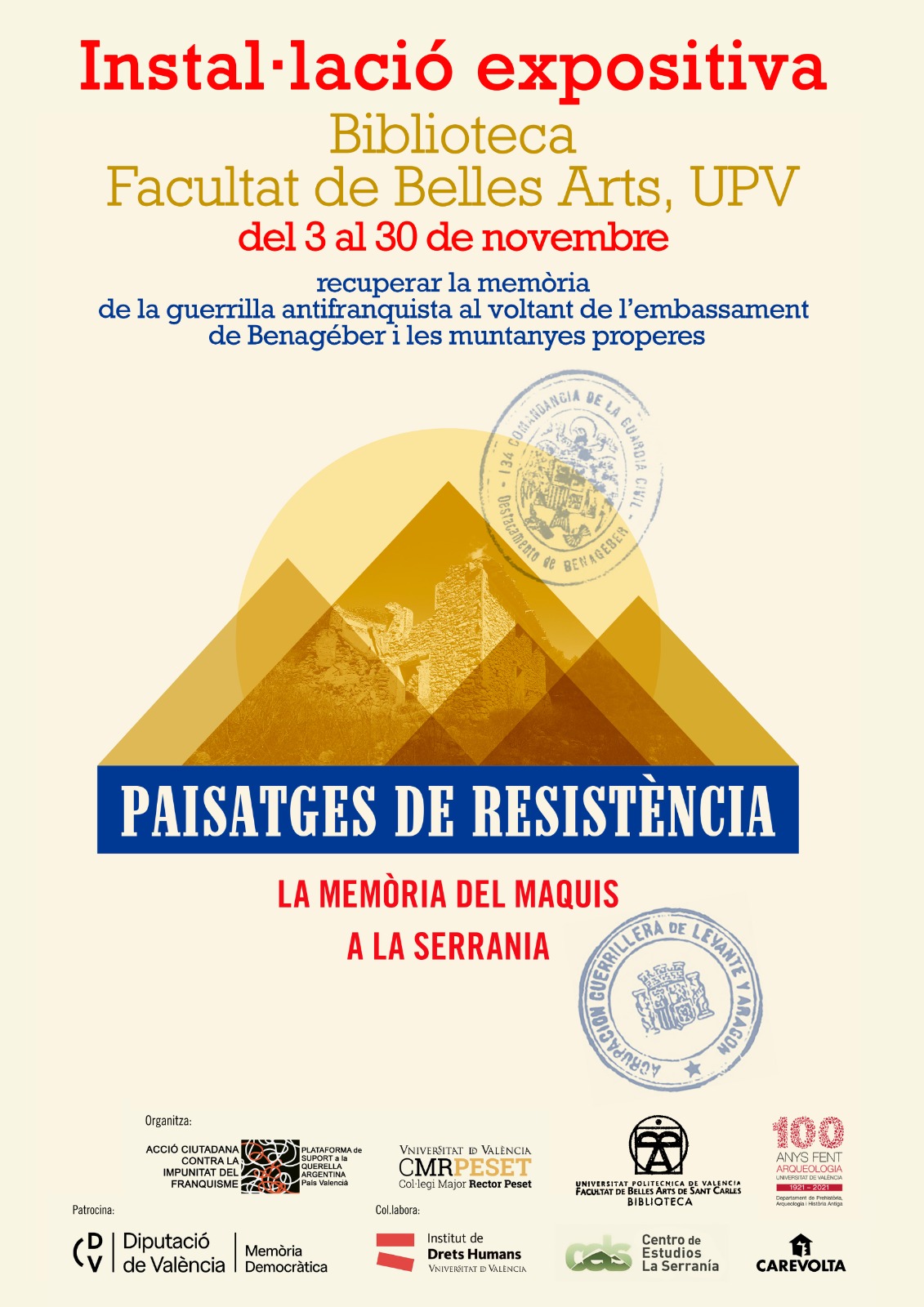
Exhibition Installation and Educational Unit: Landscapes of Resistance: The Legacy of the Maquis in the Serrania
Guerrilla warfare, the Franco regime, and the international context
The armed struggle waged by thousands of people against the dictatorship was a result of their political commitment, but it was also a result of the specific international and national historical context of the 1940s and early 1950s.

The Serranía at War
In late 1946, guerrilla groups from the Agrupación Guerrillera de Levante y Aragón (AGLA) formed a military contingent organized into three operational zones (Zones 5, 11, and 17) under a joint command. Zone 11 established itself in the Serranía region to begin operations. The guerrilla movement thrived in the area thanks to its network of contacts and the numerous “support points” it established with the residents of towns such as Calles, Tuéjar, Chelva, and Benagéber, as well as others in the Plana de Utiel-Requena region, such as Sinarcas. Among these networks, one stands out: it was formed by workers and families from the Colonia Obrera del Pantano de Benagéber, which was still under construction (1932–1952). Some of these workers had been subjected to forced labor as Republican prisoners at the penal camp that operated there between 1941 and 1944. Dozens of people provided food, supplies, and information to the guerrillas, and some farmhands made spaces and locations available as contact points with the maquis. The dictatorship’s military and police forces’ relentless war against the guerrillas also had a profound impact on the lives of the villages in the Serranía.
Benagéber as a Landscape of Resistance
We propose as a case study the area surrounding the Benagéber Reservoir, where, within a radius of approximately six kilometers, several events and sites linked to the maquis’ struggle are concentrated. This landscape has been a witness to repression and, at the same time, a repository of memories of the resistance, silenced for decades. In the spring of 1947, the Civil Guard carried out an operation that resulted in the deaths of eight people and the arrest and prosecution of dozens more. The area still bears the traces of those events.

A project organized by ACIF (Citizens' Action Against Impunity for the Franco Regime) and the Rector Peset Residence Hall.
Sponsored by the Democratic Memory Department of the Valencia Provincial Council