




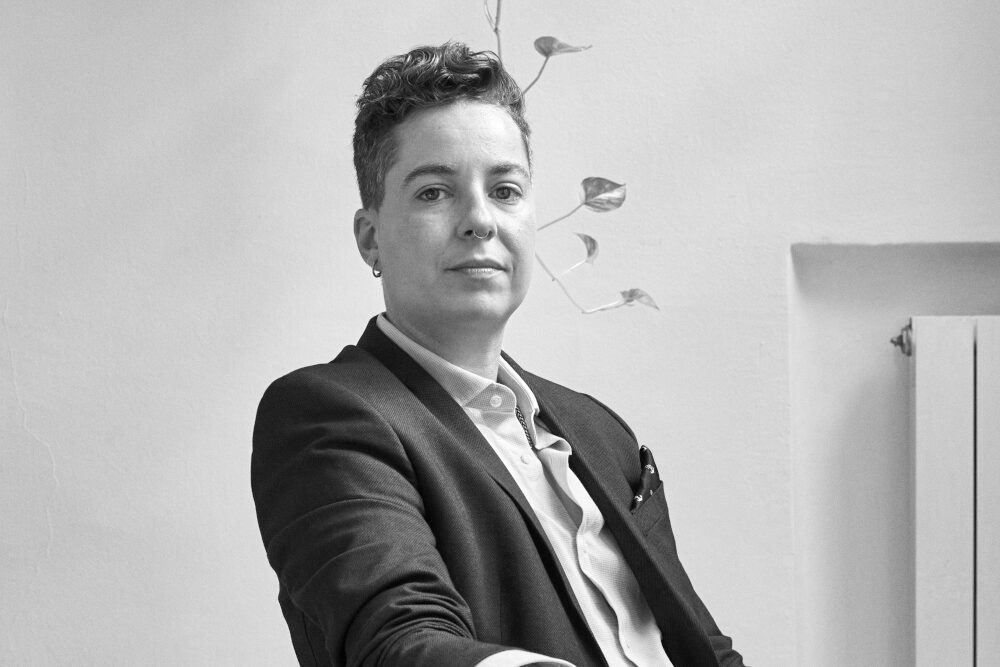
The next day March 27, Diego Marchante “Genderhacker“ will visit the Master’s Degree in Visual Arts and Multimedia. During his visit he will give a lecture at the Classroom A-3-3 of the Faculty of Fine Arts of San Carles at16:00h.
Activist, artist and teacher
Diego Marchante “Genderhacker” is a transfeminist activist, transmedia artist and professor of Audiovisual and Gender Studies at the Faculty of Fine Arts of the University of Barcelona since 2008, also participating as an external professor in the Master in Cultural Studies and Visual Arts (cuir/queer feminist perspectives) MUECA of the Miguel Hernández University of Elche.
He is a member of the research group in art, science and technology IMARTE, and principal investigator, together with Laura Baigorri, of the research project Cuerpos conectados III. Espacios latentes de la inteligencia artificial en la creación audiovisual identitaria of the Ministry of Science, Innovation and Universities.
Hacking the genre, a strategy of cultural reappropriation and reassignment
His artistic practice is situated at the crossroads between contemporary art, transfeminist activism and theoretical research on the politics of the body, gender and memory, proposing a critical approach to the cultural and epistemological systems that produce and regulate gender identities, understanding art as a space for political intervention and production of situated knowledge.
One of the general concepts of his practice is the concept of hacking the genre, understood as a strategy of reappropriation and reassignment of the cultural codes that sustain sexual binarism and gender normativity.
Through artistic research methodologies, he combines resources from audiovisual art, performance, archival practice and transmedia formats to explore how dissident identities can generate alternative narratives and new forms of political agency. Far from understanding the archive as a mere documentary repository, Diego proposes it as a dynamic space for the production of genealogies, affections and collective knowledge, through the creation of transfeminist and queer counter-archives, conceived as critical devices aimed at recovering and activating the memory of political movements. Through them, he articulates a reflection of the body as a living archive, where biographical experience, community memory and identity transformation processes converge, contributing to imagine new forms of representation and construction of subjectivities in the contemporary context.
A practice between the exhibition space and critical writing
His work has been exhibited in different spaces, such as: Centro Huarte, Caixaforum, Fabra i Coats, Sala d’Art Jove, Centre de Cultura Contemporáni de Barcelona (CCCB), Museu d’Art Contemporani de Barcelona (MACBA), ETOPIA Centro de Arte y Tecnología and the Museo Nacional Centro de Arte Reina Sofá (MNCARS). He has published several texts in books such as: Transfeminismos. Epistemes, fricciones y flujos (2013), Barbarismos queer y otras esdrújulas (2017), Cuerpos conectados. Arte identidad y autorrepresentación en la sociedad transmedia (2021) and Memorias queer y prácticas de archivo (2026).
UPV SIRVE 2026 Strategic Plan.