

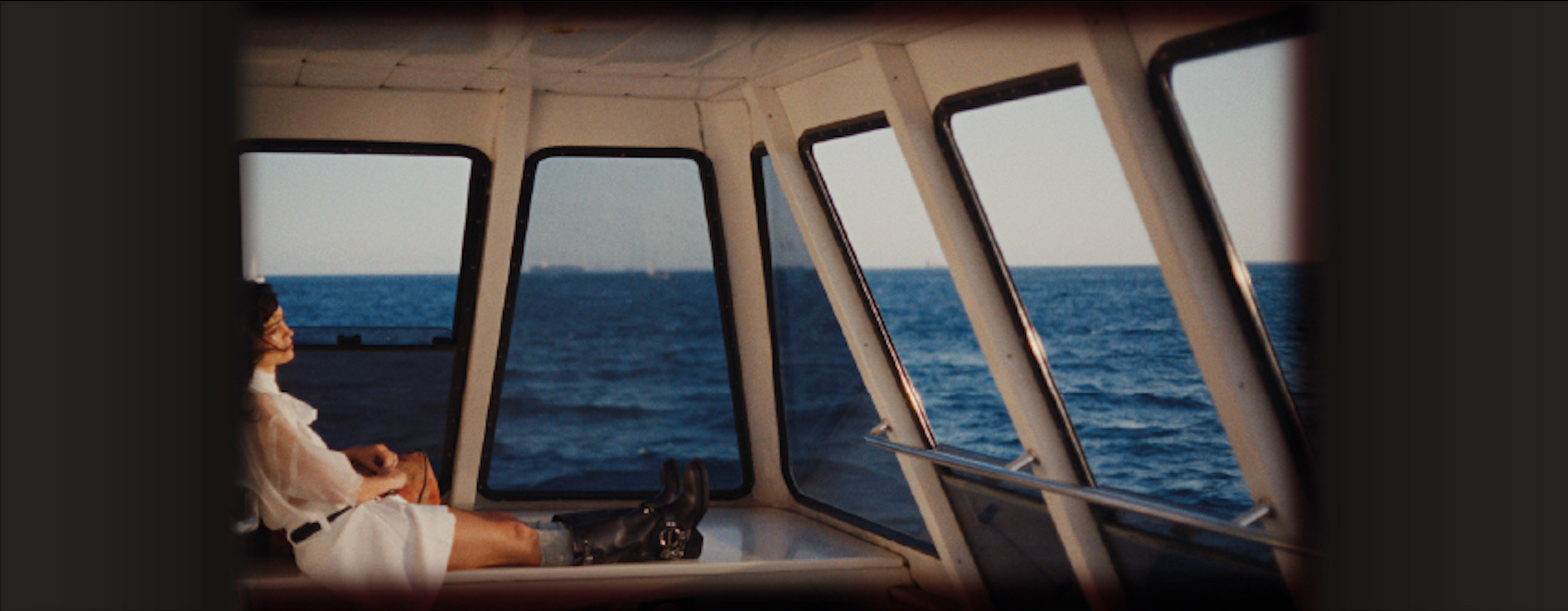
Image: Carta a mi madre para mi hijo. Carla Simón
Project of the Vice-rectorate of Art, Science, Technology and Society for the Alcoy Campus of the Universitat Politècnica de València.
Entreactos proposes an expanded encounter around cinema and contemporary image: a programme that articulates screenings contextualised by invited filmmakers and specialists, together with a workshop on listening to context and film creation.
The selected films are situated images that both enunciate and question, that do not close off their meaning, but rather open up spaces for reflection both on their own materiality—that of the image—and on the issues and themes they address. After viewing them, we will reflect on issues such as the industrial past and present, capitalism, precariousness and its construction of subjectivities, rituals, family and emotional relationships, filmic correspondences, the diary, the archive and the reappropriation of materials, and the blurred boundary between documentary and fiction.
In parallel with the screening sessions, there will be a film-essay workshop in which we will explore the power of images, while constructing our own narratives by recovering untold stories or collectively rewriting others, also highlighting the power of audiovisual media to generate community.
Design, curatorship and coordination: Sonia Martínez Navarro.
Film-essay Workshop: from listening to narration
Alcoy Campus
Workshop – laboratory for the realization of a small non-fiction filmic piece, oriented to any interested person.
The workshop is conceived as a listening process in which the participants themselves will define the nuclei and agents of interest (people, buildings, places…) for the documentary, related to the history and intangible heritage of Alcoy and its surroundings. The objective is, on the one hand, to bring to the surface and make visible minor stories that have not been told or to which other layers of meaning can be added, and on the other hand, to share references and contemporary audiovisual resources for the construction and reading of documentaries and other film pieces of a more essayistic nature.
Directed by Cine por venir (Mar Reykiavik and Miguel Ángel Baixauli)
Dates and times:
The following Wednesdays and Thursdays in February: 4 and 5, 11 and 12, 18 and 19, from 4 to 7:30 pm*.
Friday, February 27: screening and meeting of people involved.
*On the 12th and 19th the sessions will end at 6.15 p.m. to participate in the screenings.
Maximum number of participants:15 people.
Pre-registration until January 28th: entreactes.cinema@gmail.com
Price: free.
Oriented to: any interested person (it is not necessary, but the link with the UPV will be positively valued).
At the time of pre-registration, we will ask you for a short presentation in which you indicate your relationship with Alcoy and why you are interested in the workshop.
+ information about the workshop at the bottom of the page.
Projections
Place: CADA (Rigoberta Albors Street. 6, Alcoy). Free admission until full capacity.
Session 1. Friday, February 6, 6.30 pm
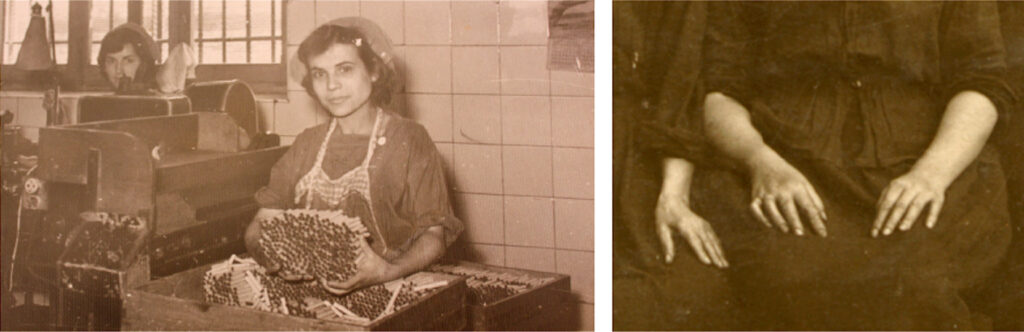
Las Cigarreras, Teresa Lanceta (2011/ 2022), 60′.
Context: Teresa Lanceta and Edurne Vaello.
“From my mother I inherited a fighting, social and working-class spirit.” Daughter of a cigarrera.
Las Cigarrera edited by Virginia García del Pino, collects memories and opinions of the workers of the tobacco factory in Alicante, once it was closed. When it opened in 1801, Alicante was a walled city with a small port. Located outside the city walls, the factory was staffed by women from the city’s poorest neighborhoods and neighboring farming villages. Women who supported this industry with long working days rolling cigars by hand and, when industrialization took hold, making cigarettes in front of the machines. The close coexistence over time makes them share experiences and a friendship is generated. Being a cigarrera was a way of life, with a deep-rooted solidarity among companions and a conscience of its own. The cigarrera legend is based on the forging of strong personalities built through effort and mutual help.
Session 2.Thursday February 12, 6:30 p.m.
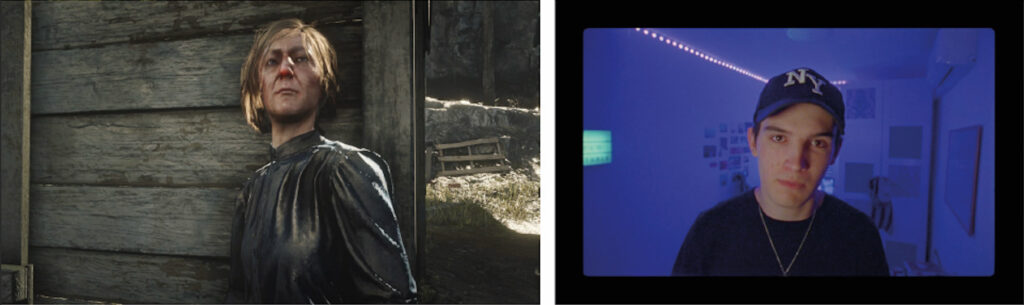
Hardly Working, Total Refusal (2022), 20′ and +10K, Gala Hernández (2025), 33′.
Context: Gala Hernández and Nuria Alabao.
Hardly Working. Total Refusal (2022)
Best Short Film at the European Film Awards. With “Red Dead Redemption 2” as the testing ground,Hardly Working puts the spotlight on the characters that normally remain in the background: the Non-Player Character (NPC). An ethnographic exploration of the work and life realities of non-player characters, the digital extras of videogames. Their work loops, activity patterns, failures and dysfunctions draw a vivid analogy of labor in capitalism.
+10K, Gala Hernández (2025)
Pol is 21 years old and lives with his grandmother. He dreams of living in Miami and earning +10k a month. He attends personal growth events, followscoaches online and invests in cryptocurrencies. Pol doesn’t know what day or time he will finally reach his goals and become the best version of himself. The only thing he knows is that one day he will achieve it.
Session 3.Thursday February 19, 6:30 p.m.
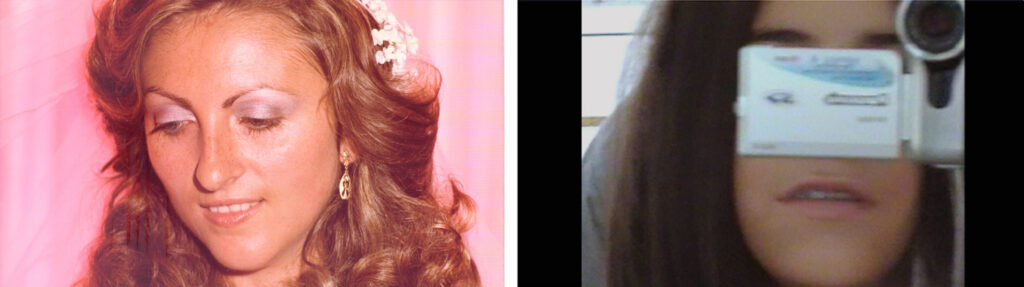
Las novias del sur, Elena López Riera (2024), 40′, and Soc filla de ma mare, Laura García Pérez (2023), 1h
Context: Elena López Riera and Laura García Pérez.
Las novias del sur, Elena López Riera (2024)
Mature women talk about their marriage, their first time, their intimate relationship with sexuality. In the repetition of these ancestral rites, the director questions her own absence of marriage, of children, and with it, a chain of mother-daughter relationships that is becoming extinct.
“Las novias del sur has been in my head for years. I’ve always been fascinated by it, everything that has to do with the ritual of marriage, the traditional story of eternal heterosexual love, surrender and how this is staged. Above all, and very specifically, the bride picture: a woman dressed in white, who is assumed to be a virgin, and who is going to give herself to a man.” Elena López Riera
Soc filla de ma mare, Laura García Pérez (2023)
With a huge family archive on the horizon, the filmmaker reflects on identity through the reconstruction of her memories. An intimate documentary about her past that serves to reconcile her with her present.
For the first few years of her life, Laura García Pérez called the camera “papá”. Her father spent much of the year out of the country for work, while her mother filmed her so he could watch her grow up. With her and her grandmother, she now reviews those home videos, as well as photographs from which the father has disappeared and the diary her mother wrote in a psychiatric center.
Session 4. Thursday, February 26, 6:30 pm
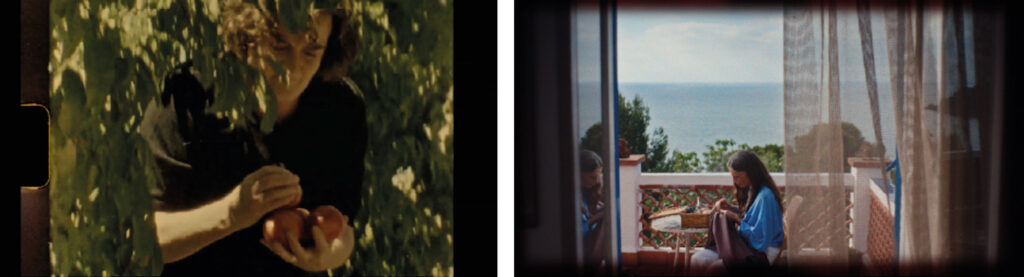
Correspondencia, Carla Simón and Dominga Sotomayor (2020), 19.29′, and Carta a mi madre para mi hijo, Carla Simón (2022), 24.17′.
Context: Carla Simón and Álvaro Devís.
Correspondencia, Carla Simón and Dominga Sotomayor (2020)
In the form of a filmed epistolary conversation, two young filmmakers talk about cinema, the family present and past, inheritance and motherhood. The personal and profound reflections – embodied in the delicate images shot day by day – suddenly echo the political emergency of a country.
Carta a mi madre para mi hijo, Carla Simón (2022)
Carla is pregnant and naked, just like in the photos where her mother poses pregnant with Carla herself. Sunlight streams through the windows. We see Super 8 bursts of grandparents, uncles, aunts, fathers, great-grandparents; smiling, sewing, reciting poetry. Then, we see a young woman grow from the 60s to the present day, passing through the 80s, crossing the thresholds of femininity and history, until she meets Carla pregnant next to the blue sky of the Catalan coast.
Session 5. Friday February 27, 6:30 p.m.
Film result of the workshop From listening to narration
Context: Mar Reykjavik, Miguel Ángel Baixauli and workshop participants.
+ information about the participants in each of the screenings
Session 01. Friday, February 6, 6.30 pm
Las cigarreras, Teresa Lanceta (2011/ 2022)
“…and it seemed to me that life was a bit like that: to be staring at something you can barely see.” Teresa Lanceta
Teresa Lanceta is an artist and winner of the 2023 National Prize for Plastic Arts. She holds a degree in History from the University of Barcelona and a PhD in Art History from the Complutense University of Madrid. Her work is expressed through weaving, painting, drawing, video and writing. Textile folk art, Middle Atlas weavings and 15th century Spanish carpet make up her practice. Between 2013 and 2020 she was a teacher at the Massana School in Barcelona. She has lived and worked in Barcelona, Madrid, Seville, Marrakech, La Palma, Alacant and Mutxamel, where she currently lives. In 2011 she carried out the audiovisual project Cierre es la respuesta in 2012, the research De mi madre he heredado. Mujeres e industria tabaquera en Alicante, it was awarded the Bernat Capó prize. Her writing work has led her to contribute to numerous publications and to collaborate with magazines such as Concreta and Dardo. Some time ago she started a relationship that goes beyond collaboration and that she calls “co-authorship” or “shared authorship”: a way of working together with other people or institutions.
Edurne Vaello holds a degree in Art History (UV) and has completed a Master’s degree in Conservation and Restoration of Cultural Heritage (UPV) and a Master’s degree in Cultural Management (UV). She has recently defended her doctoral thesis at the Faculty of Social Sciences of the University of Valencia on the representation and representativeness of women in protected areas, with the case study of the Montseny. She is a cultural manager and her professional career revolves around cultural heritage, both from management and research, conservation and safeguarding, where her feminist perspective is very present. Last 2022 she was the winner of the Joan Francesc Mira research award with her work on women in the textile industry in Alcoy. Màquines de fil, cossos de ferro. She is also involved in different cultural and feminist associative movements in the Comtat and l’Alcoià and actively participates in the organization of cultural festivals such as Moniàtic (Alcoy).
Session 02. Thursday, February 12, 6:30 p.m.
Hardly WorkingTotal Refusal (2022)
Total Refusal (Susanna Flock, Robin Klengel, Leonhard Müller, Michael Stumpf) is an open artist collective that artistically critiques and appropriates contemporary video games. Since most mainstream game narratives use the same reactionary themes looped ad infinitum, the genre hardly challenges the values of its players, but, on the contrary, affirms hegemonic moral concepts. Aware that these media do not currently exploit their full potential, our goal is to appropriate the spaces of digital games and put them to new use. Moving within the framework of these video games, but leaving aside the intended mechanics of the game, we redirect these resources to new activities and narratives, with the intention of creating “public” spaces with critical potential.
+10K, Gala Hernández (2025)
Gala Hernández López is an artist, filmmaker and researcher. Her interdisciplinary practice combines filmmaking with the creation of video installations, performances and publications. Her work critically analyzes the new modes of subjectivation produced by computational capitalism. She examines the imaginaries circulating in virtual communities, the desires conveyed by disruptive technologies and the new reactionary techno-utopias as shared fictions that populate our collective unconscious. His works are research-based and combine materialistic analysis with poetry, intimacy and dreams with the aim of dissecting fantasies of unlimited techno-scientific control over reality. Her work has been presented at international festivals and institutions such as Cannes, Berlinale, Rotterdam, IDFA, DOK Leipzig, Cinéma du Réel, Curtas Vila do Conde, IndieLisboa, Berlinische Galerie, Palais de Tokyo, Festival du Nouveau Cinéma, Camden Film Festival, Sarajevo Film Festival, Vancouver Film Festival, Tabakalera, transmediale, Kurzfilmtage Winterthur, FRAC Île-de-France, among others. Her film La Mécanique des fluides won the César for best documentary short film in 2024.
Filmography
. La Mécanique des fluides (2022)
. For here am I sitting in a tin can far above the world (2024)
. +10k (2025)
. Like moths to light (2026)
Nuria Alabao is a researcher, journalist and anthropologist. She holds a degree in journalism from Pompeu Fabra University. PhD in Anthropology from the University of Barcelona. She coordinates the Feminisms section of Ctxt.es and is part of the editorial collective of Zona de Estrategia. She studies the treatment of gender issues in the conservative reaction; antifeminisms, extreme right, etc.; and its intersections with migrations and racialization processes. Her knowledge production arises from and is nourished by the collective discussions of grassroots social organizations and their forms of resistance. He has written, among other books, Ínceles, gymbros, criptobros y otras especies antifeministas. Lo que la manosfera nos dice de los adolescentes y del mundo en que vivimos (2025).
Session 03. Thursday, February 19, 18.30h
Las novias del sur, Elena López Riera (2024)
Elena López Riera is a filmmaker, programmer and teacher. After a doctoral thesis on contemporary Argentine cinema, she taught comparative literature at the University of Geneva, the University Carlos III of Madrid and Valencia.
Her first short film Pueblo (2015), premiered at the Cannes Filmmakers’ Fortnight at the Cannes Film Festival; Las vísceras (2016) premiered at the Locarno Film Festival; and Los que desean (2018) won numerous international awards such as the Pardino d’Oro for Best Short Film at the Locarno Festival and the Jury’s Special Mention at the San Sebastian Festival, among others. El agua her first feature film, had its world premiere at the Cannes Filmmakers’ Fortnight at the Cannes Film Festival 2022. Her latest film Las novias del sur was premiered at the Semaine de la Critique de Cannes, where it received the Queer Palm among all the Cannes sections, it has also just received the César for best documentary short film and was nominated for the Goya.
Filmography
. Las novias del sur (2024)
. El agua (2022)
. Los que desean (2018)
. Las vísceras (2016)
. Pueblo (2015)
. Pas à Genève (2014)
Soc filla de ma mare, Laura García Pérez (2023)
Laura García Pérez is a filmmaker. Soc filla de ma mare is his first feature film. It was developed at EICTV (Cuba) in 2020 and in ‘Walden Residencies’ within the context of the Majordocs film festival. It is a work awarded by DOCMA, Alcances, Cinema Jove and L’Alternativa; nominated for the Berlanga Awards of the Valencian Academy of Audiovisual. She is co-creator with Inés Calero of the non-fiction film podcast ‘Docs&Talks’;
Specializes in autobiographical cinema. She has given workshops on filmmakers such as Agnes Vardà, Naomi Kawase and Chantal Akerman. She was part of the team ‘Salvem els videos’, where she recovers and restores domestic films damaged by the 2024 DANA in Valencia, in direct contact with the families.
Session 04. Thursday, February 26, 6:30 pm
Correspondencia, Carla Simón and Dominga Sotomayor (2020) and Carta a mi madre para mi hijo, Carla Simón (2022)
Carla Simón is a filmmaker and screenwriter, National Cinematography Award in 2023. She is part of an extended family that is a bottomless well of stories. Watching and listening to all these stories, she decided to make films to show the complexity of the human condition, as well as the complexity of family relationships in particular. After graduating in Audiovisual Communication from the UAB, Simón got the Obra Social “La Caixa” to study at the London Film School in the UK.
Verano 1993 (2017) was her autobiographical debut. It premiered at the Berlinale 2017 where it won the Best Film Award and the Generation Kplus Grand Prix. The film has collected more than 30 awards worldwide and earned him the Goya for Best New Director, as well as being chosen to represent Spain at the Oscars. Simón also received the Women in Motion Emerging Talent Award at Cannes 2018. In 2002, Simón released the short film MiuMiu Women’s Tales. Carta a mi madre para mi hijo (2022) as part of the Giornate degli Autori at the 79th Venice International Film Festival. Her second film, Alcarràs (2022) won the Golden Bear at the 72nd Berlin International Film Festival. It was selected in more than 90 international festivals and sold in more than 35 territories. It also represented Spain at the 2023 Oscar Awards, received three EFA Award nominations and won 6 Gaudí Awards. Romería (2025) is the third film by Carla Simón that had its world premiere in the Official Selection of the Cannes Film Festival.
Álvaro Devís is an editor at Culturplaza, where he writes mainly about film and audiovisual, music, literature and class culture and its intersectionalities. He also co-directs, together with Clara Gorria, the film podcast ‘Algo nuevo, algo viejo, algo prestado’ (Something new, something old, something borrowed).
+ Information about the workshop
Participants do not necessarily have to have audiovisual knowledge, but rather the will to remember, make visible and build a small collective story together. During the sessions we will share interests, memories and knowledge that will shape the content of the documentary piece. Once defined, the filming will be planned, the shots, sequences and interviews will be recorded, pre-montages will be made, which will be shared to decide their final form, and the documentary will be shared in a public session to which all the people involved will be invited.
The sessions will also include the viewing of fragments of other film works that may be inspirational for the construction of our film.
Linked to the workshop, but as activities open to the public, one or two experts in some of the project’s core areas of interest will be invited, so that they can encourage dialogue and reflection, as well as focus on the particularities of Alcoy and its tangible and intangible heritage.
The workshop will be led by Cine por venir, collective that since 2013 generates various actions related to film and contemporary image, both in programming and curatorship as well as in the creation and articulation of laboratories and workshops for learning and exchange. It is a mutable collective in which different people collaborate depending on the context and the proposal.
Mar Reykjavik and Miguel Ángel Baixauli will teach this workshop and produce the audiovisual piece.
Mar is an artist, Master in MasterLav ‘Laboratorio de creación audiovisual contemporánea’ and has a degree in Fine Arts from the Universitat Politècnica de València. She combines her artistic practice with teaching.
Miguel Ángel is a filmmaker, curator, educator and researcher. He has made two feature films and numerous medium-length documentaries and has taught many workshops related to film and social participation. Founding member of Artxiviu de l’Horta.