

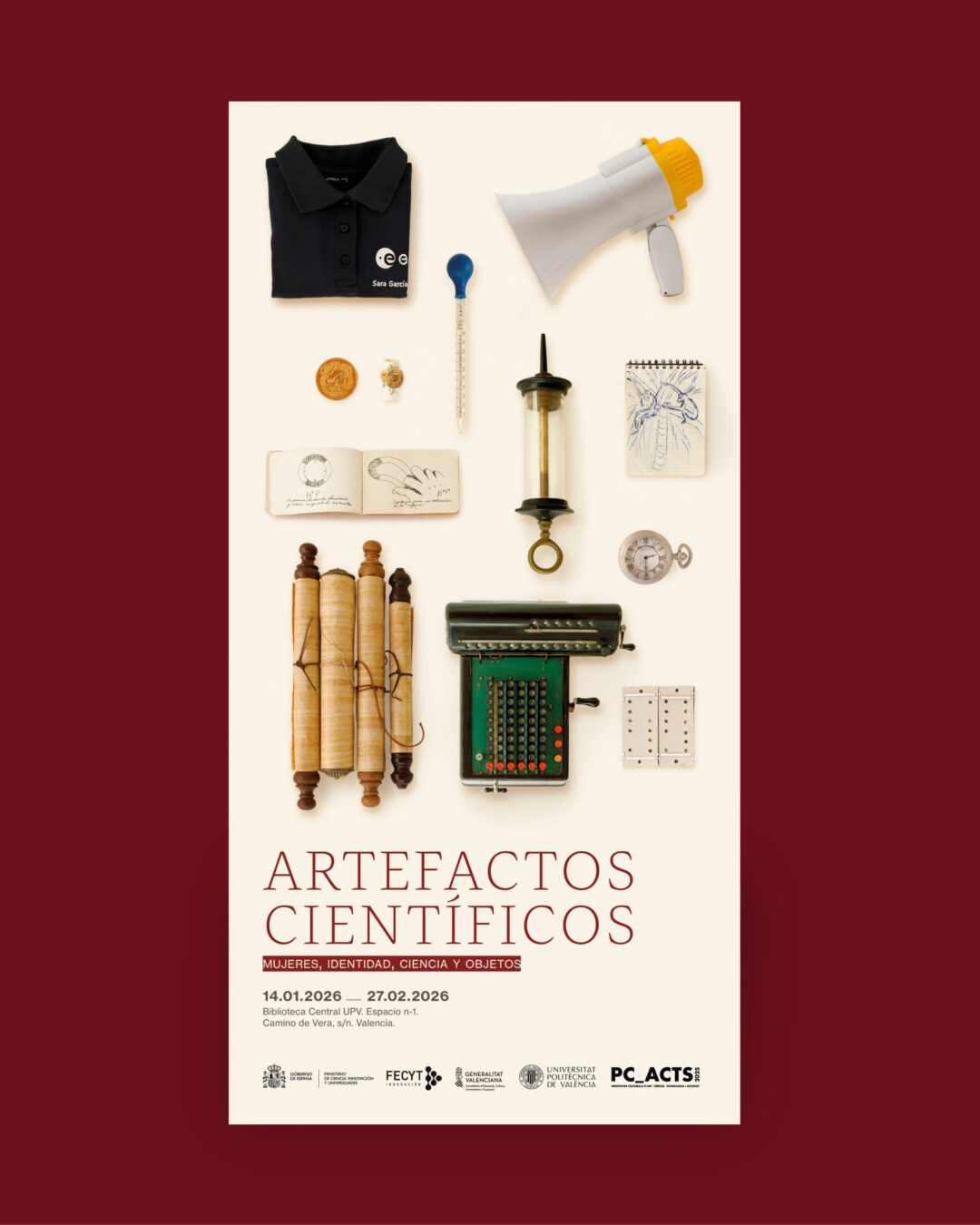
From January 14 to February 27, 2026 at the Espai n-1, UPV Central Library.
Opening: January 14 at 6:30 pm. Free access.
The objects that accompany us throughout our lives form a symbolic and material map of our life journey. If we could gather all the objects that have been important to us from childhood to old age, we could build a mosaic full of reflections of our multifaceted identity.
Objects trap remnants of our soul and are accessible to anyone who wants to see them. But an object alone tells little. It needs the company of other objects to produce narratives.
An ARTEFACTO gathers important objects of a woman to draw a faithful but open image, a portrait without a person, an invitation to understand and to imagine. An ARTEFACTO uses objects as raw material. An ARTEFACTO suggests and affirms.
With the exhibition SCIENTIFIC ARTEFACTS: Women, Identity, Science and Objects we explore the feminine universe of eleven women scientists, through artistic compositions inspired by the portraits of the project’s murals.Science Gifts. Our ARTEFACTOS combine art, history and imagination to vindicate the role of women in science, transforming everyday objects into poetic narratives that celebrate their lives and achievements. Each work follows the line of Artifact Portraits an exercise in visual poetry that imagines what objects could have been part of the lives of the women portrayed. Beyond the physical, each object becomes a clue, a piece of a narrative puzzle that allows us to imagine new stories, connect with the women scientists portrayed and reflect on their impact.
We do not seek to represent history accurately, but to imagine it with rigor and care. We are interested in understanding their history, their context, their passions, their legacy. To do this, we thoroughly researched the life of each woman represented. Some of them have personally given us important objects from their lives.
From there, we highlight what touches us the most: an anecdote, a gesture, a choice.
As when Marie Curie kept tubes with radium salts in her desk and manipulated them with fascination, not yet knowing the risk they entailed. Or the work of Hypatia of Alexandria with astronomical and mathematical calculations, and that is why we evoke her with an abacus. Or Jane Jacobs defending her city with banners, paint and megaphone. Or Katherine Johnson performing her orbital calculations with a Monroe calculator, surrounded by men in a NASA research center. And so, all of them show us facets of their lives.
SCIENTIFIC ARTEFACTS: Women, Identity, Science and Objects encourages reflection on the role of women in science, not only as a legacy of the past, but also as a call to the future. What new stories, dreams and achievements will inhabit the artifacts of tomorrow’s women scientists?