

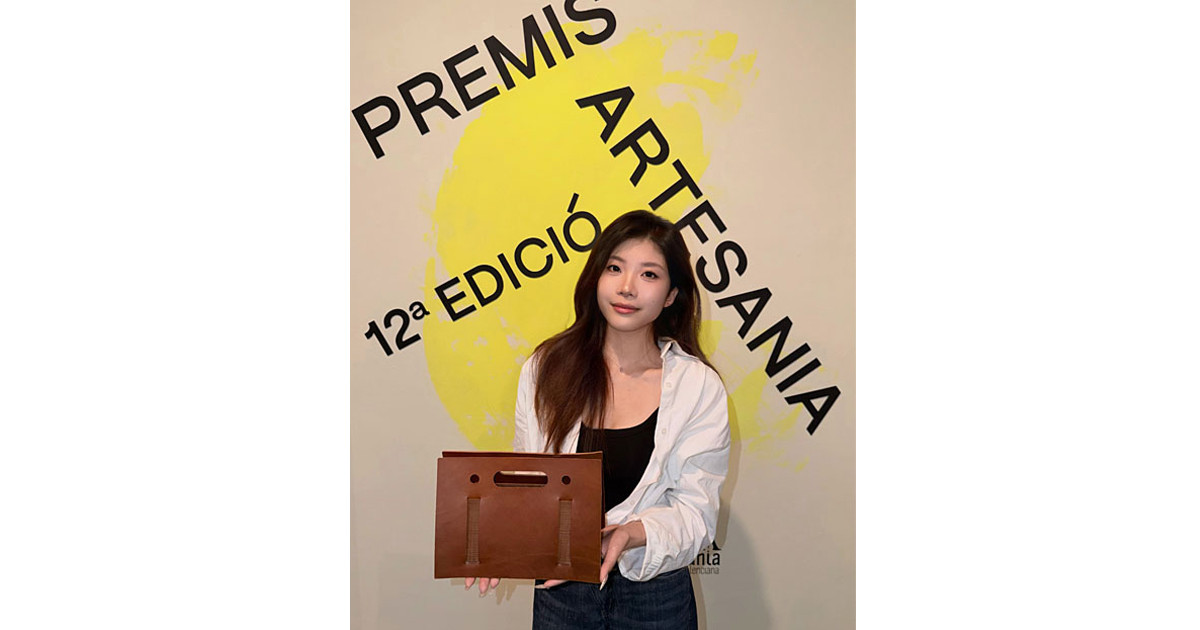
Chenxue Li, student of the Degree in Industrial Design Engineering and Product Development of the ETSIADI at the UPV, wins the award in the Nous Talents category.
Chenxue Li, a fourth-year student of Industrial Design and Product Development Engineering at the School of Aerospace Engineering and Industrial Design (ETSIADI) of the Universitat Politècnica de València (UPV), is the winner of the Premis Artesania Comunitat Valenciana contest in the Nous Talents category.
Organized by the Crafts Center of the Valencian Community, the awards are intended to encourage craft creation, innovation, commitment to sustainable development, adaptation to market trends and, in turn, reward the know-how of Valencian craftsmen and craftswomen by giving them social and business recognition.
Joy and encouragement
“This award is a great joy for me and, above all, a huge stimulus to continue growing as a designer,” says Chenxue smiling. “It especially encourages me in relation to manual work and artisanal processes, an area that I have discovered with great interest and respect during the development of this project,” adds the UPV student.
“The origin of this work,” he recalls, “is to be found in the Models and Prototypes Workshop course, which I took during the third year of my degree. Through it I had my first approach to the subject of traditional craftsmanship, which allowed me to learn more about the richness of Valencian crafts and develop a proposal linked to the Valencian orchard”.
Collaboration with Oobuka decisive
On the road to the award, Chenxue has not been alone. In fact, the collaboration in the project of the Oobuka studio has been fundamental. “Being able to count on them has been fortunate. At the beginning, not being from Valencia, I didn’t know this context in depth and I didn’t feel completely confident. However, thanks to the support and guidance of my teachers, as well as the Oobuka artisans, I was able to gradually approach the world of craftsmanship and discover its value,” says the winner.
“Working with them,” she continues, “allowed me to learn more about leather goods and understand firsthand the processes, materials and sensitivity behind the craftsmanship. For me, it was a very valuable practical opportunity, as I was able to come into direct contact with professionals in the trade and develop a real piece from that learning.”
Inspired by the Valencian barraca and with a self-assembly system.
“The work,” says Chenxue, “is inspired by the Valencian barraca, taking as a reference its formal characteristics and its relationship with the traditional landscape of the huerta. The intention of the design is to reinterpret this traditional element from a contemporary perspective”.
It should also be noted that the piece has a special feature, which is that “it does not need seams or external joining elements, as it works by means of a self-assembly system. In addition, I designed sustainable packaging that allows the part to be transported flat before use. This not only helps to reduce transport costs and volume, but also offers the user the possibility of participating in the assembly process,” explains Chenxue, who indicates that, “with this project, I wanted to unite tradition and modernity, and show the potential of leather craftsmanship from a modern perspective”.
“At the same time, I was also interested in highlighting the irreplaceable nature of handcrafted work: due to the leather’s own qualities, the piece will change over time, acquiring new tones and textures, which makes it a unique object,” he concludes.
Source: UPV