


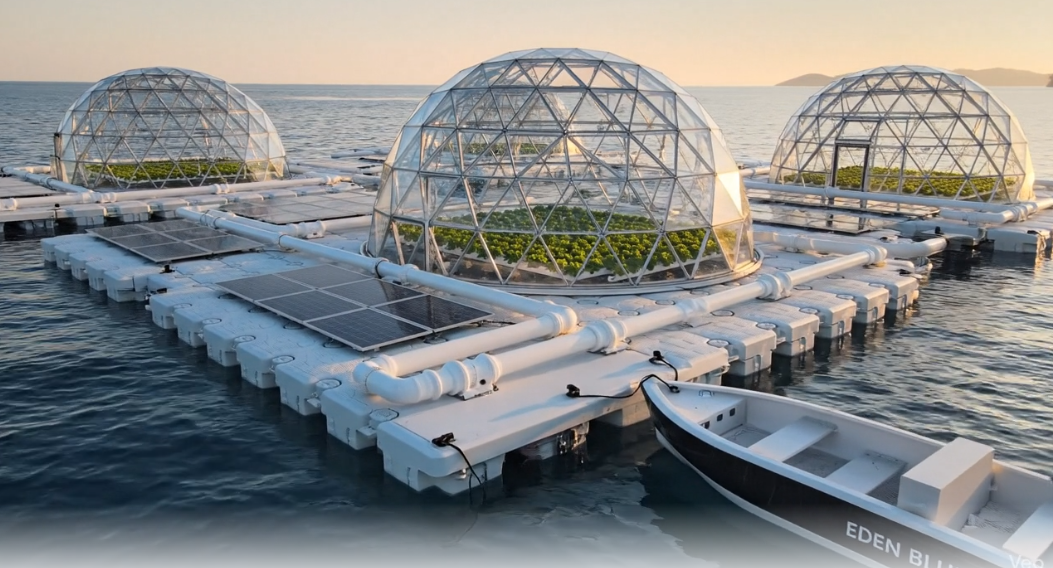
The project, led by student Mario Ribelles, combines agriculture and marine biotechnology to harness seawater and solar energy. Eden Blue Represents Gandia at Innpulso Emprende 2026.
“Why do we continue to base food production on two increasingly limited resources—fresh water and fertile soil—when we have two extraordinarily abundant resources: the sea and the sun?” This question is the origin of Eden Blue, a project that aims to integrate desalination, agriculture, and marine biotechnology into a single system.
Its founder, Mario Ribelles, a student in the dual degree program in Biotechnology and Chemistry at the Universitat Politècnica de València (UPV), explains that the project “tackles in a comprehensive way problems that are usually addressed separately: water scarcity, soil degradation, food production, the management of brine from desalination, and the use of marine resources.”
The proposal is based on what Ribelles calls the “coastal paradox”: Many of the areas that are beginning to experience water stress are located right next to the sea, surrounded by vast amounts of water that they cannot use directly for drinking or farming.
The solution proposed by Eden Blue involves developing, in the long term, modular floating platforms capable of producing fresh water and food while also making use of the byproducts generated during the process.
From Desalination to Food Production
The system would use solar energy to desalinate seawater and produce fresh water for growing plants. The resulting brine would be utilized—rather than treated solely as waste—to cultivate halophilic microorganisms capable of producing compounds of interest.
“Eden Blue’s innovation lies not in a single technology, but in integration,” says Ribelles. The goal is to create a cascade of utilization in which the byproducts of one process become resources for the next. And “the entire system would be monitored using sensors and IoT technology.”
A first prototype by the end of the year
According to its developer, Eden Blue is “between the proof-of-concept phase and the laboratory validation of its various components.” The team has already designed the first freshwater production unit and is beginning to assemble it. At the same time, it is working on an experimental protocol to compare different substrates, irrigation systems, and beneficial microorganisms in the plant module.
The next step will be to conduct an initial integrated bench-scale test: to produce water continuously, use it in a plant growth experiment, and use the resulting brine to feed a photobioreactor. “We’re not looking for that first prototype to be visually appealing or marketable; we want it to produce reliable data,” explains Ribelles. The plan is to publicly unveil this prototype by the end of 2026.
From a college project to real-world technology, backed by awards
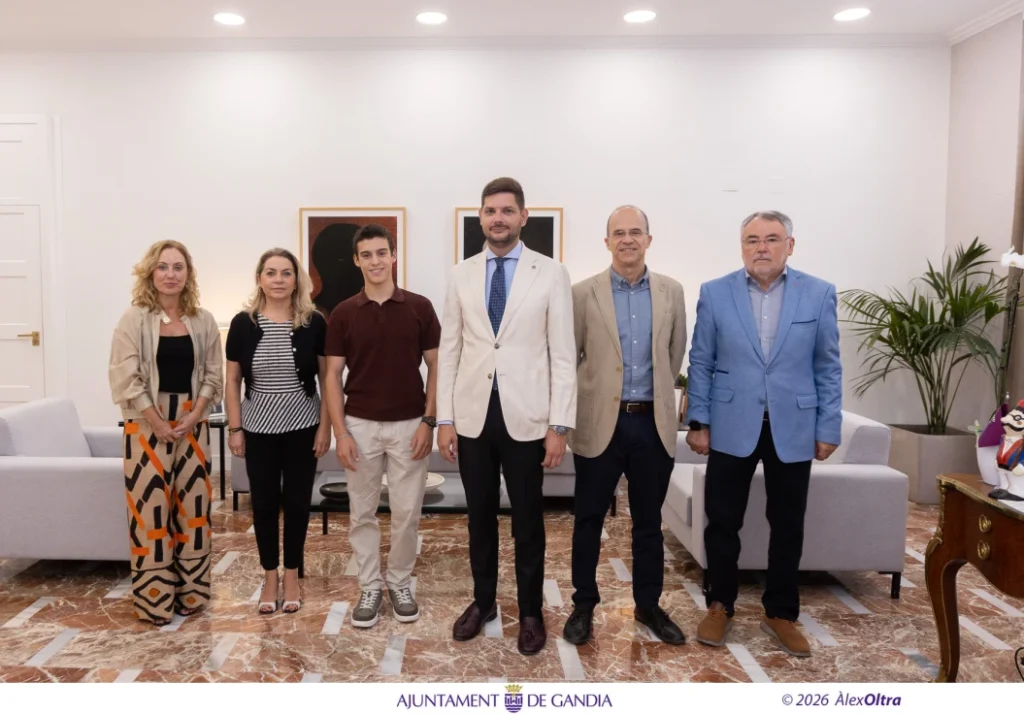
Eden Blue received the Valencian Community Young Talent Award in the Science Category, and was selected to receive support from ARI HUB. For Ribelles, these two recognitions have helped lend credibility to the project and bring it closer to the business and technology worlds.
Now, the project is facing another milestone: Eden Blue has been selected as Gandia 2026 Innovative City Project and will represent the city at Innpulso Emprende, which will be held on September 30 in Terrassa. For Ribelles, this is one of the most special honours because “we’re not just representing a group of students; we’re representing our city.”
Currently, the Eden Blue team consists of sixteen students from different grade levels and is mentored by a professor from the UPV’s Gandia campus Claudia Palloti Sagripanti.
The challenge is to turn an idea born in the classrooms and laboratories of the UPV “into a validated and deployable technology capable of contributing to food production in places where agriculture is increasingly dependent on limited resources.”