


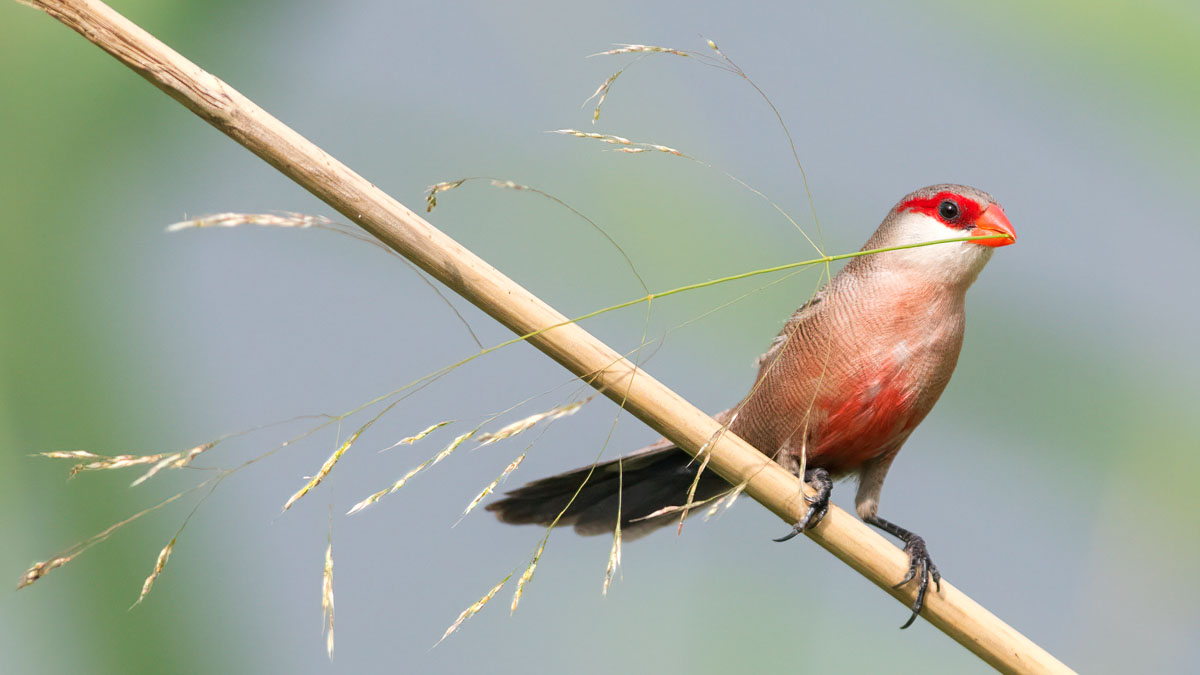
Agricultural abandonment and colonization by invasive plants has led to the expansion of the common strilda in the Iberian Peninsula, an exotic bird of African origin.
A study led by the professor at the Gandia Campus of the Universitat Politècnica de València Pau Lucio Puig analyzes how the abandonment of agricultural land and its subsequent colonization by invasive plants are favoring the proliferation of the common strilda (Estrilda astrild), a small exotic passerine of African origin that has spread throughout most of the Iberian Peninsula.
The introduction of alien species is one of the main threats to biodiversity on a global scale, causing significant ecological and economic impacts. “In agricultural and peri-urban environments, landscape transformation, crop abandonment and the presence of invasive vegetation generate new ecological opportunities that some alien species can exploit very effectively”, explains Pau Lucio.
In this context, the study demonstrates that the common strilda has a remarkable ability to adapt to humanized landscapes, especially in abandoned agricultural fields, where it feeds on both native and exotic seeds. The results reveal that the presence of the strilda is associated with two of the most pernicious and globally widespread invasive plants, the Argentine duster (Cortaderia selloana) and the common reed (Arundo donax), which provide shelter and, in the case of the Argentine feather duster, also food through their seeds.
The common waxbill breeds continuously from May to approximately October, from May to about October, reaching its highest densities in late autumn. “Our study shows that where the common waxbill breeds continuously from May to approximately October, was present, it came to dominate the bird communities,” says Pau Lucio.
This work highlights how agricultural abandonment and its subsequent colonization by invasive plants facilitate the expansion of exotic birds, potentially altering the functioning of Mediterranean ecosystems.
“Long-term monitoring programs must be strengthened, as well as implementing landscape management measures aimed at curbing the spread of invasive species and exploring the impacts they may have on native bird communities,” adds Rafael Muñoz, also a researcher at the UPV Gandia campus and co-author of the study.
The work has been published in open access in the journal Journal of Ornithology.
Reference: Lucio-Puig, P., Muñoz-Mas, R., Garófano-Gómez, V. et al. Association patterns between farmland abandonment and the non-native Common Waxbill (Estrilda astrild) in the eastern Iberian Peninsula. J Ornithol 166, 773-789 (2025). https://doi.org/10.1007/s10336-025-02257-5