


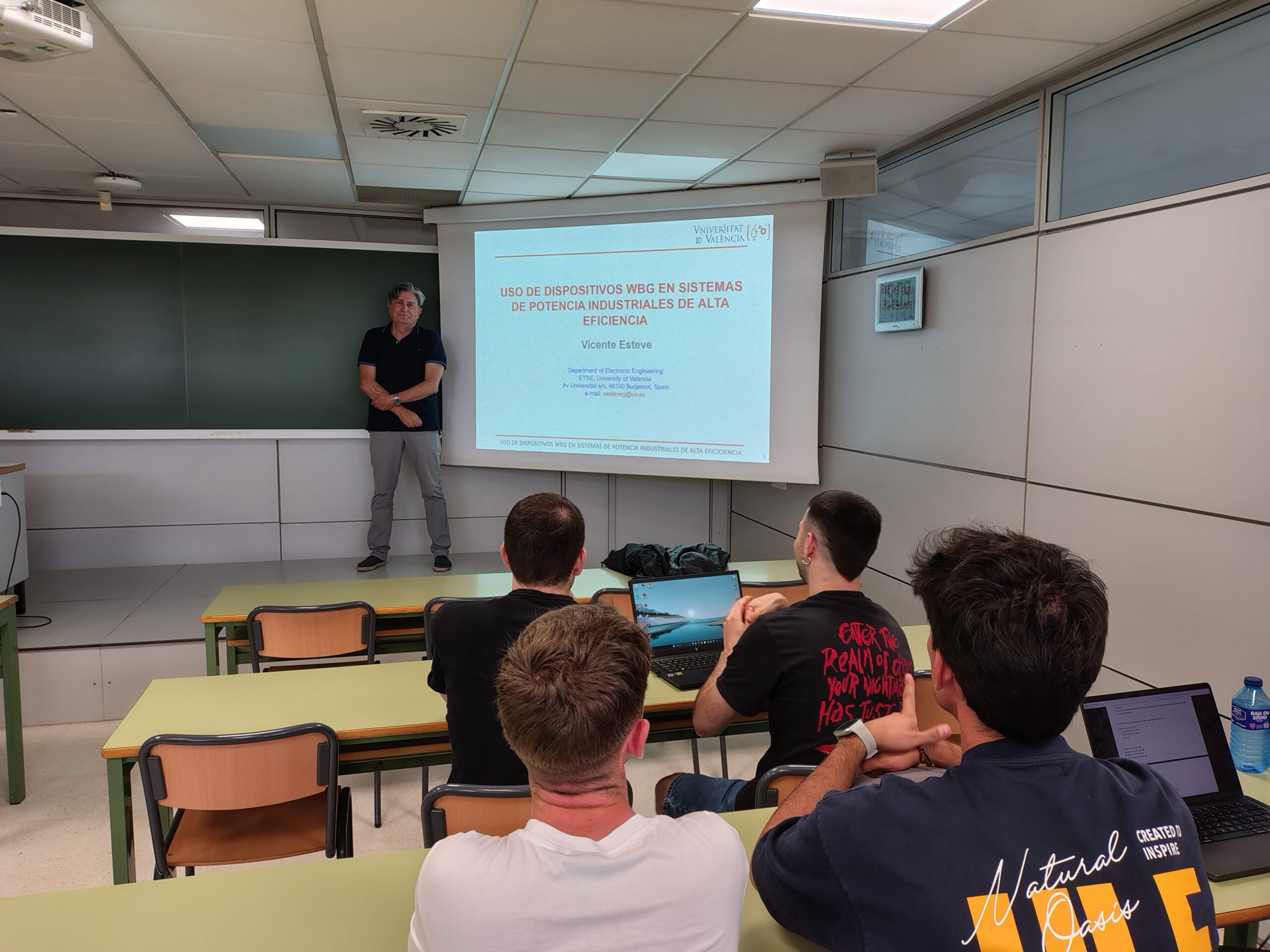
The June 9, 2026, the Master’s Degree in Electronic Systems Engineering (MUISE) The Polytechnic University of Valencia held a professional seminar focused on one of the technologies with the greatest impact on the evolution of power electronics: the wide bandgap devices (Wide Bandgap, WBG). The session was led by Vicente Esteve Gómez, professor in the Department of Electronic Engineering at the University of Valencia, who provided a comprehensive overview of the potential of semiconductors in silicon carbide (SiC) and gallium nitride (GaN) for the development of high-efficiency electronic systems.
During the seminar, the physical properties that distinguish WBG devices from traditional silicon-based semiconductors were analyzed, highlighting their ability to operate at higher voltages, switching frequencies, and operating temperatures. These characteristics make it possible to design more compact, efficient, and reliable electronic converters, reducing both energy losses and cooling requirements—essential factors in today’s industrial applications.
One of the main focuses of the session was the study of the power converter design based on WBG devices for applications related to photovoltaic power generation, energy storage, and industrial electrification. Professor Vicente Esteve explained how the incorporation of these new semiconductors changes traditional design criteria, requiring consideration of aspects such as managing high switching speeds, electromagnetic compatibility, printed circuit board design, and thermal performance optimization.
The seminar also delved into the switching strategies and in the analysis of losses in high-frequency converters, demonstrating how the proper selection of devices and control techniques can maximize the system’s overall efficiency. Through practical examples and experimental results, students were able to see how these technologies are transforming the design of equipment intended for applications where energy efficiency is a top priority.
In addition to the technical content, the event provided an opportunity to present some of the main lines of research currently underway in the field of power electronics based on WBG devices, giving students insight into the scientific and technological challenges that will shape the next generation of electronic converters. This approach proved particularly enriching for students interested in continuing their education through research projects or doctoral studies.
The discussion held at the end of the session fostered an interesting exchange of ideas between the speaker and the attendees, who raised questions regarding the current limitations of SiC and GaN devices, their cost, their reliability, and the prospects for their implementation in various industrial sectors. This dialogue complemented the seminar’s content with a practical perspective based on the speaker’s research experience.
From the academic administration of the MUISE We would like to express our gratitude to the Prof. Vicente Esteve Gómez for sharing their experience and knowledge in a field of enormous importance for the future of power electronics. We would also like to thank the University of Valencia, whose participation helps strengthen cooperation among institutions and provide our students with an education closely linked to cutting-edge research.
With this seminar, the Master’s Degree in Electronic Systems Engineering It continues to strengthen its commitment to specialized education that is aligned with emerging technologies and designed to prepare future engineers to tackle the challenges of the energy transition, electric mobility, and high-efficiency electronic systems.
This seminar was funded by the UPV’s SIRVE program.