


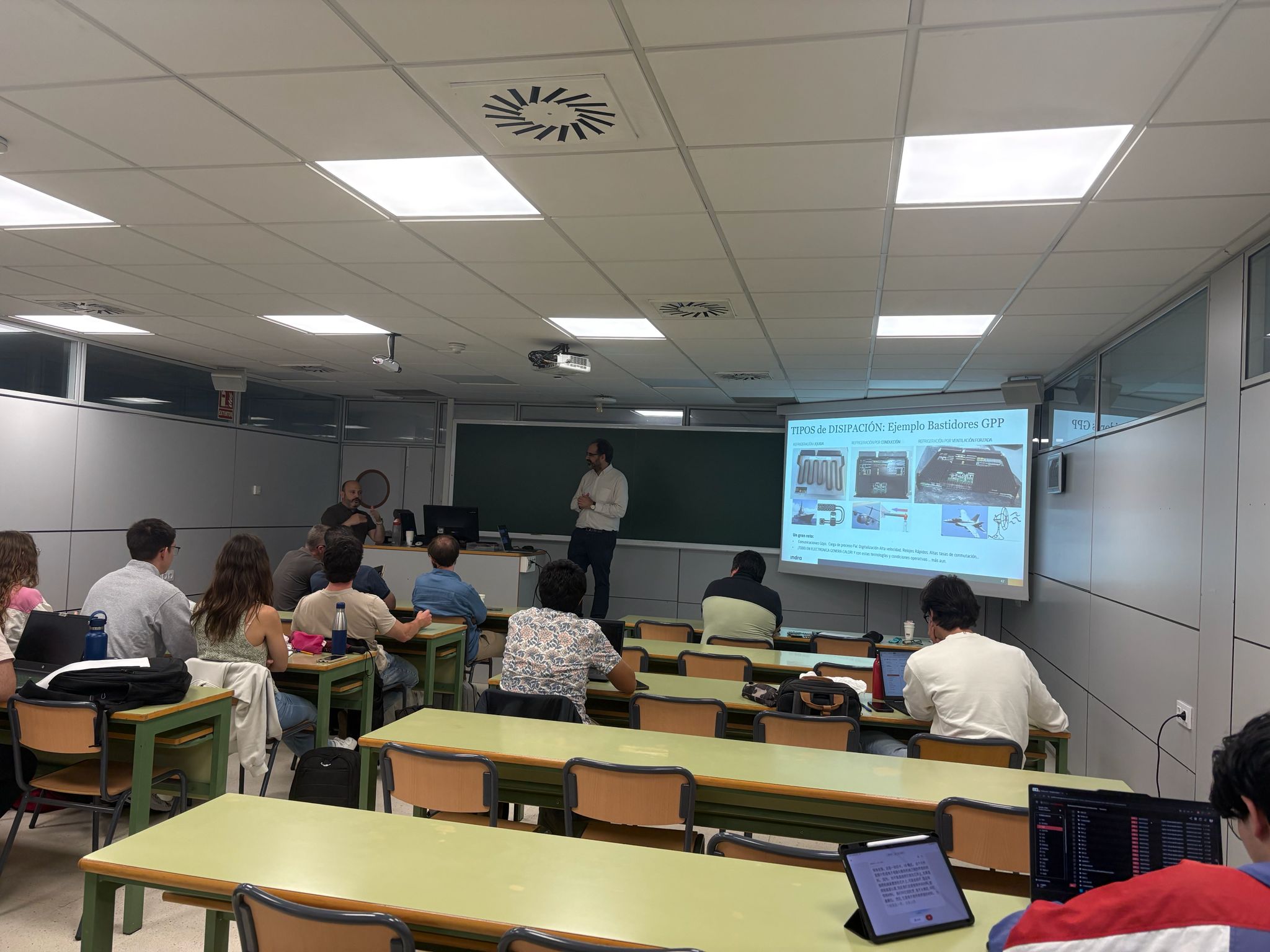
On June 5, the seminar“INDRA Defense & Quantum FPGA: Innovation in FPGAs to address technological challenges.”This was a very interesting session that allowed students to learn first-hand about cutting-edge advances in digital electronics, as well as career opportunities in the defense sector.
The seminar began with a presentation by Prof. Dr. Francisco García, from the Complutense University of Madrid, who gave an introduction to one of the great challenges of quantum computing: the need to identify the quantum state before its collapse. In this context, he highlighted the key role of error correction algorithms implemented in FPGA, which appear to be able to respond quickly to the demands of these systems.
This approach highlights how reconfigurable digital electronics is positioning itself as an enabling technology in emerging fields, opening up new career opportunities for hardware engineers in highly innovative sectors.
In the second part of the seminar, the INDRA Defense team presented its most recent developments in radar systems, an area in which the company is an international benchmark. During the session, both technological advances and current challenges in the sector were addressed, highlighting the growing complexity of the systems and the need for high-performance solutions based on specialized hardware at a time when the defense of the EU is a priority.
The speakers also highlighted the demand for electronic engineering profiles, especially in the field of FPGA design, system validation and real-time processing. This direct contact with the company allowed the students to learn first-hand about the most valued skills in the professional environment.
The seminar was particularly enriching as it connected two fields of great projection – quantum computing and defense systems – with hardware design, demonstrating the strategic role played by electronic engineers in the development of advanced technologies.
This type of activity reinforces MUISE’s commitment to applied training and bringing students closer to the industrial reality, facilitating the development of key skills for their professional future. The activity has been funded by the SIRVE program of the UPV.