


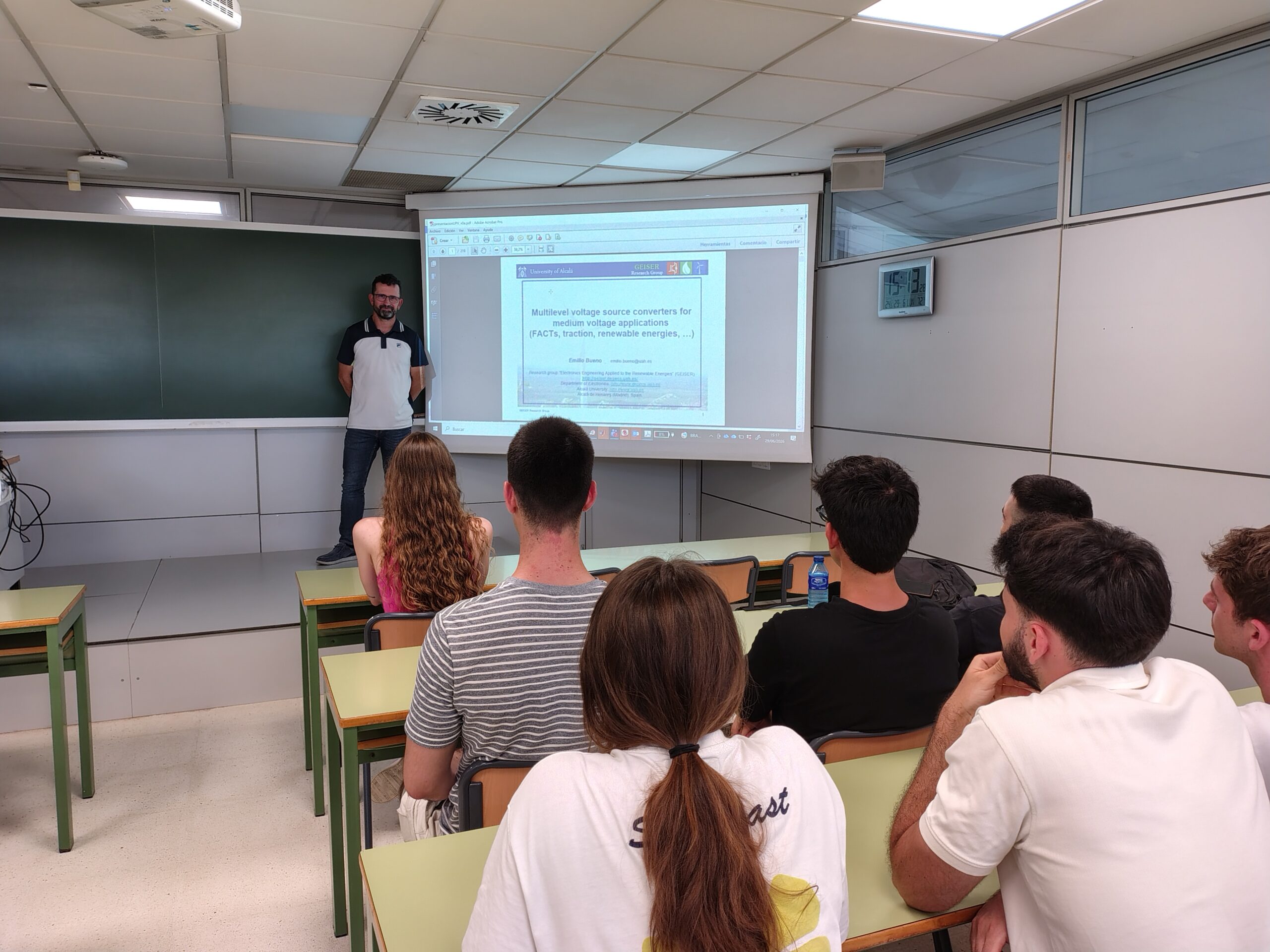
The days June 29 and 30, 2026, the Master’s Degree in Electronic Systems Engineering (MUISE) The Polytechnic University of Valencia held another professional seminar dedicated to one of the most promising technologies in the field of power electronics: the multilevel converters. The workshop, led by the Prof. Dr. Emilio Bueno, professor at the University of Alcalá, brought together master’s and undergraduate students, as well as professionals interested in learning about the latest advances in medium- and high-power energy conversion systems.
During the two sessions, Professor Bueno provided a thorough and up-to-date overview of the main multilevel topologies, analyzing from the classical architectures of Cascaded H-Bridge (CHB), Neutral Point Clamped (NPC) and Flying Capacitor (FC) up to the multi-level modular converters (MMC), which are currently considered the gold standard for very high-power applications. In addition to studying the inner workings of each architecture, attendees were able to compare their advantages, limitations, and areas of application, paying special attention to criteria such as the quality of the generated voltage, efficiency, control complexity, and hardware requirements.
One of the most rewarding aspects of the seminar was the analysis of the real-world applications of these technologies. Examples of their use in systems were shown FACTS to improve the stability of power grids, in rail traction, where they enable the operation of high-power, high-performance engines, and in renewable energy facilities, where they play a key role in integrating large wind and solar farms into the power grid. These applications helped the students understand how the concepts they studied in class are put into practice in infrastructure that is critical to the energy transition.
The seminar also addressed current challenges in power electronics research, including issues related to balancing efficiency, reliability, modularity, and scalability in converters. The speaker’s research and industrial experience allowed him to supplement the theoretical foundations with numerous practical examples and reflections on the trends that will shape the evolution of this field in the coming years.
As is customary at MUISE’s professional seminars, the event fostered a participatory atmosphere in which students were able to ask questions and discuss different design alternatives, control strategies, and career opportunities within the power electronics sector. This direct exchange with a renowned researcher is one of the main added values of this seminar series, exposing students to the technological challenges they will face in their future careers.
On behalf of the academic administration of MUISE, we would like to thank the Prof. Dr. Emilio Bueno his excellent presentation and the quality of his talk, which have allowed our students to gain a deeper understanding of a technology that is essential for the development of the smart grids, the electric mobility and the integration of renewable energy. We would also like to thank the University of Alcalá, whose participation helps strengthen ties between institutions and enrich the specialized training offered by our master’s program.
Through this seminar, MUISE continues to reinforce its commitment to an education that is closely linked to research and industry, offering its students the opportunity to gain firsthand experience with the technologies that are shaping the future of power electronics systems.
This seminar was funded by the UPV’s SIRVE program.