


Page contents
Description of the degree
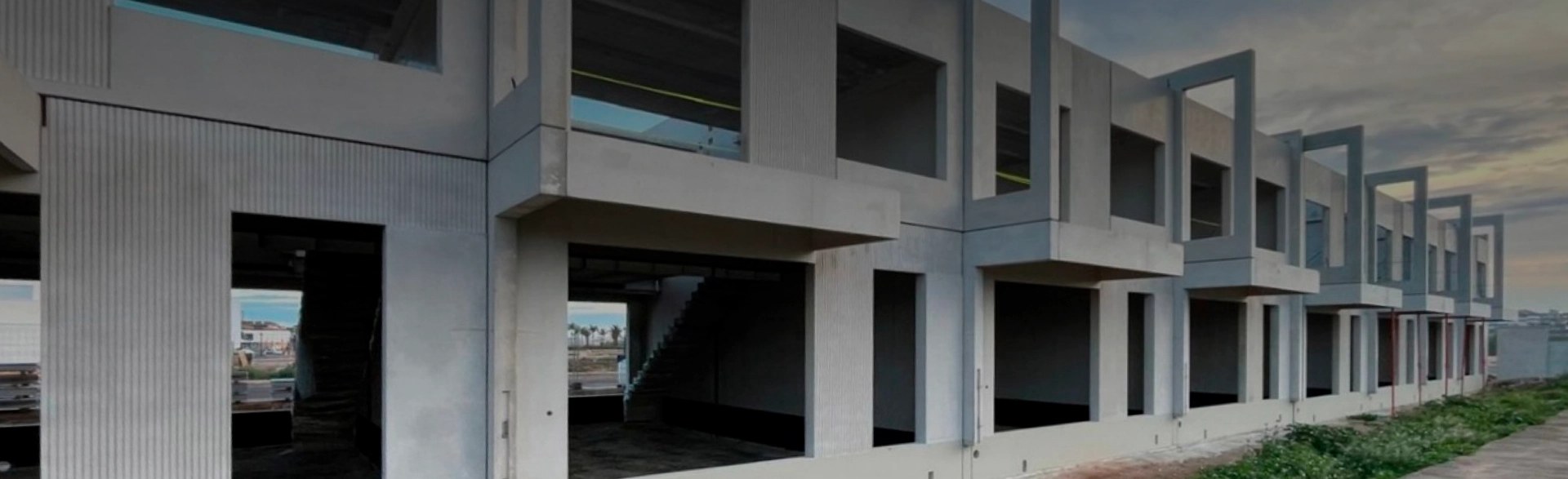
This Master’s Degree aims to respond to the new challenges of the building sector, driven by the need to build in a more efficient, sustainable and technologically advanced way. The constant evolution of materials, construction systems and digital tools has led to the incorporation of industrialized solutions in building, which makes it possible to systematize processes, optimize decision-making and improve efficiency in all phases of the project. This approach is aligned with European regulatory objectives, the SDGs and the principles of the circular economy, promoting the reuse of materials, energy optimization, waste reduction, improved occupational safety and social inclusion. It also enables greater control of environmental indicators, allowing the assessment and comparison of the environmental and economic impacts of buildings throughout their life cycle.
The Master’s Degree in Industrialised Construction and Building Prototyping offers specialized training that develops advanced competences in industrialized construction processes and provides the skills needed for research in this field. In addition, it promotes the technical specialization required to access emerging professional profiles and to manage this type of project effectively and efficiently. The program integrates knowledge of BIM methodology with component prototyping techniques, covering their design, management, evaluation and planning, and placing students at the forefront of innovation in building.
Objectives of the degree

The main objective of the Master’s Degree in Industrialised Construction and Building Prototyping is to train professionals in the building field in industrialized construction of buildings and their prototyping. This specialization is achieved by addressing aspects ranging from knowledge of industrialized construction techniques and systems based on the generation of digital twins, which make it possible to manufacture off-site components for subsequent on-site assembly.
It also delves into the understanding and optimization of industrial processes applied to the building sector, as well as into the planning of the production of industrialized systems. Students acquire competences in parametric modeling through BIM methodology and the use of collaborative digital twins, which facilitates the efficient creation of components and fundamental decision-making.
In addition, the Master’s integrates sustainability into the management of Industrialized Construction, incorporating environmental assessment and circular economy principles into construction processes and developments.
Career opportunities
In the field of building site management, specialists are required in specific areas of knowledge directly related to the contents of the master’s degree.
Main career opportunities include:
- Technicians specialized in the management and use of BIM tools aimed at creating digital twins and prototyping components in industrialized building.
- Experts in BIM Analyst, BIM Consultant and BIM Researcher roles.
- Experts in construction techniques and materials used in industrialized construction.
- Experts in process management and planning of industrialized constructions using Lean methodology.
- Project Manager in industrialization processes for construction works. Site managers and project technicians specialized in industrialized construction.
- Expert in the competences of the Technical Architect in the integral process of industrialized construction of buildings, quality control of materials, coordination of health and safety, and control of execution in off-site and in-situ work environments.
Main target audience
The master’s degree is designed for professionals interested in deepening their specialization in the building, architecture and construction sectors.
- Graduates in Technical Architecture.
- Graduates in Architecture Fundamentals.
- Graduates in Public Works Engineering.
- Graduates in Civil Engineering.
- Graduates in equivalent degrees
Structure of the master’s degree
Credits: 60 ECTS
Compulsory: 51 ECTS | Optional: 3 ECTS | External internships: 0 ECTS | Master’s thesis (TFM): 6 ECTS
Internships in companies
Here you can consult the Regulations establishing the general conditions and rules for external academic internships at the UPV.
Research and access to doctoral studies
Students will have the opportunity to join the lines of research and doctoral programs developed by the teaching staff linked to the master’s degree.
At the Doctoral School you will find all the programs offered by the UPV.
Academic exchange / agreements with other universities
From the Deputy Directorate of International Relations and Employment of the Higher Technical School of Building Engineering (ETSIE) carries out important international relations activities.
Every year, students of the School have the opportunity to complete their training at a foreign institution. ETSIE participates in a large number of cooperation programs, both at European and global level.
Facilities and laboratories
The spaces where the master’s teaching will take place are the classrooms in building 1C, where there are 3 classrooms dedicated to teaching on the first floor, three teaching laboratories on the ground floor, one of them equipped with computers and spaces for meetings, seminars and presentation of academic work.
In addition, in building 1B there are drawing classrooms and laboratories where some of the master’s practical sessions will be held (Construction Laboratories, Materials Laboratories, Installations Laboratories, Electrochemistry Laboratory, Mathematics Laboratory and Physics Laboratory).
The School also has, among other spaces:
- 2 open-access computer classrooms and 5 computer laboratories for teaching.
- 2 seminar rooms
- Graduation hall
- Main lecture hall
- Library
Master’s Thesis
The Master’s Thesis of the Master’s Degree in Industrialised Construction and Building Prototyping is a module and a subject taught during the second semester and has a teaching load of 6 ECTS credits.
The general framework governing the conditions under which it will be carried out is established by the Regulations on Bachelor’s and Master’s Theses of the Universitat Politècnica de València, approved by the Governing Council on 21/07/2022.
The module that includes the TFM, a research or professional specialization project (6 ECTS), will enable students to integrate knowledge and consolidate the skills and competences acquired.
Partner companies and more
There is close contact, on the part of the master’s management, with other entities and companies with which we collaborate and from which we receive information on the needs of the sector. Conferences and extracurricular activities are frequently organized so that students and lecturers can broaden their knowledge and horizons.
There are shared lines of work and frequent collaborations with public national research institutes such as the Eduardo Torroja Institute for Construction Science (IETcc-CSIC); with research institutes and centers in the Valencian Community (Valencian Innovation Agency -AVI-, Interuniversity Institute for Molecular Recognition and Technological Development -IDM-, University Institute for Concrete Science and Technology – ICITECH-, Research Center Architecture, Heritage and Management for Sustainable Development – PEGASO-); with public-interest foundations governed by private law such as the Valencian Institute of Building (IVE); with prestigious entities and centers in the construction sector (Construction Labor Foundation), CEVISAMA (Feria Valencia); with sector associations (Valencian Federation of Construction Employers -FECEC-, Association of Companies for the Selection and Recycling of Construction and Industrial Waste -ARCI-); as well as with leading product manufacturing companies such as SIKA, Mapei, Kerakoll, Molins, Projar, Tejas Borja; construction and engineering companies such as Bertolín, Itercon, Edicover; and companies in the industrialized construction sector such as Ubiko, Viraje Arquitectura, Porcelanosa-Butech, INHAUS, The Corten Co, SPANS Builden Tech, among others.
On the other hand, there are currently several active chairs at ETSIE (Chair of Technical Architecture, Housing Observatory Chair, Bertolín Chair) that promote the generation of knowledge and research, and therefore represent another opportunity for master’s students by enabling the development of activities that foster disciplinary transversality.