


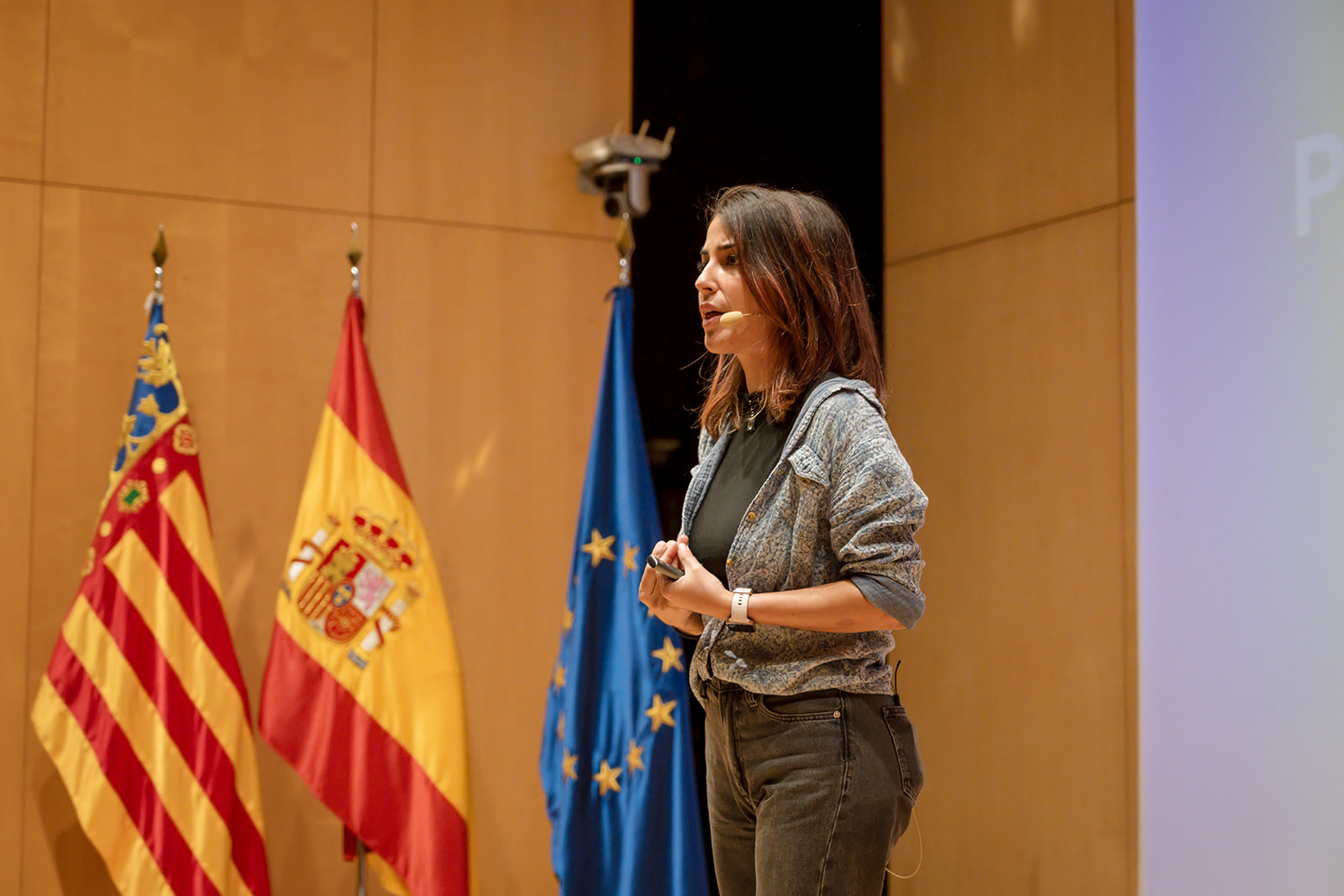
The journalist and science communicator, known on social media as Schrödinger’s Cat, delivered the opening lecture, titled “Thinking in a World of Noise”.
Journalist and science communicator Rocío Vidal, known on social media as Schrödinger’s Cat, delivered the inaugural lecture for the 2026–2027 academic year at the Gandia campus of the Universitat Politècnica de València (UPV), titled “Thinking About a World of Noise.”
In it, Vidal addressed the challenges of the digital society and reflected on how information overload, misinformation, and immediacy shape the way we stay informed, understand reality, and interact with one another. “We are drifting toward a uniformity of content where talent—the essence—is becoming increasingly important,” the journalist noted.
Fake news and artificial intelligence were central themes of the discussion, which highlighted the growing difficulty in distinguishing reliable information from misleading content, as well as the effects of overstimulation on concentration and critical thinking.
The journalist and public educator has also warned of the risks of giving visibility to voices that spread ideas without subjecting them to scrutiny. “Pseudo-thinkers are given a platform, with no one to challenge them, and there are young people who are very lost,” she said.
Faced with a scenario in which artificial intelligence can generate realistic-looking content and make it difficult to detect manipulation, the journalist has advocated for the need to develop tools and criteria for evaluating information. “We shouldn’t be afraid of what’s to come, but rather see the opportunities,” she said.
In the face of these challenges, Rocío Vidal has emphasized the value of science, art, and knowledge, as well as the importance of setting aside time to read, write by hand, and reflect.
Through his lecture, he invited the university community to question the information it receives and to foster critical thinking in a society marked by constant connection and reaction.