

Determinants
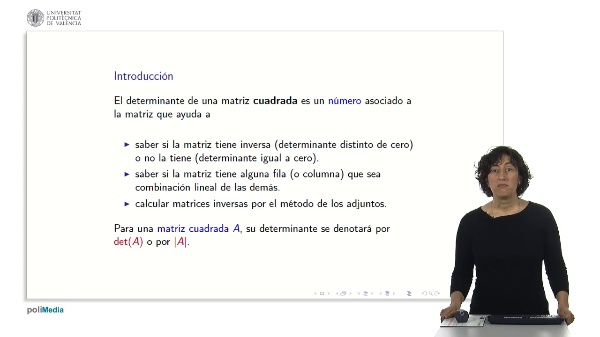
In this video, an educational lesson on determinants of square matrices is presented. The concept of a determinant is introduced, explaining its importance for quickly determining if a matrix has an inverse or if its rows or columns are linear combinations of others. The lesson begins with the simplest case, the determinant of a 1x1 matrix, and then moves on to 2x2 matrices, demonstrating how to calculate the determinant by multiplying the diagonal elements and subtracting the products of the secondary diagonal. The video then expands the concept to 3x3 matrices, showcasing the calculation of determinants involving the addition and subtraction of products from both the main and secondary diagonals. An example is provided to illustrate the process, leading to a method known as Sarus' rule, which simplifies determinant calculations visually. Properties of determinants are explained, such as transposition, zero lines, swapping of parallel lines, parallel line equality, multiplication by a scalar, proportional parallel lines, and linearity. These properties assist in simplifying determinant calculations. The concept of the transpose matrix and its determinant being equal to the original is highlighted with examples of 2x2 matrices. The video continues with definitions important for understanding the adjoint method of calculating inverses. Key among these is the concept of the complementary minor and the adjoint of an element in a determinant. It is demonstrated how a determinant can be expressed as the sum of the products of elements of any row or column with their respective adjoints, thus making it possible to calculate larger order determinants. Finally, the general process for calculating determinants of order n is outlined, relying on properties to simplify the matrix with zeros and by developing the determinant along rows or columns with adjoints. The ultimate goal is to reduce the calculation to determinants of smaller order for easier computation. The lesson emphasizes that these operations apply to determinants and should not be confused with operations permitted in the Gauss method, which are limited to row operations only.
10:06 · 2016