


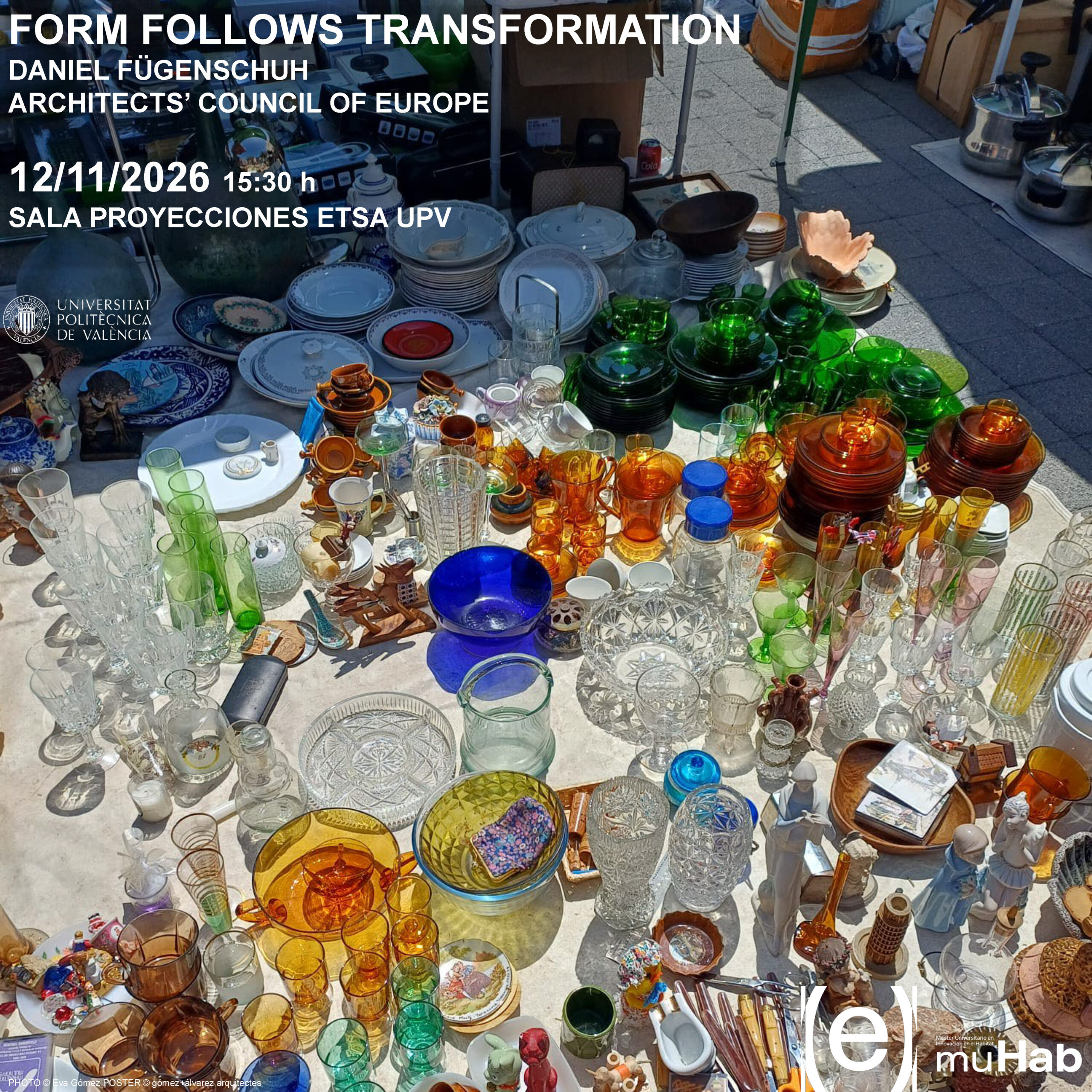
Daniel Fügenschuh, president of the Architects’ Council of Europe (ACE), visits the muHAB at the UPV in Valencia
On November 12, Carlos Gómez and Eva Álvarez welcomed Daniel Fügenschuh to Valencia to participate in “Housing and Social Sustainability 1: Cooperatives and Sustainable Communities,” a course in the Master’s Program in Housing Innovation (muHAB) at the UPV.
With the support of ARCH-E UPV and muHAB UPV, they organized a program that combines architectural education, research, and professional institutions. They began the day at the Valencian Institute of Building (IVE), where Leticia Ortega presented her research and her collaboration with the ACE. The discussions focused on post-disaster responses and industrialized housing, topics of particular interest to Daniel. Afterward, they visited our School, Classroom 521, and the main area of the UPV Agora.
The regular class for the students took place, on an exceptional basis, in the library of the Valencia Regional College of Architects (CTAV), where Daniel joined the muHAB class to engage in a discussion with the students about European architectural policies, housing, and social sustainability, with an emphasis on renovation and circular architecture. They also met with the president of the CTAV, Pablo Peñín, and members of its board of directors, who organized a press conference that morning. We would like to thank everyone for their hospitality.
The day continued with a visit to the pavilion marking the 60th anniversary of the UPV School of Architecture, located in Plaza del Patriarca, and concluded with an “Agua de Valencia” (a traditional Valencian cocktail), dinner, and a talk in the historic district.
Our sincerest thanks to Daniel for his generosity and kindness, to Julie Deutschmann and the ACE team for their collaboration, and to IVE, ETS Arquitectura, and CTAV for their hospitality.
This activity is part of the master’s program’s educational activities focused on experiential learning and is aligned with the UPV SIRVE Strategic Plan, fostering connections between universities, professionals, and European institutions, as well as raising awareness of strategies for addressing the current challenges facing the built environment.