




Page contents
Description of the title
The Erasmus Mundus Master Degree in Engineering for Environmental Sustainability and International Cooperation (EESIC) is a two-year international master’s degree (120 ECTS), jointly delivered by the Università di Trento, the Universitat Politècnica de València and Instituto Superior Técnico – Universidade de Lisboa.
The programme trains professionals capable of tackling complex environmental challenges from an international perspective, integrating sustainability, cooperation and academic excellence. During the first three semesters, students rotate among the partner universities and receive training in civil and environmental engineering, research methodologies, nature-based solutions, systems thinking and intercultural skills. The fourth semester strengthens the applied and international dimension of the programme through associated entities. EESIC prepares graduates to design solutions that are technically, environmentally, economically and socially sustainable.
Objectives of the degree
EESIC aims to train professionals with a solid background in environmental engineering, capable of addressing the major sustainability challenges from an international, interdisciplinary and applied perspective. The programme combines advanced technical training with transversal skills geared towards the analysis of complex problems, innovation, critical thinking and the understanding of diverse social and cultural contexts.
Its main objectives include:

Enabling students to design environmentally sustainable, technically rigorous solutions adapted to local realities.
Promoting an integrated vision of natural resource management, social development and economic growth.
Preparing future engineers to work in international environments where the challenges are not only technical, but also social, territorial and cultural.
Likewise, EESIC seeks to promote a new graduate profile with the capacity to work in areas such as sustainable water management, pollution reduction, sanitation, protection against natural hazards and ecosystem conservation, incorporating approaches such as nature-based innovation, international cooperation and systems thinking.
Career opportunities
EESIC prepares its graduates to develop their professional careers in fields related to environmental engineering, sustainability and international cooperation, combining a solid technical foundation with global, interdisciplinary and intercultural competences. The programme is designed to train professionals capable of working in complex contexts, where environmental challenges require solutions that are technically rigorous and, at the same time, socially and territorially adapted.
Likewise, the master’s degree offers appropriate preparation to join multidisciplinary teams in applied research, innovation and strategic planning in environmental sustainability, both in Europe and in other international contexts. Its practical, interdisciplinary and globally oriented approach, together with the development of skills such as problem solving, adaptability, intercultural understanding and complex systems management, broadens the possibilities of professional integration in emerging sectors related to the ecological transition and sustainable development.
The main career opportunities include working in environmental consulting and engineering, employment in public administrations and international organisations, participation in development cooperation projects, as well as joining entities and companies dedicated to sustainable water management, sanitation, waste management, pollution reduction, protection against hydrological and hydrogeological risks and the planning of nature-based solutions. These opportunities match the graduate profile promoted by EESIC, focused on designing infrastructures and strategies that are sustainable, equitable and adapted to diverse regional needs.
- Work in environmental consulting and engineering.
- Employment in public administrations and international organisations.
- Participation in development cooperation projects.
- Joining entities and companies dedicated to sustainable water management.
- Joining entities and companies dedicated to sanitation.
- Joining entities and companies dedicated to waste management.
- Joining entities and companies dedicated to pollution reduction.
- Joining entities and companies dedicated to protection against hydrological and hydrogeological risks.
- Joining entities and companies dedicated to planning nature-based solutions.
- Integration into multidisciplinary teams for applied research in environmental sustainability.
- Integration into innovation teams in environmental sustainability.
- Integration into strategic planning teams in environmental sustainability.
- Professional integration in emerging sectors related to the ecological transition.
- Professional integration in emerging sectors related to sustainable development.
Aimed primarily at
EESIC is mainly aimed at university graduates with training in civil-environmental engineering or related scientific disciplines, who meet the academic and language requirements established in the admission process.
Candidates must prove a minimum English level of B2. The application must include mandatory documentation such as identification, CV, academic transcript, degree certificate, proof of English, motivation letter and references, and may be complemented with additional merits such as relevant experience or a short presentation video. Selection is carried out through an evaluation system based on academic merits, motivation, recommendation letters, experience and an interview.
EESIC is mainly aimed at:
- Graduates in Civil Engineering and/or Environmental Engineering (at least 180 ECTS), or in closely related scientific disciplines.
- Graduates from other related areas who, although not coming directly from civil-environmental engineering, can prove sufficient training in mathematics, physics and chemistry, civil-environmental engineering and structures.
Structure of the master’s degree
Credits: 120 ECTS
Compulsory: 75 ECTS | Elective: 15 ECTS | External internships: 0 ECTS | Master’s thesis (TFM): 30 ECTS
Internships
EESIC offers students the possibility of carrying out their Master’s Thesis in collaboration with a wide international network of Associated Partners, made up of universities, companies, public bodies and non-governmental organisations from different continents. These entities can host students during the last semester to develop applied practical experiences or supervise final research projects in real and international contexts.
Professional and international dimension
This professional and international dimension reinforces the applied nature of the programme and facilitates direct contact with working environments related to environmental sustainability, engineering and international cooperation.
Connection with the labour market
In addition, the associated partners take part in thematic workshops, guest lectures and training activities, and also constitute a valuable channel of connection with the labour market and with future professional opportunities.
Research and access to Ph.
EESIC offers advanced training aimed not only at professional practice, but also at applied research in environmental engineering and sustainability.
Its international, interdisciplinary and technically demanding approach provides a solid basis for continuing an academic career in areas such as water management, environmental quality, modelling, climate change or sustainable planning.
- Water management
- Environmental quality
- Modelling
- Climate change
- Sustainable planning
Likewise, participation in the master’s degree facilitates the continuation of studies in the field of doctoral research.
In the case of the Universitat Politècnica de València (UPV), EESIC is an appropriate access route to the PhD Programme in Water and Environmental Engineering, an official programme of the UPV Doctoral School linked to the Department of Hydraulic and Environmental Engineering and to the Institute of Water and Environmental Engineering (IIAMA).
- Doctoral research
- PhD Programme in Water and Environmental Engineering
- UPV Doctoral School
- Department of Hydraulic and Environmental Engineering
- Institute of Water and Environmental Engineering (IIAMA)
Academic exchange / agreements with other universities
EESIC is an Erasmus Mundus Joint Master delivered jointly by the University of Trento (Italy), Instituto Superior Técnico in Lisbon (Portugal) and the Universitat Politècnica de València (Spain). This international structure allows students to study one semester at each of the three consortium universities, benefiting from a truly European, itinerant and interdisciplinary academic experience. The integrated mobility between Lisbon, Valencia and Trento is one of the programme’s main added values.
Facilities and laboratories
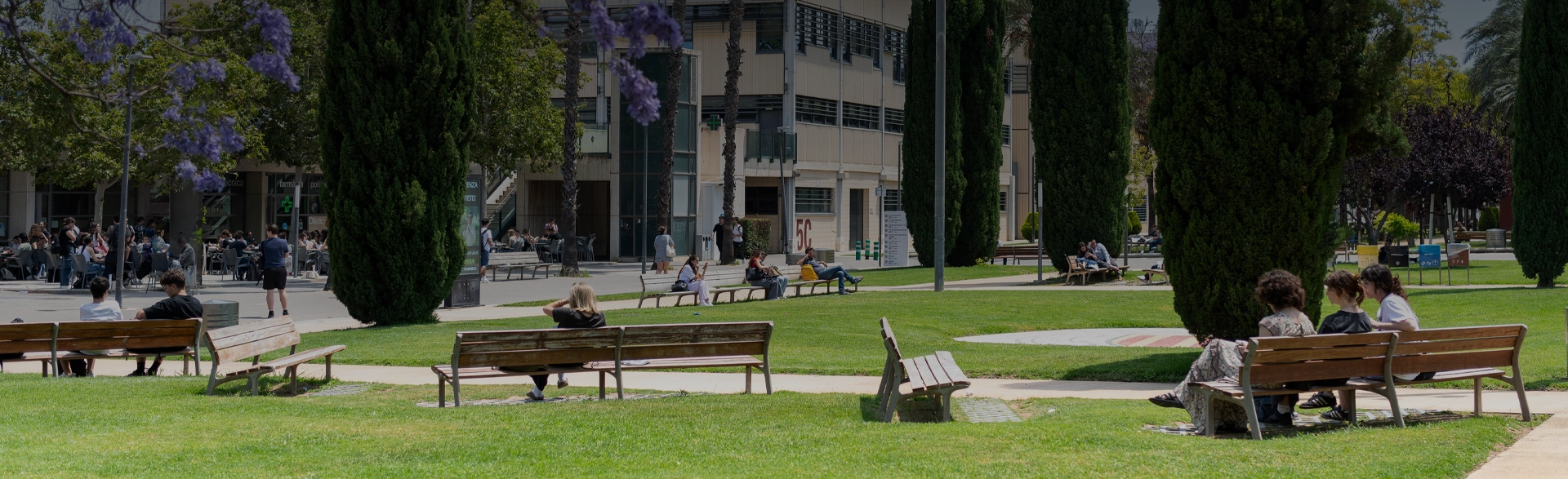
The School of Civil Engineering (ETS de Ingeniería de Caminos, Canales y Puertos) at the UPV has extensive teaching and experimental infrastructure on the Vera campus, organised into three buildings and nine large laboratories: Structures, Hydraulics, Construction, Pavements and Road Surfaces, Geotechnical Engineering, Chemistry, Materials, Environment, and Ports and Coasts. This configuration reflects the technical and applied nature of the School, oriented both towards teaching and towards experimentation and research in civil and environmental engineering.
Master’s Thesis
The Master’s Thesis (TFM) is one of the core components of EESIC and is carried out during the fourth semester of the programme, with a total load of 30 ECTS. Of these, 24 ECTS correspond to the Master Dissertation and 6 ECTS to the course Engineering for International Sustainable Development: Project work, specifically designed to support the development of the final project.
The approach to the Master’s Thesis reflects the distinctive focus of the master’s degree, based on challenge-based learning and project work. The official programme website highlights that this phase includes a component of collaborative work, with supervised fieldwork in real international development initiatives, complemented by a final thesis focused on applied research in engineering. The aim is for students to formulate solutions that are not only technically sound, but also environmentally sustainable, economically viable and socially responsible.
In addition, the Master’s Thesis can be carried out at one of the consortium partner universities or at one of the Associated Partners, which reinforces its applied and international dimension. This possibility makes it possible to develop the final project in contact with diverse professional and academic contexts, linked to real issues of environmental sustainability and international cooperation.
Collaborating companies and more
Partner companies
The Associated Partners play an essential role in the development and international projection of EESIC. They form a network of 48 entities linked to the master’s degree, made up of universities, companies, public bodies and non-governmental organisations, which collaborate with the consortium to strengthen the applied, international and professional dimension of the programme. These partners contribute directly to the success of the master’s degree and to its consolidation as an environment of excellence in environmental sustainability and engineering for international cooperation.
Geographical scope of the network
From a geographical point of view, the Associated Partners have a very broad international distribution, with a presence on all continents. The network includes entities from Europe —for example, Belgium, France, Italy, Poland, Portugal, Spain, the Netherlands and Kosovo—; from Africa —such as Libya, Kenya, Nigeria and Zambia—; from Asia —such as India, Indonesia, Nepal, Vietnam and Kazakhstan—; from Latin America and the Caribbean —such as Argentina, Brazil, Colombia, Mexico, Paraguay and the Dominican Republic—; and also from North America, with a presence in the United States. This distribution explicitly responds to the criterion of ensuring a balanced geographical representation and a truly global projection of the programme.
Relationship with students
The relationship between the Associated Partners and EESIC students is particularly relevant during the fourth semester of the master’s degree. At this stage, students can gain practical experience in real environments through training stays, applied work, supervised fieldwork and the completion of the final thesis in one of the associated institutions or under their mentoring.
Programme strengths
The Associated Partners are one of EESIC’s main strengths, as they connect academic training with professional practice and applied research in a genuinely international framework. Thanks to this network, students not only complete their training in contact with diverse environmental realities, but also broaden their opportunities for employment, scientific collaboration and participation in international sustainable development projects.
Organisation
- Department of Sculpture
- Department of Painting
Co-funding
- Ministry of Education