


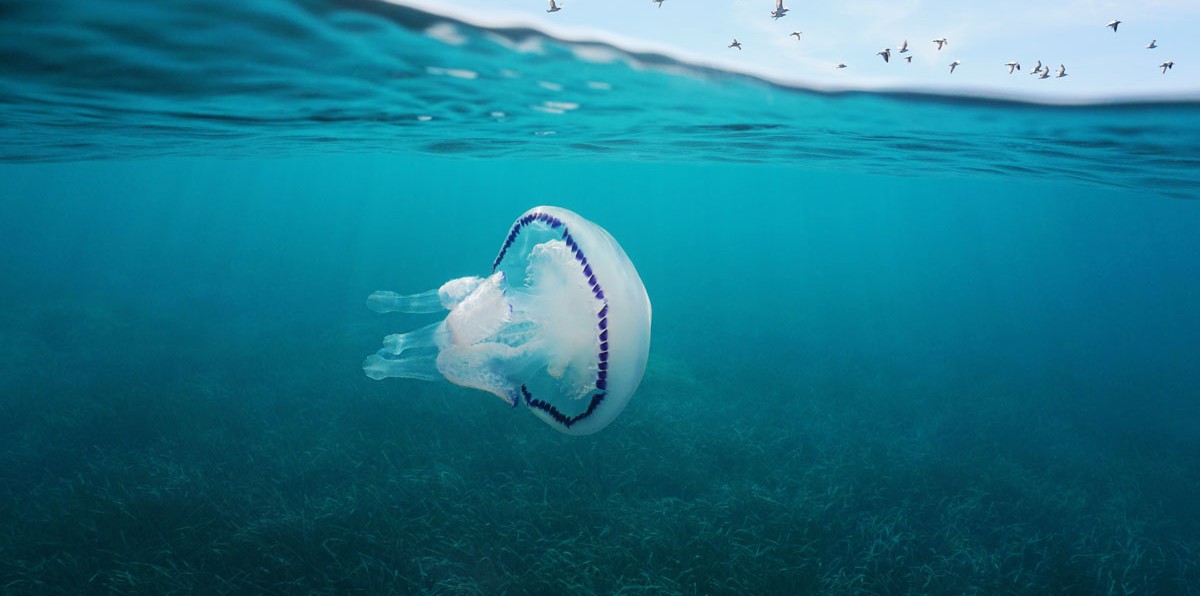
UPV and UA researchers develop a new floating anti-jellyfish buoy. The buoy is equipped with electronic components and coils that generate electromagnetic fields that prevent jellyfish from approaching the swimming area.
Researchers from the Universitat Politècnica de València and the University of Alicante have developed a new floating jellyfish buoy, which helps to stop the arrival of these animals to the coast, thus reducing the possibility of stings among bathers.
The buoy is equipped with different electronic components, power sources and a series of coils that generate electromagnetic fields that paralyze the jellyfish and prevent them from approaching the bathing area. This system has been designed and evaluated by a team of the Research Institute for Integrated Coastal Zone Management at the Campus of Gandia of the UPV coordinated by Jaime Lloret.
“Jellyfish movement is based on pulsations by which they contract their umbrella to create a flow of water that allows them to move. By creating electromagnetic fields, it is possible to reduce the number of jellyfish pulsations, and even paralyze them, thus reducing their ability to move and maintain their position,” explains Lloret.
In this way, they are temporarily limited in their movements, but when they move away from the emitter, due to the effect of gravity and currents, they recover their full mobility.
The technology is completely harmless and sustainable, as it generates an immediate deterrent effect on jellyfish without causing them any harm and without producing any waste that affects the marine environment. “The system is completely harmless and, once out of the device’s radius of action, they can move regularly,” adds César Bordehore, coordinator of the Terrestrial and Marine Ecosystem Management and Restoration (GRE) research group at the University of Alicante.
In addition, unlike physical barriers that also affect other species, this system acts only on jellyfish without producing negative effects on other species. And among its advantages, it also stands out for its lower cost compared to physical barriers and also requires less maintenance due to its dimensions. “In addition, the main elements of the device are concentrated in the floating buoy, which makes access to it and the repair or replacement of components easier,” they conclude.
Other sensors
The buoy also incorporates other sensors created by the IGIC team to measure different water parameters such as temperature, turbidity, chlorophyll and oxygen levels.
This new system is the result of more than five years of research. Along with Jaime Lloret, the UPV team that has developed this system is completed by Sandra Sendra, Lorena Parra and Alberto Ivars, who is currently finishing his final degree work focused on this buoy designed to save swimmers from stings, without interfering with the jellyfish.
The development of this work has also been framed within the framework of an activity of the Inter-University Chair of the Sea and Sustainability of the Nautical Sector, co-directed by Jaime Lloret at the UPV and César Bordehore at the UA, and sponsored by Marina Port Valencia.