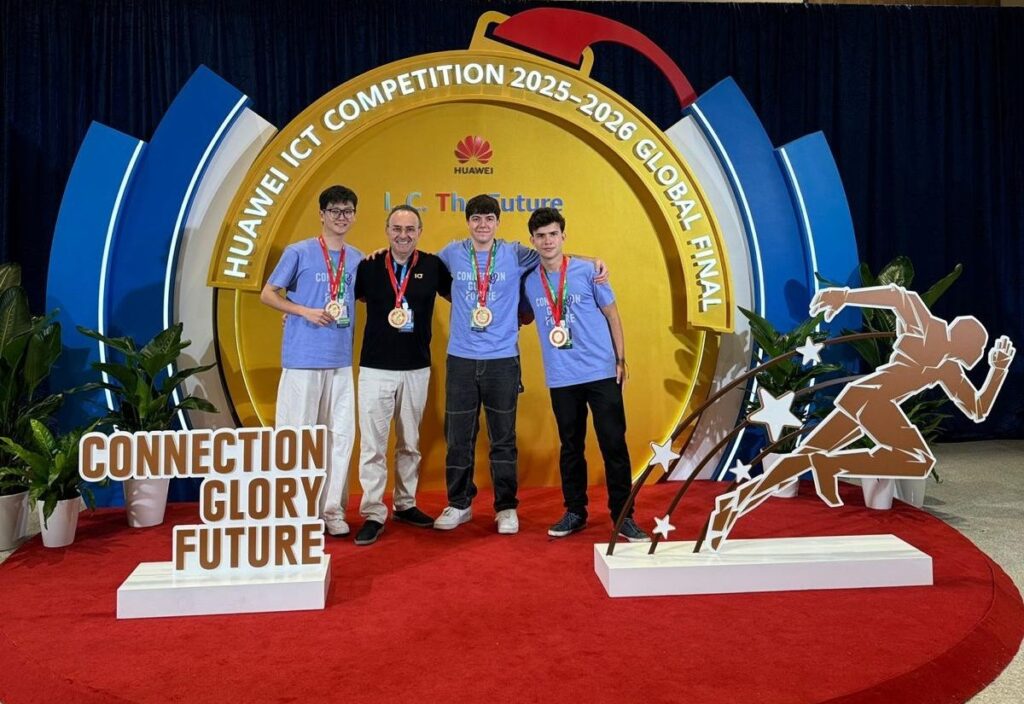
The VirtualDoors project, developed by students from the UPV Gandia Campus, has been recognized among the best international proposals.
The talent of the students of the Gandia Campus of the Universitat Politècnica de València (UPV) stands out again on the international map. Advanced EPSG has achieved the third prize worldwide in the Innovation category of the Huawei ICT Competition one of the most prestigious university competitions in the technological field.
The team, which represented the UPV in the final held from June 3 to 5 in Shenzhen (China), was composed by Mario Climent Jimenez student of the Degree in Interactive Technologies; Renato Kafure Cavalcante of the Double Degree in Telecommunication Systems Engineering, Sound and Image and Audiovisual Communication; and ZhangTian “Alex” Liang, a student of Telecommunication Systems Engineering, Sound and Image.
“It has been a very enriching experience. We have had the opportunity to present our project before international juries, compete with teams of the highest level and demonstrate that an idea developed from the academic field can have a real application in a sector as important as the port sector,” says Alex.
The recognition comes after months of work dedicated to the development of VirtualDoorsa solution based on artificial intelligence to optimize the management of truck traffic in port environments.
The project has also been tutored by the professor of the Department of Electronic Engineering of the Polytechnic School of Gandia, José Marín-Roig.
An intelligent solution for port access
The Innovation category of the Huawei ICT Competition rewards projects capable of solving real problems through advanced technologies, with special emphasis on originality, feasibility and potential impact. As Renato explains, “the jury highlighted the innovative nature of VirtualDoors, as well as its direct application to the logistical challenges of the port sector”.
The proposal aims to transform port accesses into intelligent systems capable of making decisions in real time. To this end, it incorporates artificial intelligence models that analyze traffic, anticipate congestion and dynamically redistribute the flow of vehicles by coordinating different access points and adapting signaling.
The project began to be developed following the creation of Advanced EPSG in 2024, with the aim of promoting technological solutions linked to the SmartPort concept and improving the efficiency of port operations.
A recognition with international projection
The competition jury recognized the technical quality and potential of VirtualDoors with the award of the third overall prize in the Innovation category. “This recognition is a very important validation of our idea”, says Advanced EPSG. Now, “we want to improve the technical part, strengthen the simulation, advance in the prototype and continue exploring possible collaborations with institutions and companies linked to port logistics. We would also like the project to evolve into a real-life initiative, including as a basis for a future start-up”, says Mario.
Advanced EPSG, a multidisciplinary team on the rise
Currently, Advanced EPSG is formed by 23 students from different degrees of the Gandia Campus. The team works on projects related to artificial intelligence, software engineering, distributed systems and telecommunications, with a multidisciplinary approach oriented to the development of applied technological solutions.
The third world prize in the Innovation category of the Huawei ICT Competition, achieved by Advanced EPSG, is an important recognition of the work done by the team and reinforces the role of the UPV and its campus in Gandia as spaces for innovation, entrepreneurship and technology transfer with international projection.