


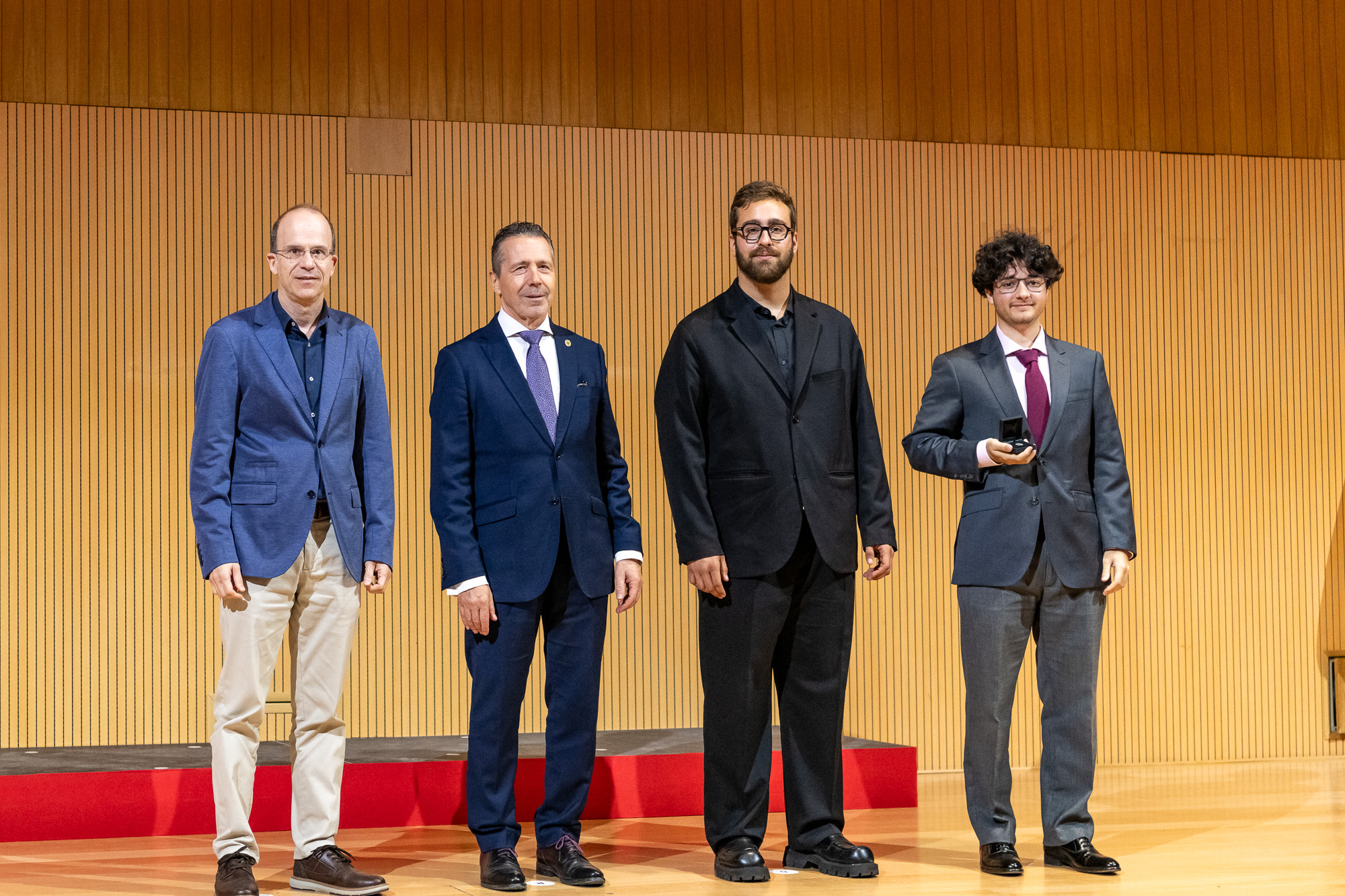
The Rector of the UPV welcomes the new top representatives of the delegations.
They represent the capital body of our institution, the students, whose academic and human training gives meaning to the very existence of the Universitat Politècnica de València (UPV). Precisely because of this condition, their work acquires a vital relevance, because no one better than a student can understand their needs to successfully fulfill their mission, which is none other than to achieve a comprehensive training that makes them better, both them and the society around them.
For this reason, the rector of the UPV, José Esteban Capilla, presided over a ceremony to welcome the new student representatives from all the centers, and to bid farewell and recognition to the outgoing ones, marked both by a sense of gratitude and by the necessary demand that maintains the path of improvement.
Elena García Lleó: “Who cares for those who care?”
Elena García Lleó, outgoing president of the UPV Student Council, expressed herself precisely along these lines, and focused her speech on the “opportunity cost” of those who dedicate themselves to student representation.
“The presidency cannot be combined with a job, nor with a full enrollment,” he said, recalling his own case, in which “I had to un-enroll in several subjects. That is not conciliation”. Thus, despite emphasizing that “the driving force of student representation is and must be altruism”, he demanded “more flexible study plans, canteen scholarships, attendance dispensations that are worthwhile, administrative technicians to support the work of economic management, etc., because if we do not ensure that anyone can access a position of representation, this loses its meaning”.
Samuel Gil Medina: “Demand the maximum from us and understand our limitations”.
Elena’s successor in the presidency of the Student Council, Samuel Gil Medina, has emphasized, in this aspect, two points in his opinion fundamental in the relationship between the central body he leads and the different delegations: “We ask you, firstly, to demand the maximum from us, and secondly, that you also understand our limitations, because the Student Council will only work hand in hand with its delegations, and the delegations will only work hand in hand with the Student Council”.
To close his speech, Samuel Gil stated that “the public university transforms society because it first transforms the individual. That is why we must defend it, and defending it sometimes means being the most critical, those who push the limits, those who dare to say that something can be done better. If anything characterizes student representation, and especially that of the UPV, it is that it never conforms, and that will not change.”
José E. Capilla: “Representing the student body means dedication, time and a sense of institutional responsibility”.
For his part, the rector of the UPV, José Esteban Capilla, had words of thanks for the outgoing representatives and recalled that “representing the student body means dedication, time and sense of institutional responsibility. It is not only an experience that you take with you as part of your curriculum, which of course it is. It is also an act of generosity towards your colleagues and the institution”.
Likewise, the highest representative of the UPV wanted to remember “something that is obvious, but that sometimes we forget, which is that, in the university, everything should and does revolve around a fundamental mission, which is to provide the best possible training to our students”, which goes “beyond academics”.
Glen Hernandis, representative of the Gandia Campus delegation.
Glen is a third year student of Telecommunication, Sound and Image Systems Engineering at the Gandia Campus of the UPV. He ran for the elections held last December “with the idea of being able to help more and better” to the student body.
From his current position, he defends the need to “channel and respond to student problems in an organized and effective way”. To this end, he has a previous trajectory within the Student Delegation: he began as Mistral manager and later as vice-delegate. These stages have allowed him to know closely the inner workings of the university and identify the real needs of the student body.
Balancing the responsibilities of being a delegate with his studies is not always easy. Glen himself acknowledges that it is a demanding job, as he is still a student first and foremost and must fulfill his academic obligations.
As for the most common problems, he explains that many are repeated over time and “are usually resolved through the class delegates or through Mistral”. Only in specific cases do larger conflicts arise that require more extensive intervention.
He also points out that, although part of the student body -especially those who have been at the university for more years- is aware of the work of the Delegation, there is still “a notable lack of knowledge among first-year students, both about who we are and what our functions are”. A situation she hopes to reverse through “activities and initiatives we have planned”, aimed at giving visibility to the Delegation and explaining how it can help the student body.