

Can a university campus help slow climate change? How can neighborhoods and cities adapt to its effects? These questions guided the Summer School Climate by Design: Can Global Climate Goals Succeed Without Local Creativity? organized by Warsaw University of Technology in collaboration with the Polytechnic University of Valencia and RWTH Aachen University. The initiative brought together participants in Warsaw from September 7 to 11 19 students from 6 universities in the ENHANCE Alliance.
Climate change also begins in our own backyard
Although climate change is a global challenge, many of the decisions that influence its effects are made at the local level: in the way we design buildings, organize public spaces, get around, or manage resources.
The Summer School He invited the students to analyze these factors in nearby locations, such as the university campus itself, neighborhoods, and cities. Drawing on their knowledge of climate change, its scientific foundations, and available technologies, the participants explored how local communities can help drive long-term change.
From Ideas to Design Proposals
The program combined online training, in-person work, and a final project development phase. During the initial sessions, held from September 1 to 3, the students prepared the concepts and knowledge they would later apply in Warsaw.
During the in-person week, they worked as a team to analyze climate challenges and develop innovative spatial solutions. Using various design tools and activities, they had to delve deeper into the identified problems, explore unconventional alternatives, and integrate the contributions of each team member. This approach allowed them to address climate change from different perspectives and to understand that the most effective solutions do not depend solely on technology: they also require creativity, collaboration, and sensitivity to people’s needs.
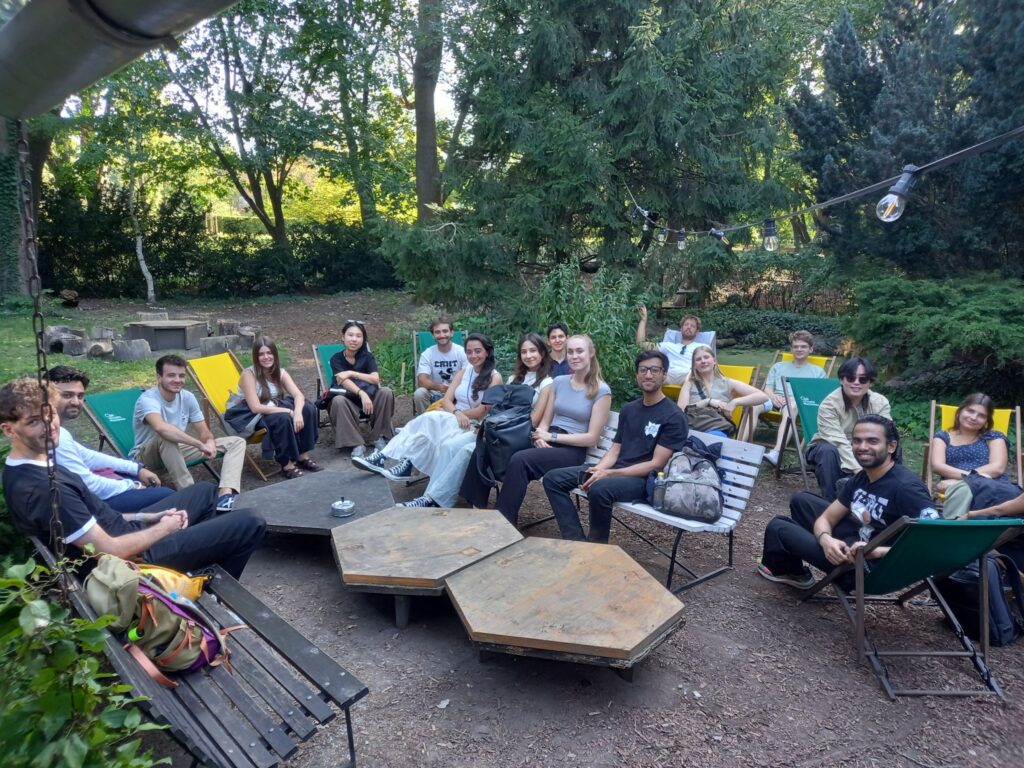
Jazdów: An Example of How Spaces Can Bring About Change
One of the highlights of the program was a field trip to Otwarta Pracownia Jazdów, a space located in one of the Finnish houses in the Jazdów neighborhood of Warsaw and managed by the academic association of the Faculty of Architecture at the Warsaw University of Technology. During the visit, Mateusz Potempski explained the studio’s day-to-day operations, its history, and its role in the life of the city and its residents, particularly in relation to the challenges of climate change.
The visit provided an opportunity to reflect on the importance of shared spaces, citizen-led initiatives, and the relationship between the built environment and the community. It is an example of how observing specific places can help us better understand urban challenges and imagine new ways to address them.
The program concluded with a final online phase, from September 14 to 18, dedicated to individual work and video presentations of the group projects. Students who successfully completed the program received 4 ECTS credits and a certificate.