


An exhibition that combines art, history and imagination to vindicate the role of women in science. Open to the public until May 29 in the Multipurpose Room of the CRAI.
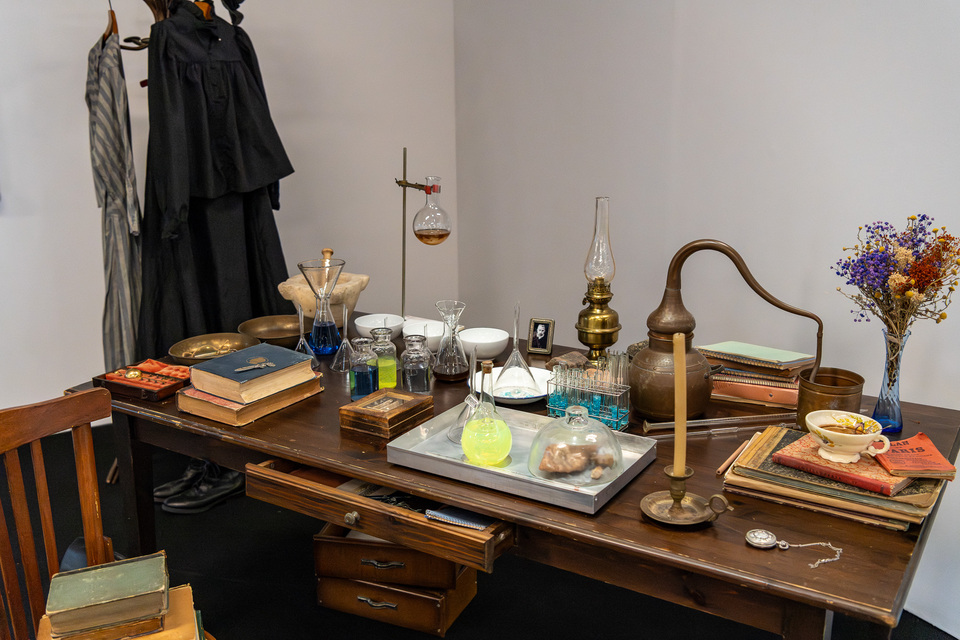
The Gandia Campus of the Universitat Politècnica de València (UPV) is hosting the exhibition Scientific artifacts. Women, identity, science and objects. The exhibition, inspired by the murals of the project Science Gifts and developed from the approach of the artistic and visual project of Artefacto Portraits, proposes a journey through the vital and professional universe of eleven women scientists through compositions created from significant objects, both personal and professional.
Among its protagonists are UPV professor and restorer Pilar Roig; Sara García Alonso, molecular biologist and ESA reserve astronaut; and Anna Lluch, breast cancer researcher and professor of Medicine.
Original objects full of stories
“We do not seek to represent history accurately, but to imagine it with rigor and care. We are interested in understanding and conveying the history, context, passions and legacy of each of the eleven women who are the protagonists of this project,” explain the curators and artists of the exhibition, Virginia Vinagre and Ella Ahonen.
To do so, they have documented in depth the life of each woman represented and, when possible, they have relied on objects personally donated by the protagonists or by their families and friends. In other cases, the objects have been recreated or located in antique shops, flea markets and collections of family and friends.
Pilar Roig, for example, has lent a restoration syringe, a box of her father’s antique weights and a book of poems by Francisco Brines dedicated by the author himself. For her part, Sara García Alonso has lent one of her official European Space Agency polo shirts, some guitar picks and a copy of her doctoral thesis. Anna Lluch, in turn, has contributed a painting dedicated to her, the medal of the Royal National Academy of Medicine and her doctor’s ring.honoris causa awarded by the Universitat Jaume I of Castelló.
Pioneers and benchmarks
The exhibition also pays tribute to other outstanding figures: Margarita Salas, biochemist and reference of molecular biology in Spain; Concepción Aleixandre, physician, gynecologist and pioneer inventor; Jane Goodall, primatologist, conservationist and explorer of animal behavior; Ada Lovelace, mathematician and precursor of computation; Katherine Johnson, key mathematician in the calculation of spatial trajectories; Hypatia of Alexandria, astronomer, philosopher and teacher; Jane Jacobs, urban thinker and activist; and Marie Curie, pioneer in the study of radioactivity.
Marie Curie is evoked through the tubes with radium salts, which she manipulated with fascination; Hypatia of Alexandria, through an abacus that refers to her astronomical and mathematical calculations; Jane Jacobs appears defending her city with banners, paint and megaphone; and Katherine Johnson performing complex orbital calculations with a Monroe calculator, surrounded by men in a NASA research center.
The exhibition Scientific artifacts. Women, identity, science and objects will be open to the public until May 29 in the Multipurpose Room of the CRAI of the Gandia Campus. Opening, Tuesday, May 5 at 12:30 pm.