

What are UPV Elections?
The UPV elections are the process through which the university community elects its representatives to the various governing and representative bodies of the Polytechnic University of Valencia.
Through voting, the university community exercises its democratic right to decide who will serve on the various single-member and collegial bodies that make up our university.
These electoral processes are essential to ensuring a university that is participatory, transparent, and committed to the needs of all its communities
What are the stages of the electoral process?
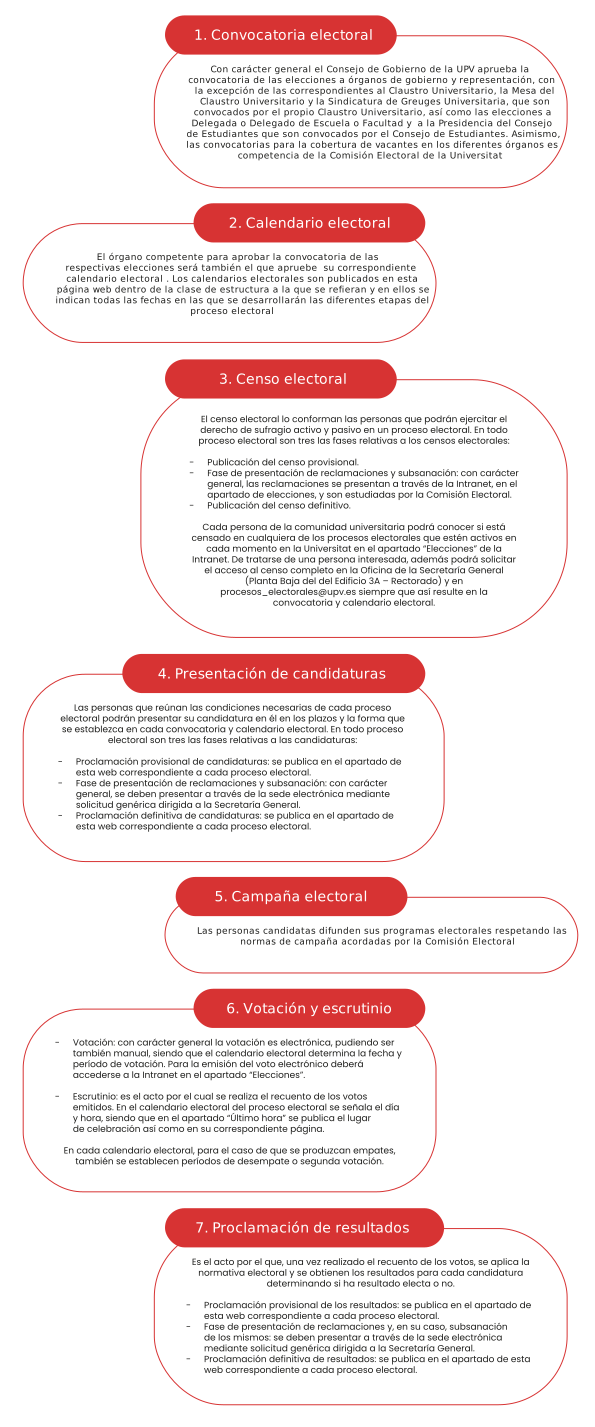
Regulations and Agreements
State Regulations
Regional Regulations
Regulations of the Polytechnic University of Valencia
Regulations and Agreements
Regulations and Agreements

State Regulations
- Organic Law 2/2023, of March 22, on the University System.
- Organic Law 5/1985, of June 19, on the General Electoral System.
Regional Regulations
Regulations of the Polytechnic University of Valencia
- Regulations on the Electoral System of the Polytechnic University of Valencia (BOUPV 2024/0154).
- Regulations of the University Senate of the Polytechnic University of Valencia (BOUPV 156/2022)
- Regulations of the University Ombudsman’s Office of the Polytechnic University of Valencia (BOUPV 2025/0109)
- Regulations of the Student Delegation of the Polytechnic University of Valencia (BOUPV No. 125, dated April 17, 2019)
Regulations and Agreements
Explanatory videos
Do you have questions about how to vote, which offices are up for election, or why it’s important to participate?
We explain it to you in a simple and visual way in these videos:
Frequently Asked Questions
Which UPV bodies are elected through an electoral process?
The UPV bodies that are elected through some form of electoral process are as follows:
Single-person governing and representative bodies:
- President (male or female)
- School Principal and Dean of the Faculty.
- Department Director (male or female)
- Director of the University Research Institute.
- Director of an independent research unit.
Governing bodies and collegial representative bodies:
- University Senate (and University Senate Executive Committee).
- Governing Council.
- School and Faculty Council
- Doctoral School Steering Committee.
- Department Council.
- Board of the University Research Institute.
- Scientific and Technical Advisory Board of the in-house research unit.
Governing and Participatory Bodies:
- School and Faculty Coordinator.
- Department Coordinator
- Coordinator of the University Research Institute.
- Coordinator of an in-house research unit
Ombudsman’s Office University Ombudsman’s Office
Students
- Student Representatives at the Schools.
- President of the Student Council.
Who can vote in UPV elections?
In the UPV’s electoral processes, the university community votes, which is composed of the following groups: university faculty who are civil servants and tenured faculty members, emeritus faculty, full-time non-tenure-track faculty and researchers, non-tenured part-time teaching and research staff, research staff, technical, management, administrative, and service staff, and students. Each of these groups may vote only in those elections specified by the applicable regulations for each case.
What is a weighted vote?
Weighted voting is a mechanism whereby, to determine the final result of an election, the votes received by each candidate must be grouped according to the demographic group to which they belong, so that the corresponding weighting coefficient can be applied to them. Thus, even if a candidate receives many more votes from a particular group, their influence is limited to the weighting percentage assigned to that group. At our university, this mechanism is applied in elections for the president, as well as in elections for school directors and deans.
If the description above isn’t clear enough, you could include an example and add something like this:
For example, in the case of elections for the position of rector, the following weighting coefficients are established:
- University faculty members who are civil servants and tenured professors: 59%
- Non-tenured teaching and research staff: 4%
- Non-tenure-track research staff: 7%
- Technical, management, administrative, and service staff: 9%
- Students: 21%
If the number of votes received by two candidates from each of the groups were as follows:
| Groups | Candidate A | Candidate B | Total votes |
| Government Officials and PPL | 600 | 400 | 1,000 |
| Non-permanent PDI | 300 | 450 | 750 |
| Non-permanent PI | 250 | 270 | 520 |
| PTGAS | 320 | 230 | 550 |
| Students | 2,500 | 3,700 | 6,200 |
| TOTAL | 3,970 | 5,050 | 9,020 |
Although Candidate B received 1,080 more votes than Candidate A, when the above weighting coefficients are applied, Candidate A would emerge as the winner with 54.07% of the weighted vote.
| Groups | Weighted Vote for Candidate A | Weighted Vote for Candidate B |
| Government Officials and PPL | 35.40% (600 / 1,000 × 0.59) | 23.60% (400 / 1,000 × 0.59) |
| Non-permanent PDI | 1.60% (300 / 750 × 0.04) | 2.40% (450 / 750 × 0.04) |
| Non-permanent PI | 3.37% (250 / 520 x 0.07) | 3.63% (270 / 520 × 0.07) |
| PTGAS | 5.24% (320 / 550 × 0.09) | 3.76% (230 / 550 × 0.09) |
| Students | 8.47% (2,500 / 6,200 × 0.21) | 12.53% (3,700 / 6,200 × 0.21) |
| TOTAL | 54.07% | 45.93% |
On the other hand, the first frequently asked question lists the following under “Governing Bodies and Participation”:
- School and Faculty Coordinator.
- Department Coordinator
- Coordinator of the University Research Institute.
- Coordinator of an in-house research unit
These coordinators report to the directors of each of the units, so it should be:
- Coordinator of school principals and college deans.
- Coordinator of Department Chairs
- Coordinator of the Directors of the University Research Institute.
- Coordinator of Directors of In-House Research Units
If I run for office, can I vote for myself?
Since voting is a personal and secret process, and given that there is currently no rule preventing candidates from voting for themselves, this option is possible in both electronic and in-person voting.