

Definition of Matrix
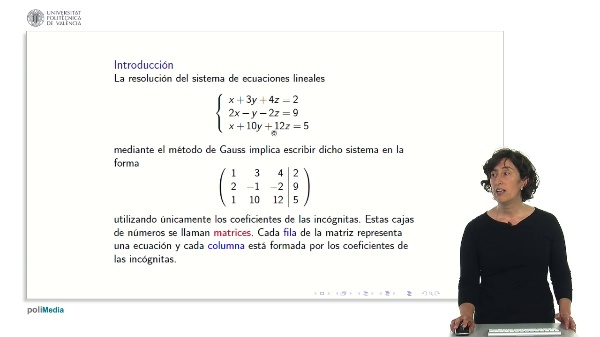
In this video, the presenter introduces the concept of matrices and explains various classes of matrices. The explanation begins with the context of linear equation systems and demonstrates how these can be represented using a matrix, highlighting that matrices facilitate simpler calculations. Examples include representing the connections between airports in different countries as a matrix, where each entry indicates the number of flights between them. The video describes a matrix as a collection of numbers arranged in rows and columns, clarifying that the size is denoted by the number of rows (m) times the number of columns (n). Matrices are shown to come in various sizes, including square matrices, where rows and columns are equal, and vectors, which are matrices of size one row by n columns or m rows by one column. The concept of equality in matrices is introduced; two matrices are equal if they match term-to-term. The presenter then proceeds to explain special types of matrices, such as the null matrix (all elements are zero), the transpose of a matrix (rows and columns exchanged), opposite matrices (element signs changed), and square matrices (same number of rows and columns). Specific focus is given to square matrices, including the main and secondary diagonals, diagonal matrices (with zeros outside the main diagonal), identity matrices (ones on the main diagonal, zeros elsewhere), symmetric matrices (same elements for mirrored indices about the main diagonal), and antisymmetric matrices (mirrored indices with opposite sign, zeros on the main diagonal). In summary, the video provides a foundational understanding of matrix concepts, the types of matrices, and their practical applications in solving linear systems and representing data in various fields.