

Regular matrices
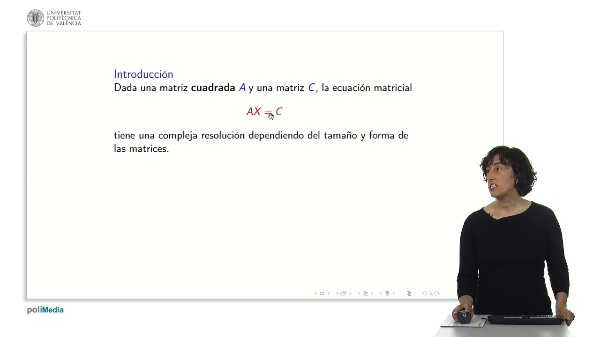
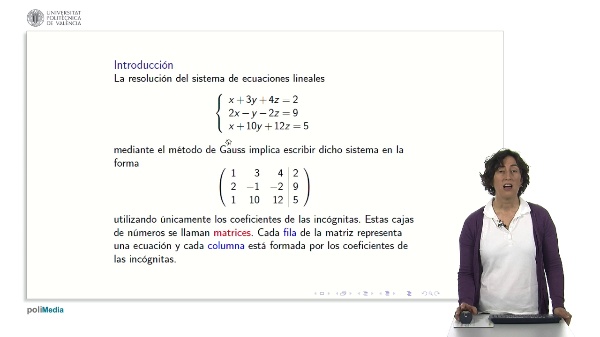
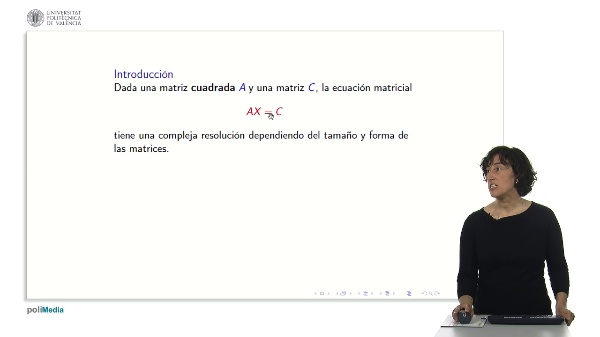
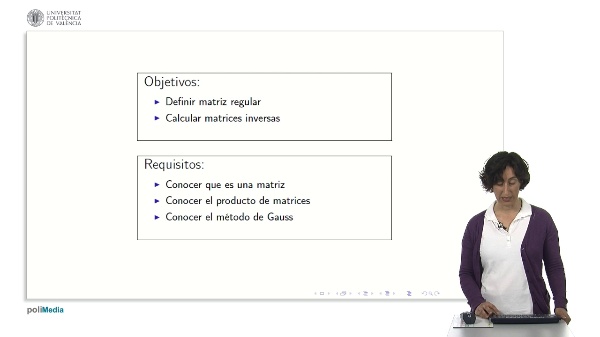
In this video, the instructor explains the concept of regular square matrices and how to calculate their inverses. The presentation covers the definition of square matrices, matrix multiplication, and the Gauss method for solving linear equation systems. A regular square matrix is defined as one that can be multiplied by another matrix to produce the identity matrix, both pre- and post-multiplication, and this other matrix is called the inverse matrix, denoted as "A" raised to the power of minus one. The video outlines important properties of inverse matrices, including their uniqueness and the fact that if a matrix is regular, so is its product with another regular matrix, and vice versa. Additionally, the inverse of a product of matrices is related to the inverses of the individual matrices. The lecturer introduces two methods to calculate inverse matrices: solving a system of equations and using the Gauss method. The former involves establishing a matrix equation and solving for the variables that will form the inverse matrix. However, this method becomes impractical for matrices of higher order. The Gauss method is preferred for its efficiency, particularly with larger matrices. It involves performing row operations on the matrix alongside an identity matrix to eventually isolate the inverse matrix. The video concludes by demonstrating the Gauss method with examples, showing how it can confirm whether a matrix is regular (invertible) or singular (non-invertible). The lecture emphasizes that the ability to find an inverse matrix is crucial for simplifying the process of solving matrix equations.

8:22 · 2021