

Operations with matrices
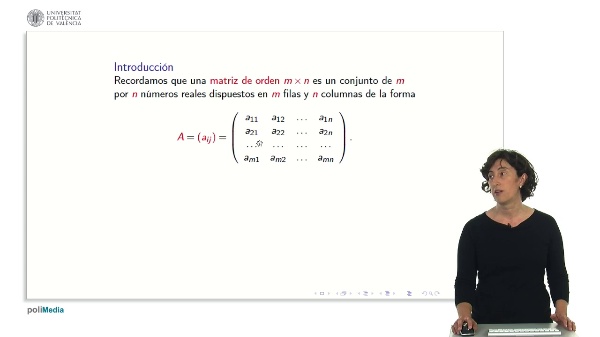
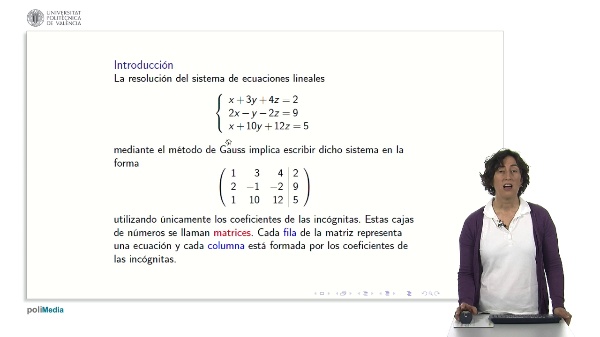
In this video, the presenter introduces the fundamental operations that can be performed with matrices: addition, multiplication by a scalar, and matrix multiplication. They begin by explaining that a matrix is an arrangement of numbers into rows and columns, denoted by a capital letter or a subscript notation to simplify the calculations in the operations. For addition, matrices must be the same order, meaning having the same number of rows and columns, and are added element by element. Addition of matrices has several properties such as being commutative, associative, having a matrix zero that doesn't change the result when added, and the existence of opposite matrices that lead to a zero matrix when added to the original. The multiplication of a matrix by a scalar involves multiplying each element of the matrix by a number. The presenter lists properties of scalar multiplication with matrices, which mirror those of real-number arithmetic, including distributive, associative, and the identity property of multiplication. Matrix multiplication is more complex as it involves producing a new matrix whose elements are the sums of products of corresponding elements of the rows of the first matrix and the columns of the second matrix. The presenter stresses that this operation requires the number of columns in the first matrix to be equal to the number of rows in the second matrix. Properties of matrix multiplication include associativity, the use of a unit identity matrix, and distribution over addition. Unlike addition, matrix multiplication is not commutative. The video concludes with a summary of the operations, emphasizing the three key processes of matrix addition, scalar multiplication, and matrix multiplication.

10:05 · 2025

10:29 · 2013