

Cramer's rule
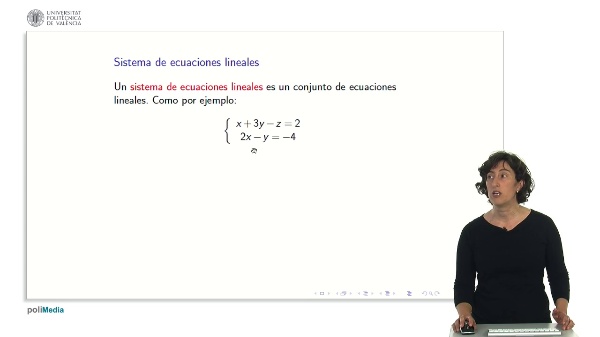
In this video, the presenter explains how to use Cramer's rule to solve systems of linear equations. The video begins by reviewing the concepts of linear equation systems and determinants of square matrices. It establishes the key criteria that a system must have the same number of equations as unknowns for Cramer's rule to be applicable, and the matrix must be invertible, indicated by a non-zero determinant. The video then illustrates how to express a system of linear equations as a matrix equation, showing the coefficients of the system and the independent terms and how these can be used to form the coefficient matrix, the vector of unknowns, and the vector of independent terms. Moving on to the application of Cramer's rule, the presenter details that it involves solving for each unknown in the system by calculating the determinant of a modified matrix where a column of the coefficient matrix is replaced by the vector of independent terms. This is then divided by the determinant of the original coefficient matrix. The rule is showcased with a practical example, where a system of linear equations is solved step by step using Cramer's rule. The video concludes by reinforcing that Cramer's rule can effectively solve a system of linear equations when it meets necessary conditions, providing determinants as a solution to the system.




14:45 · 2016