

Matrix Range
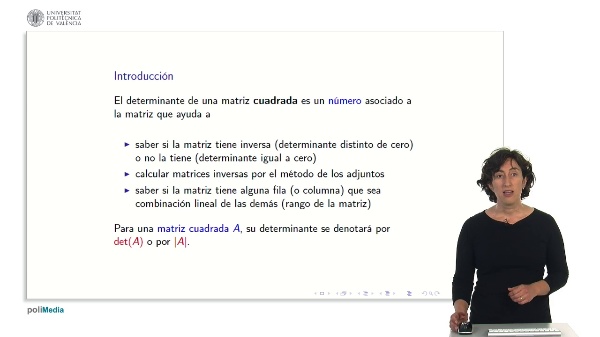
In this video, the presenter explains the concept of the range (or rank) of a matrix and how to calculate it using determinants. The determinant is firstly described as a numerical value associated with a square matrix that indicates whether the matrix has an inverse and if it contains rows or columns that are linear combinations of others. To calculate the range of a matrix, one must identify the largest square submatrix with a non-zero determinant, known as a minor of the matrix. The speaker uses the notation "det(A)" to represent determinants and describes the process of calculating minors of various orders from a given matrix "B" with dimensions n by m. By selecting "r" rows and "r" columns from the matrix "B," minors of less than order "r" are determined. An example is given with a 2x3 matrix "B," demonstrating the inability to create a minor of order 3, and thus revealing that the rank of "B" is 2. Another example uses a larger matrix "A," with 3 rows and 4 columns, to illustrate how to methodically determine the rank by evaluating minors of descending orders until a non-zero determinant is found. After calculating the minors of order 3 and finding them all to be zero, the determination moves to minors of order 2. Finding a minor of order 2 with a non-zero determinant concludes the rank of the matrix "A" is 2. The video concludes with a general strategy for calculating matrix ranks regardless of matrix size.