

Loudness, pitch, timbre
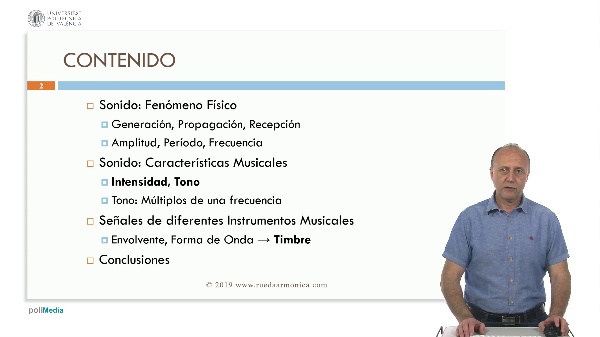
[EN] By considering a sound as a periodic signal, its height or pitch is defined by the frequency or number of oscillations per second, which is the inverse of the period. The intervals obtained when multiplying the frequency by certain natural numbers are indicated. It is also indicated which is the hearing range or frequency interval that can be perceived by the human ear. With respect to the signal amplitude, it corresponds to the loudness, which is commonly expressed in decibels. The concepts of envelope and waveform are explained, too. They determine the timbre of a sound, and several examples are provided for musical instruments and a human voice. Nuño Fernández, Luis (2026). Loudness, pitch, timbre. https://riunet.upv.es/handle/10251/238280 DER