
Do we vote with our heads or with our emotions?
The MACOM laboratory at the UPV analyses how image, fear and identity influence perceptions of candidates and the final vote.
[ 23/11/2026 ]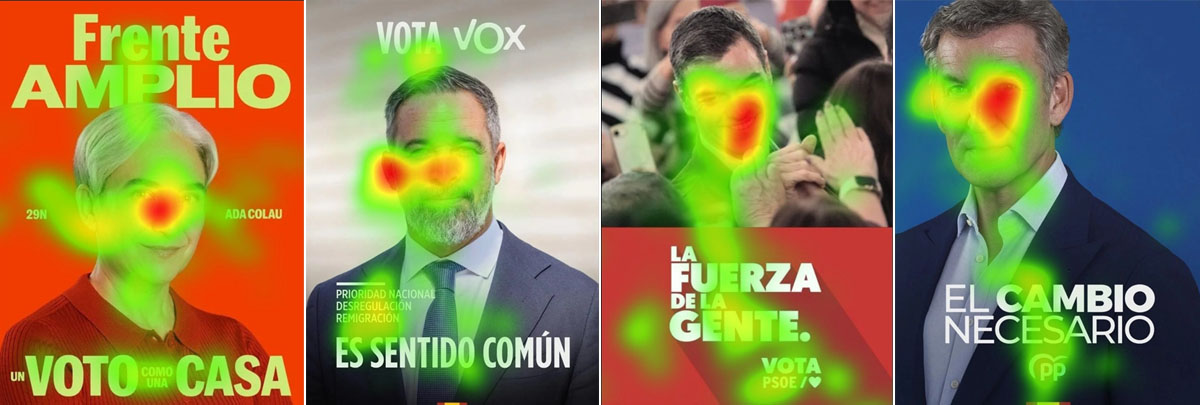
What impression does a candidate make on us before we know their proposals, simply by looking at their election posters? A team from the MACOM laboratory at the Universitat Politècnica de València (UPV), led by David Juárez, is studying how the electorate responds to different poster designs. The research focuses on the role of images and emotions in these first impressions.
To this end, the team at the MACOM laboratory on the UPV's Alcoy campus uses a technique known as 'face coding'. This enables them to identify visible facial changes, such as eyebrow or mouth movements, while participants view the posters. According to Juárez, these expressions provide clues as to their reaction to the election material.
"A candidate's appearance can influence voting intentions because we form impressions of competence, trust and leadership before we have sufficient information about their proposals," says David Juárez. This initial assessment involves eye contact, posture, clothing, apparent age, and physical appearance. And the same expression can be interpreted differently depending on the campaign context.
In their study, the UPV team analysed the reactions of 80 participants to the posters of the four main candidates ahead of the elections on 29 November: Pedro Sánchez, Alberto Núñez Feijóo, Ada Colau and Santiago Abascal.
An impression formed in a second
Juárez explains that in 2005, a study published in Science by Alexander Todorov and his team showed that just one second of exposure to a candidate's face was enough for participants to form an impression of their competence. "In the US Conference elections analysed, these impressions allowed the outcome of the races to be predicted better than by chance. And in 2011, Gabriel Lenz and Chappell Lawson observed that the link between candidates' images and voting decisions was stronger amongst people with less political knowledge and greater exposure to television," adds Juárez.
The role of emotions in campaigns
For the UPV researcher, image forms part of a broader communication strategy that also encompasses gestures, audiovisual messages, and identification with a group. "The sense of belonging to a group is one of the key emotional resources in electoral communication. This ability to connect with the public helps to explain why an image or a message can provoke an immediate reaction, before the voter has even assessed the candidates' proposals," concludes David Juárez.
Outstanding news
 Study a degree at the best technological university in Spain
The Universitat Politècnica de València is ranked number 1 among Spanish technology universities, according to the Shanghai ranking
 Highly Cited Researchers 2025
Avelí Corma, Juan Bisquert and Luis Guanter, the international scientific elite with a Universitat Politècnica de València hallmark
 Historic Milestone in Spanish Higher Education
The UPV inaugurates the Beihang Valencia Polytechnic Institute, the first Spanish university center in China
 Study in English
The UPV offers eight degrees, 16 master's and 650 courses in English for the 2025-26 academic year
 A Latin Grammy... with the UPV hallmark
'Music teaches us to listen and live together,' says Rafael Serrallet, Doctor of Music at the UPV, awarded in Las Vegas as the author of the Best Instrumental Album of 2025
 THE Impact Ranking
The UPV, the Spanish university with the greatest social and economic impact in the world