
A study by the UPV identifies the factors that exacerbated the 2024 flash flood in l'Horta Sud.
An analysis of the event reveals that the near-simultaneous rise in water levels in several ravines, sediment transport, and urban development in flood-prone areas were key factors in understanding the scale of the event.
[ 27/10/2026 ]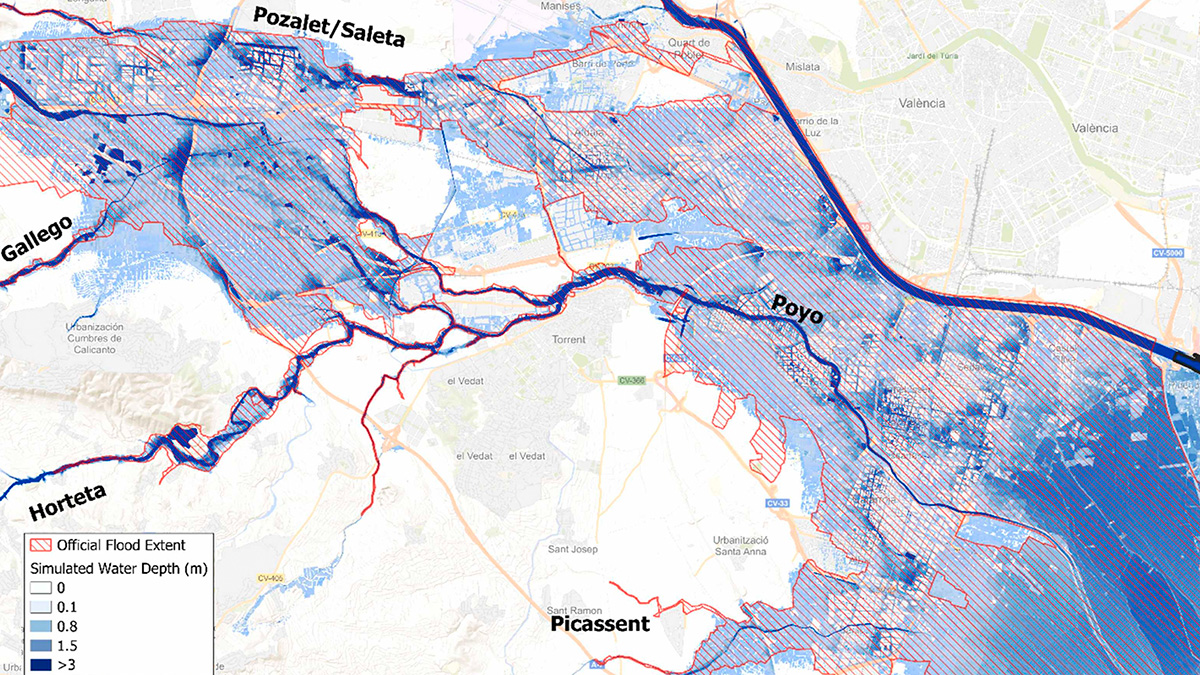
Ahead of the second anniversary of the DANA, the study estimates the system's combined discharge at around 7,000 cubic metres per second.
The severity of the flooding experienced by l'Horta Sud on 29 October 2024 can be explained by a combination of exceptional rainfall, near-simultaneous rises in several ravines, and a heavily urbanised area. This is the conclusion reached by a study carried out by the Institute of Water and Environmental Engineering at the Universitat Politècnica de València (UPV), which reconstructs the event using rainfall data and mathematical models capable of simulating how rain is transformed into runoff, how water carries sediment, and how the flood spreads across the territory.
The study, carried out by Carles Beneyto, Jaime Alberto Cachay-Melly, José Ángel Aranda, Miguel Á. Eguibar, Rafael García-Bartual and Félix Francés, researchers at IIAMA-UPV, has been published in the *Journal of Hydrology: Regional Studies*.
Coinciding with the second anniversary of the DANA on 29 October, the study provides a better understanding of what happened and offers lessons to strengthen prevention measures against Mediterranean flash floods.
The convergence of the floods multiplied the water inflows
One of the main conclusions is that the flood cannot be explained solely by the flow rate of the Poyo ravine. In fact, most of the ravines analysed reached their peak flows between 18:30 and 19:50, causing large quantities of water from different watercourses to converge within a very short timeframe, thereby exacerbating the flood.
"To understand the scale of the flooding, we need to analyse how the various ravines responded and when their water levels peaked. The convergence of large volumes of water and sediment within a very short timeframe was a key factor in exacerbating the scale of the flooding," explains Carles Beneyto, lead author of the study.
In this regard, the simulations indicate that the system's combined inflow was approximately 7,000 cubic metres per second before the main overflows.
"This figure represents a combined estimate of the inflows from the ravines, not a flow rate measured at a single point," states IIAMA research.
Furthermore, the sequence of rainfall proved decisive, as the morning's rain had already saturated the catchment areas, "which led to a faster and more intense response to the exceptional rainfall in the afternoon", explains Beneyto.
Sediment and urban development exacerbated the effects
The study estimates that sediments accounted for approximately 7% of the total flood volume, rising to around 19% at peak flow rates.
"These materials increased resistance to flow and contributed to reducing the drainage capacity of the watercourses, exacerbating the effects of the flooding," notes Félix Francés, Professor of Hydraulic Engineering and a researcher at IIAMA.
Furthermore, development in floodplains, infrastructure, and artificial barriers influenced the paths water took and the depths it reached.
"The results show that the impacts depended both on the magnitude of the floods and on their interaction with the landscape," states Félix Francés.
To reconstruct these processes, the researchers used the TETIS hydrological model, developed at IIAMA, and high-resolution hydraulic simulations. The reconstruction consistently reproduced the general extent of the observed flooding, although it has limitations in representing temporary obstacles and urban details that locally altered water flow.
Planning that takes all processes into account
In their study, which received funding from the Ministry of Science and Innovation through the TETISPREDICT project, the UPV team warns that episodes of this complexity cannot be assessed solely through statistical estimates of flow rates at specific points,
"One of the main lessons is that we must assess rainfall, catchment response, sediment transport and land use together. Integrating these processes is essential for improving risk assessment, spatial planning and preventive measures against extreme flooding in the Mediterranean region," concludes Félix Francés.
Reference
Reconstruction of the October 2024 flood in l'Horta Sud (Valencia, Spain). Carles Beneyto, Jaime Alberto Cachay-Melly, José Ángel Aranda, Miguel A. Eguibar, Rafael García-Bartual, Félix Francés. Journal of Hydrology: Regional Studies. DOI: https://www.sciencedirect.com/science/article/pii/S2214581826006919
Outstanding news
 Study a degree at the best technological university in Spain
The Universitat Politècnica de València is ranked number 1 among Spanish technology universities, according to the Shanghai ranking
 Highly Cited Researchers 2025
Avelí Corma, Juan Bisquert and Luis Guanter, the international scientific elite with a Universitat Politècnica de València hallmark
 Historic Milestone in Spanish Higher Education
The UPV inaugurates the Beihang Valencia Polytechnic Institute, the first Spanish university center in China
 Study in English
The UPV offers eight degrees, 16 master's and 650 courses in English for the 2025-26 academic year
 A Latin Grammy... with the UPV hallmark
'Music teaches us to listen and live together,' says Rafael Serrallet, Doctor of Music at the UPV, awarded in Las Vegas as the author of the Best Instrumental Album of 2025
 THE Impact Ranking
The UPV, the Spanish university with the greatest social and economic impact in the world