
New catalyst crucial for the chemical industry
The ITQ (CSIC - UPV) has discovered a new way to produce key raw materials for the chemical industry more sustainably
[ 21/10/2026 ]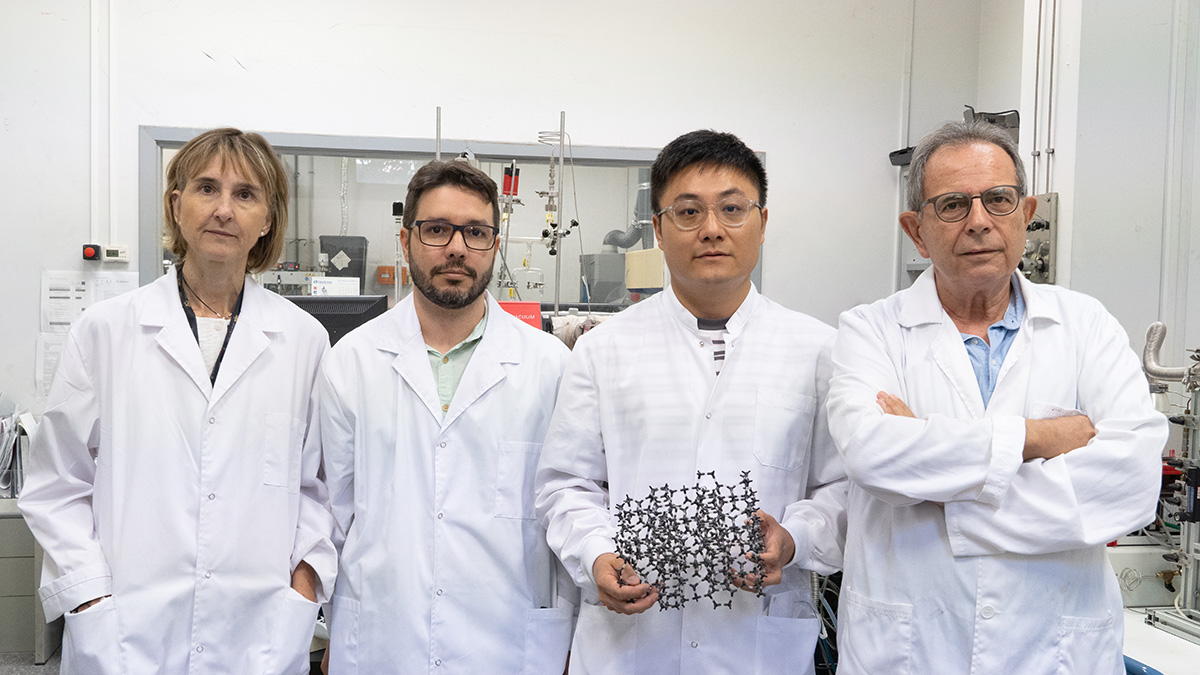
A research group at the Research Institute for Chemical Technology (ITQ), a joint centre of the Spanish National Research Council (CSIC) and the Universitat Politècnica de València (UPV), has developed a new catalyst – a material that accelerates chemical reactions – to produce key raw materials for the chemical industry more sustainably. The catalyst is used in hydroformylation, one of the most important reactions in the chemical industry, which transforms cheap and abundant compounds – known as olefins – into aldehydes, the raw materials used to manufacture thousands of everyday products. Perfumes, food flavourings, plastics, detergents and medicines are all based on these molecules. The research has been published in the journal Nature.
Hydroformylation is a chemical reaction that transforms simple molecules derived from petroleum or plants into more complex and useful ones. It does so by adding a carbon atom, along with hydrogen and oxygen, to form aldehydes – molecules that occur naturally in many living organisms and are widely used by industry to manufacture plastics, detergents, perfumes and medicines. Catalysts are used to facilitate this process; they are materials that accelerate the reaction and direct it so that the desired products are formed without being consumed themselves. In industry, catalysts based on metals such as rhodium or cobalt are commonly used.
"The reaction was discovered in 1938 by the German chemist Otto Roelen and, since then, has become one of the fundamental processes in the chemical industry for producing aldehydes from olefins," explains Avelino Corma, an ad honorem researcher at the CSIC's ITQ. "Currently, rhodium-based industrial processes typically use homogeneous catalysts and phosphine-type ligands, which present significant drawbacks in terms of toxicity and catalyst recovery," says Corma.
More selective and sustainable
The discovery made by his research group at the ITQ represents a paradigm shift in established knowledge of hydroformylation. Specifically, they have succeeded in stabilising isolated rhodium active sites in an oxidised state within the channels of an MFI-type zeolite: individual rhodium atoms positioned inside the tiny channels of a zeolite (a mineral with a structure full of pores and microscopic channels) where they act as catalysts to transform molecules into useful products. This site exhibits activity and selectivity towards the aldehyde that are superior to those of other conventional rhodium active sites.
The ITQ team has also demonstrated that it is possible to control the selectivity of the reaction by blocking less-selective active sites. "The selective blocking of sites helps to enhance the activity of the site responsible for the high yield of linear aldehyde," explains Patricia Concepción, a CSIC researcher at the ITQ. This mechanism provides an additional tool for adjusting the catalyst's behaviour in response to process conditions and raw material characteristics. In other words, it opens up new possibilities for the design of more selective and efficient catalysts.
An alternative to conventional catalysts
Compared with the systems currently in use, the new catalyst offers several advantages. These include the use of a reduced amount of rhodium, the absence of toxic phosphine ligands, the possibility of recovering and reusing the catalyst, a simple and potentially scalable synthesis, and high selectivity towards the linear aldehyde. Another important aspect is that the process can be carried out under mild reaction conditions, at around 80 °C, and the catalyst maintains its activity and selectivity across a wide range of olefins. This versatility is particularly interesting for future industrial application, as it allows different raw materials to be used to obtain various aldehydes of interest.
In addition to Avelino Corma and Patricia Concepción, the study involved Reisel Millán and Minjie Zhao from the ITQ; Laura Simonelli and Alina Skorynina from the ALBA Synchrotron; and José Juan Calvino and Miguel López Haro, both from the University of Cádiz.
Reference:
Minjie Zhao, Reisel Millán, Alina Skorynina, Laura Simonelli, Miguel López Haro, José Juan Calvino, Patricia Concepción & Avelino Corma. Rh3+ stabilised in KRh@MFI catalyses regioselective hydroformylation. Nature (2026). https://doi.org/10.1038/s41586-026-11136-9
Outstanding news
 Study a degree at the best technological university in Spain
The Universitat Politècnica de València is ranked number 1 among Spanish technology universities, according to the Shanghai ranking
 Highly Cited Researchers 2025
Avelí Corma, Juan Bisquert and Luis Guanter, the international scientific elite with a Universitat Politècnica de València hallmark
 Historic Milestone in Spanish Higher Education
The UPV inaugurates the Beihang Valencia Polytechnic Institute, the first Spanish university center in China
 Study in English
The UPV offers eight degrees, 16 master's and 650 courses in English for the 2025-26 academic year
 A Latin Grammy... with the UPV hallmark
'Music teaches us to listen and live together,' says Rafael Serrallet, Doctor of Music at the UPV, awarded in Las Vegas as the author of the Best Instrumental Album of 2025
 THE Impact Ranking
The UPV, the Spanish university with the greatest social and economic impact in the world