

ARRELS Chair
Innovation and local governance come together for climate resilience in a chair that involves collaboration among the UPV, UV, CDTI, and the Innpulso Network
[ 05/10/2026 ]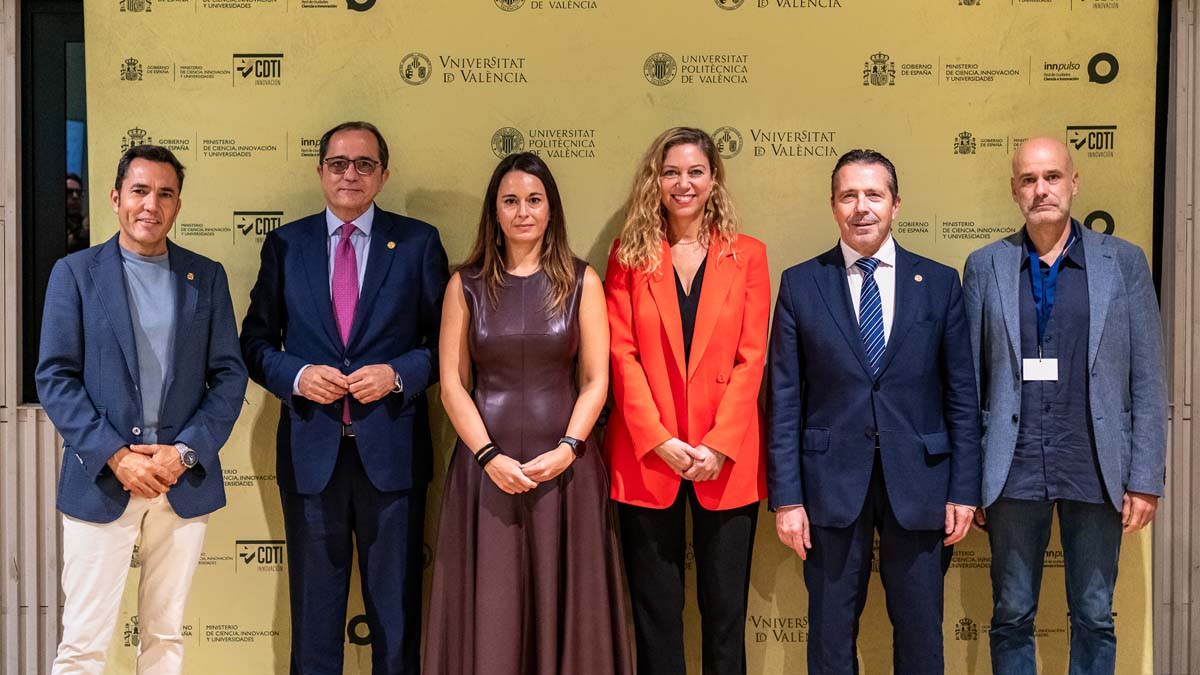
The ARRELS Chair in Innovation and Local Governance for Climate Resilience has been established to promote and develop innovation from the perspective of climate resilience and local governance to address the complexity of climate change.
It stems from an agreement between the Universitat Politècnica de València (UPV), the University of Valencia (UV), the Centre for Technological Development and Innovation (CDTI) and the Innpulso Network Association. The agreement was signed electronically last July and formalised on Monday, 5 October, with a physical signing ceremony at CaixaForum in Valencia, as part of the OECD Conference 'From crisis to recovery: Strengthening regional disaster resilience'.
A much-needed Chair
In his speech, the Rector of the UPV, José E. Capilla, spoke of the very real risk posed by "a possible disruption to the North Atlantic Current" due to climate change, which would lead to an ice age and rising sea levels, affecting numerous coastal communities. "Therefore, I welcome any work carried out by a Chair such as this one, which I also find fascinating as an academic; it is a necessary Chair, and here at the Universitat Politècnica de València we will do everything we can to innovate and generate new ideas."
The Rector of the University of Valencia (UV), Juan Luis Gandía, emphasised that this agreement represents the consolidation of an innovation model that places the UV's knowledge at the service of climate resilience and the well-being of Valencian society. "It is an opportunity to integrate research, education and local public action within a single project," he noted.
Innovation rooted in the community
This new Chair aims to promote innovation rooted in the community, where the transition towards climate resilience is boosted from within local communities, their business sector and their technological development capabilities. The objective is co-creation alongside local councils, businesses, technology centres and citizens. The objective is to generate solutions that emerge from an ongoing dialogue between technological knowledge and the lived experience of those who inhabit and govern the community.
Affiliated with INGENIO
The ARRELS Chair is affiliated with the Research Institute for the Management of Innovation and Knowledge (INGENIO, UPV-CSIC) and collaborates with the Innpulso network, which brings together Spanish local authorities from different regional contexts. The CDTI, as the state agency for technological development and innovation, provides the Chair with €75,000 annually for the four-year duration of the programme at each public university. The UPV and the UV contribute teaching staff and infrastructure, with each estimated at €16,000 per year.
The planned activities are organised around five pillars: 1) Promoting applied municipal innovation through the launch of Living Labs, risk mapping, and the mapping of vulnerabilities and innovative initiatives, as well as support for community-based initiatives linked to the university community; 2) Inter-municipal collaboration and mutual learning through postgraduate training for municipal technicians and public leadership for reconstruction, and the development of a bank of solutions and resources for municipalities; and the organisation of an annual ARRELS Conference; 3) Applied research; 4) Dissemination and outreach; and 5) Institutionalisation and internationalisation through the exchange of experiences with other European municipalities affected by flooding, including visits and meetings with those responsible for implementing resilient solutions.
With the Working Group on Innovation for Climate Resilience
ARRELS's activities are coordinated with the Working Group on Innovation for Climate Resilience, which was approved at the INNPULSO Network's plenary meeting in February this year. It is a forum for cooperation between local authorities and stakeholders in the innovation system, supported by the public universities of Valencia. Three towns share leadership of this network: Riba-roja de Túria, Alzira and Torrent. They play a driving role in promoting and coordinating activities alongside the municipalities affected by the DANA and other Innpulso towns.
Outstanding news
 Study a degree at the best technological university in Spain
The Universitat Politècnica de València is ranked number 1 among Spanish technology universities, according to the Shanghai ranking
 Highly Cited Researchers 2025
Avelí Corma, Juan Bisquert and Luis Guanter, the international scientific elite with a Universitat Politècnica de València hallmark
 Historic Milestone in Spanish Higher Education
The UPV inaugurates the Beihang Valencia Polytechnic Institute, the first Spanish university center in China
 Study in English
The UPV offers eight degrees, 16 master's and 650 courses in English for the 2025-26 academic year
 A Latin Grammy... with the UPV hallmark
'Music teaches us to listen and live together,' says Rafael Serrallet, Doctor of Music at the UPV, awarded in Las Vegas as the author of the Best Instrumental Album of 2025
 THE Impact Ranking
The UPV, the Spanish university with the greatest social and economic impact in the world