

Against sexism in memes and TikTok videos
Researchers at the Universitat Politècnica de València (UPV) develop an AI system that helps detect sexism in this content.
[ 15/10/2026 ]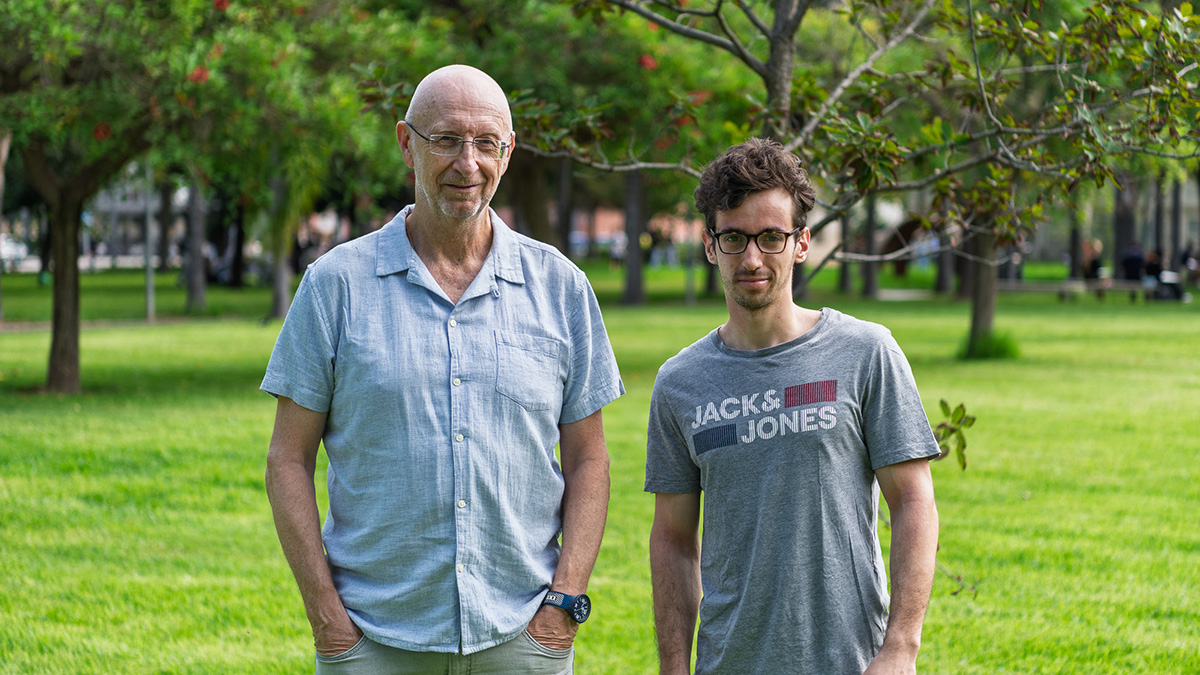
A team of researchers from the PRHLT group at the Universitat Politècnica de València (UPV) has developed a new artificial intelligence system that helps detect sexist content and messages in memes and TikTok videos. The system combines analysis of the content itself with data on viewers' brain activity, eye movements and heart rate.
"Very often, both memes and TikTok videos contain content in which sexism is disguised through humour, irony, stereotypes or seemingly harmless comments. Furthermore, to interpret a video correctly, it is necessary to consider language, on-screen text, images, gestures and context simultaneously. Our system helps to detect and flag such sexist content more effectively than the systems currently in use," says Iván Arcos, a researcher at PRHLT.
What happens when we view sexist content?
To develop the system, the researchers analysed over 4,000 memes and 2,500 TikTok videos in Spanish and English, drawn from the datasets of EXIST, an international competition on detecting sexism on social media. "We worked with ten participants in the video study and sixteen in the meme study, who viewed this content while their responses were recorded using eye-tracking, electroencephalography (EEG) and heart rate monitoring," explains Paolo Rosso, a Professor in the Computer Systems and Computation Department and a member of ValgrAI (Valencian Graduate School and Research Network of Artificial Intelligence).
And, as the study reports, reactions to sexist and non-sexist content were very different. Sexist videos generated, amongst other effects, longer reaction times and an increase in eye fixations, as well as differences in certain patterns of brain activity. In particular, the average number of eye fixations increased in videos depicting or judging sexist situations.
Rapid eye movements from one point to another (saccades) and blinks followed the same trend, and heart rate showed greater fluctuations in response to sexist videos. A similar pattern was observed in the case of memes. "The response also varied depending on the type of sexism. The study distinguishes, for example, between direct sexism and content that depicts or judges sexist situations, the correct interpretation of which requires a better understanding of the message's intention and context," explains Iván Arcos.
According to the researchers, these differences in gaze suggest greater cognitive load: the more difficult it is to interpret a piece of content, the more gaze pauses and shifts, as the viewer scans the screen for clues (text, gestures, context) before deciding what it means. This is why the effect is greatest in videos that depict or judge sexist situations, during which one must also deduce the stance of the person who posted it.
"The EEG records the brain's electrical activity via 16 electrodes, or channels, placed on the head, and allows us to distinguish between slow and fast brain waves. During viewing of a sexist video, the slow waves (delta, theta and alpha) decreased in intensity in the channels of the central and parietal regions – that is, at the top and upper back of the head. It may seem contradictory, but it is a sign that the brain is paying closer attention: these waves, particularly alpha waves, are more intense when the brain is relaxed and diminish when it is concentrating," explains Iván Arcos.
In contrast, during videos depicting or judging sexist situations – as opposed to those showing direct sexism – fast waves (beta and gamma) increased in the channels of the frontal region and the right side of the head. "These waves are associated with more elaborate reasoning. Direct sexism simply needs to be recognised, but in these videos the brain has to analyse the context to understand what the person who posted them means," adds Arcos.
Meanwhile, videos depicting sexual violence reduced the intensity of brain waves across all channels where differences were detected, particularly on the right side of the head. As was the case with sexist videos in general, this reduction indicates greater brain engagement, in this instance, in response to emotionally very distressing content. Furthermore, the fact that this activity is concentrated on the right side is consistent with previous studies showing that the two hemispheres do not process emotions in the same way.
To identify sexist content and take action against it
Based on these differences, the UPV team developed an artificial intelligence model that combines physiological signals with textual and visual information extracted from the content. The video study has just been presented at the 42nd International Conference of the Spanish Society for Natural Language Processing (SEPLN 2026), and the meme study at the Language Resources and Evaluation Conference (LREC 2026). Compared with a system based solely on text and images, incorporating physiological responses improved the system's ability to detect whether a video was sexist by around 4%, and improved by more than 6% both the distinction between direct sexism and content that depicts or judges sexist situations and the classification into different categories of sexism. The greatest improvements were seen precisely in the most difficult cases, when it was necessary to interpret the message's intention or distinguish between the most ambiguous categories, such as objectification or ideological inequality. In the case of memes, the improvement reached 26.3% in the most difficult category to identify: misogyny and non-sexual violence. "Thus, by better detecting sexism – including the most implicit or disguised forms – our tool could help platforms identify this content and take action against it," concludes Paolo Rosso.
References
Arcos, I.; Rosso, P.; Gomis, E. "Human-Centered Multimodal Fusion for Sexism Detection in Memes with Eye-Tracking, Heart Rate, and EEG Signals". In: Proceedings of the Language Resources and Evaluation Conference (LREC 2026), pp. 9830–9840 (2026).
Arcos, I.; Rosso, P. "Human-Centered Multimodal Fusion for Sexism Detection in TikTok Videos with Eye-Tracking, Heart Rate, and EEG Signals". Procesamiento del Lenguaje Natural, 77, pp. 357–369 (2026).
Outstanding news
 Study a degree at the best technological university in Spain
The Universitat Politècnica de València is ranked number 1 among Spanish technology universities, according to the Shanghai ranking
 Highly Cited Researchers 2025
Avelí Corma, Juan Bisquert and Luis Guanter, the international scientific elite with a Universitat Politècnica de València hallmark
 Historic Milestone in Spanish Higher Education
The UPV inaugurates the Beihang Valencia Polytechnic Institute, the first Spanish university center in China
 Study in English
The UPV offers eight degrees, 16 master's and 650 courses in English for the 2025-26 academic year
 A Latin Grammy... with the UPV hallmark
'Music teaches us to listen and live together,' says Rafael Serrallet, Doctor of Music at the UPV, awarded in Las Vegas as the author of the Best Instrumental Album of 2025
 THE Impact Ranking
The UPV, the Spanish university with the greatest social and economic impact in the world