

Atrial cardiomyopathy
An artificial intelligence model developed by the UPV achieves 89% accuracy in identifying arrhythmia-related abnormalities in atrial tissue
[ 28/09/2026 ]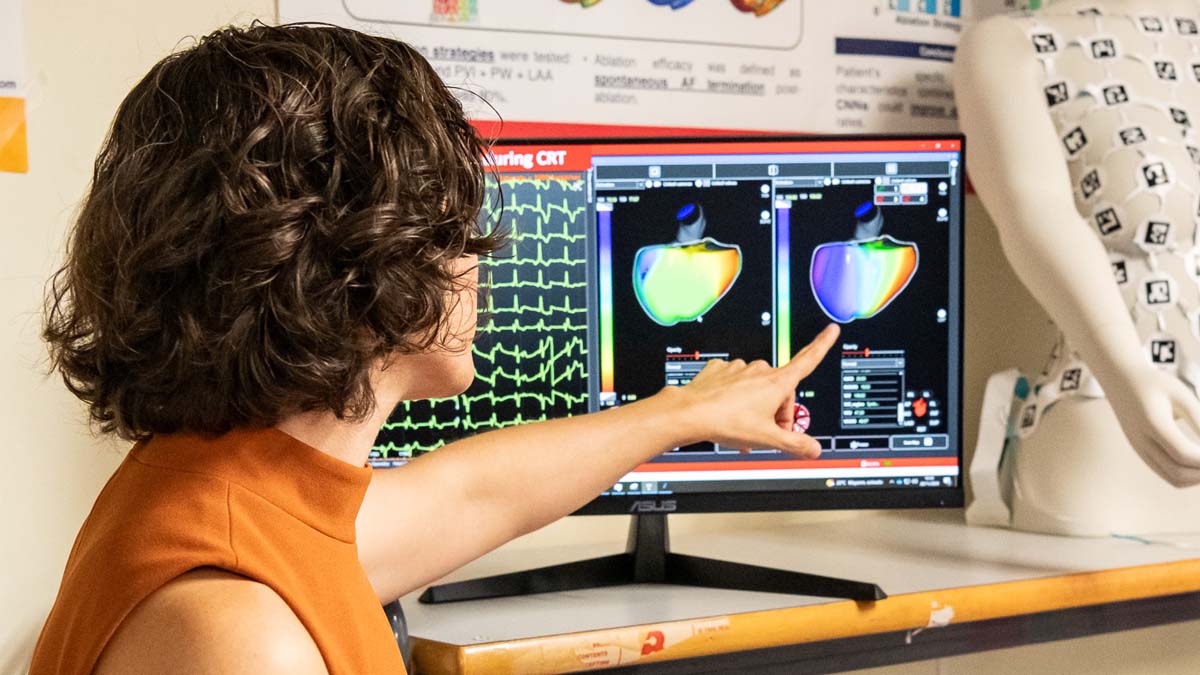
Researchers from the COR group at the Institute of Information and Communications Technologies (ITACA) of the Universitat Politècnica de València (UPV) have developed an artificial intelligence model capable of localising and quantifying tissue abnormalities associated with atrial cardiomyopathy using electrical recordings from the body's surface.
The system, based on graph neural networks (Graph Neural Networks, GNNs), achieved an accuracy of 89% in localising the affected areas and 84% in determining the extent of damage to atrial tissue. Furthermore, it maintained this capability when analysing anatomical structures not used during its training.
The next step: validating it in patients
The study is still a proof of concept developed using simulated data; therefore, its results do not imply immediate clinical application. The next step will be to validate the model using records from real patients. As the study itself points out, "prospective validation using clinical records is required before this approach can be transferred to treatment planning applications". If the results are confirmed in clinical trials, this technology could contribute to the development of new tools for characterising atrial tissue without invasive procedures and provide further information for the study and treatment of conditions associated with atrial cardiomyopathy.
The study, published in the scientific journal Discover Computing, is led by María Macarulla-Rodríguez, a researcher at COR-ITACA, and also involves Jorge Sánchez, Andreu M. Climent and María S. Guillem, researchers at ITACA and members of Corify Care S.L., as well as Cristian Barrios Espinosa and Axel Loewe (Karlsruhe Institute of Technology), and Ernesto Zacur (Corify Care S.L.).
"The main conclusion of the study is that the combination of body surface electrical maps, spatio-temporal analysis and graph neural networks shows great potential for the non-invasive characterisation of atrial cardiomyopathy," highlights María Macarulla, lead author of the paper.
A new approach to studying atrial tissue
Atrial cardiomyopathy encompasses electrical and structural abnormalities in atrial tissue, such as fibrosis, which are linked to the onset and progression of atrial fibrillation, one of the most common cardiac arrhythmias. "Knowing where the altered tissue is located and how extensive it is can help us better understand the disease and, potentially, plan treatments such as ablation," says María S. Guillem, director of ITACA and a participant in the study.
Currently, techniques such as invasive intracardiac electroanatomical mapping or certain magnetic resonance imaging (MRI) scans can be used to characterise these abnormalities. The new approach proposes using body surface potential maps (BSPM), obtained via electrodes placed across the torso to record the heart's electrical activity. "Artificial intelligence then analyses how these signals are distributed in space and how they evolve over time to identify patterns related to the location and extent of the affected tissue," explains the director of ITACA.
89 per cent accuracy in localisation
To develop and evaluate the model, the team worked with 14,400 simulated body surface potential maps, generated from different atrial and torso anatomies and with varying degrees and localisations of atrial cardiomyopathy. "In the baseline configuration, with 128 electrodes, the model achieved 89% accuracy in localising the affected tissue, with mean values of 89% sensitivity and 90% specificity," highlights María Macarulla.
One of the most significant findings is that the system managed to maintain good performance when analysing anatomies different from those used to train it, a crucial aspect for future applications in people with different anatomical characteristics. "The model also obtained an overall accuracy of 84 per cent in determining the extent of the affected tissue. Furthermore, we found that its performance remains relatively stable when signal quality decreases, which suggests a certain robustness against noise," says María Macarulla.
The results also show that the anatomical diversity of the training data is a key factor: incorporating a wider variety of atrial and torso models improved the system's classification ability.
Reference: A graph neural network framework for characterizing atrial cardiomyopathy from body surface potential maps. María Macarulla-Rodríguez, Jorge Sánchez, Cristian Barrios Espinosa, Axel Loewe, Ernesto Zacur, Andreu M. Climent & María S. Guillem. https://tinyurl.com/yc8ye2z3
Outstanding news
 Study a degree at the best technological university in Spain
The Universitat Politècnica de València is ranked number 1 among Spanish technology universities, according to the Shanghai ranking
 Highly Cited Researchers 2025
Avelí Corma, Juan Bisquert and Luis Guanter, the international scientific elite with a Universitat Politècnica de València hallmark
 Historic Milestone in Spanish Higher Education
The UPV inaugurates the Beihang Valencia Polytechnic Institute, the first Spanish university center in China
 Study in English
The UPV offers eight degrees, 16 master's and 650 courses in English for the 2025-26 academic year
 A Latin Grammy... with the UPV hallmark
'Music teaches us to listen and live together,' says Rafael Serrallet, Doctor of Music at the UPV, awarded in Las Vegas as the author of the Best Instrumental Album of 2025
 THE Impact Ranking
The UPV, the Spanish university with the greatest social and economic impact in the world