

Science captivates children at the Viveros Gardens in Valencia
The UPV and the main scientific organisations in the Valencian Community have invited schools and families to experience research in a fun way
[ 25/09/2026 ]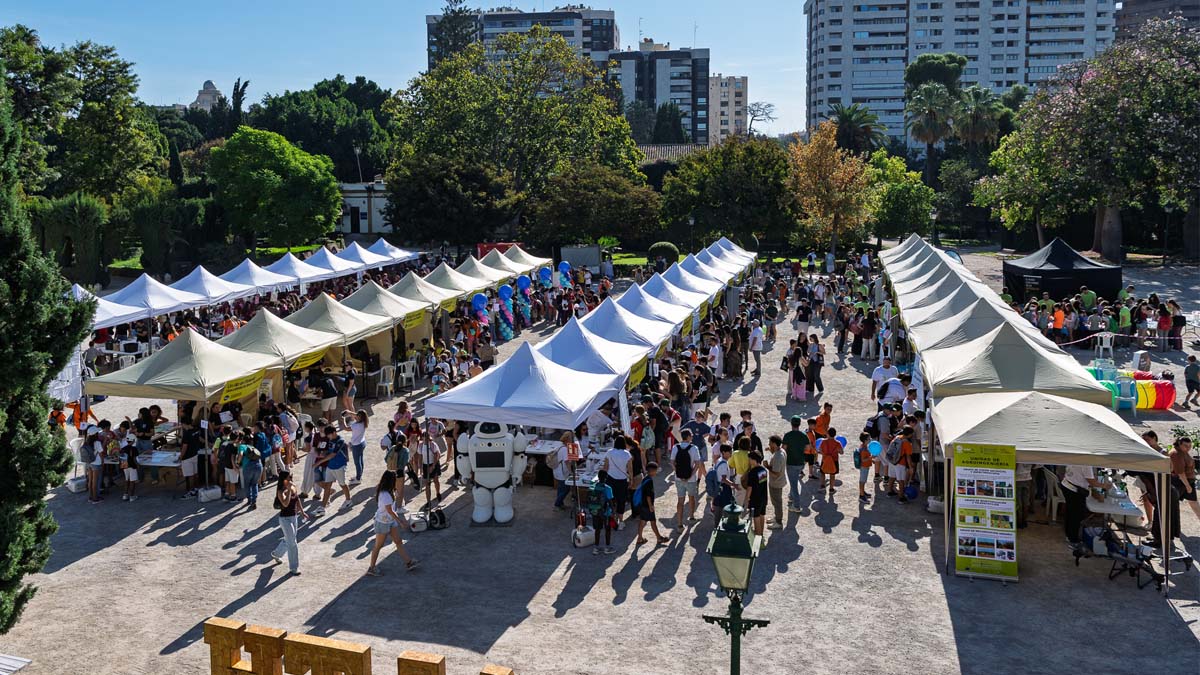
Learning how to protect endangered species such as the samaruc or the gallipato, understanding how tissues are generated to treat diseases, giving shape to their own ideas and creating in three dimensions, defying the laws of physics and building a bridge just like the one designed by Leonardo da Vinci, releasing the contributions of women scientists to knowledge, while playing cards… All this and more was on offer to the nearly 2,500 children who visited the Viveros Gardens on Friday, 25 September, as part of this year's European Research Night.
On this day, the city's leading scientific organisations brought Valencian science and research closer to the public through 40 free workshops organised into morning sessions for primary and secondary schools and afternoon sessions for families, where direct interaction with the experiments and the research staff proved to be the main attraction.
The European Researchers' Night was jointly organised by the Universitat Politècnica de València (UPV), the University of Valencia (UV), the Catholic University of Valencia (UCV), the branch of the Spanish National Research Council (CSIC) in the Valencian Community, the INCLIVA Institute for Health Research, the Foundation for the Promotion of Health and Biomedical Research in the Valencian Community (Fisabio), the Research Foundation of the General University Hospital of Valencia (FIHGUV), the Valencian Institute of Agricultural Research (IVIA) and in collaboration with the Palaeontological Museum and Museum of Natural Collections of Valencia City Council, with the support of the Spanish Foundation for Science and Technology (FECYT) of the Ministry of Science, Innovation.
Science from person to person
For UPV researcher Víctor Gallego, the experience is fantastic: “I really enjoy it; what I like most is interacting with the young people.” The scientist from the University Research Institute for Animal Science and Technology is taking part in a stand where visitors can observe threatened aquatic species, including eels, Spanish killifish, newts and even sharks. “I think this is part of what science is about: coming here and helping young people become aware of the importance of preserving these species in the wild.”
For Ian and Fabio, from IES Serpis in Valencia, the science fair is a welcome break from their usual routine: “We like that it is organised because we learn lots of things we didn't know before, we have a great time and everyone here is really friendly. We have learnt that we need to take better care of the environment because we throw away a lot of rubbish and, in the end, it affects us all.”
Fun and the thrill of discovery form the visual snapshot of a day in which interaction between the research staff and the younger participants has been key to enjoying the experience and learning from it.
Outstanding news
 Study a degree at the best technological university in Spain
The Universitat Politècnica de València is ranked number 1 among Spanish technology universities, according to the Shanghai ranking
 Highly Cited Researchers 2025
Avelí Corma, Juan Bisquert and Luis Guanter, the international scientific elite with a Universitat Politècnica de València hallmark
 Historic Milestone in Spanish Higher Education
The UPV inaugurates the Beihang Valencia Polytechnic Institute, the first Spanish university center in China
 Study in English
The UPV offers eight degrees, 16 master's and 650 courses in English for the 2025-26 academic year
 A Latin Grammy... with the UPV hallmark
'Music teaches us to listen and live together,' says Rafael Serrallet, Doctor of Music at the UPV, awarded in Las Vegas as the author of the Best Instrumental Album of 2025
 THE Impact Ranking
The UPV, the Spanish university with the greatest social and economic impact in the world