

LiveR
UPV students Joaquín Berenguer and Sergio Tordera win the 2nd National AI Prize with a project to improve liver transplant processes
[ 21/09/2026 ]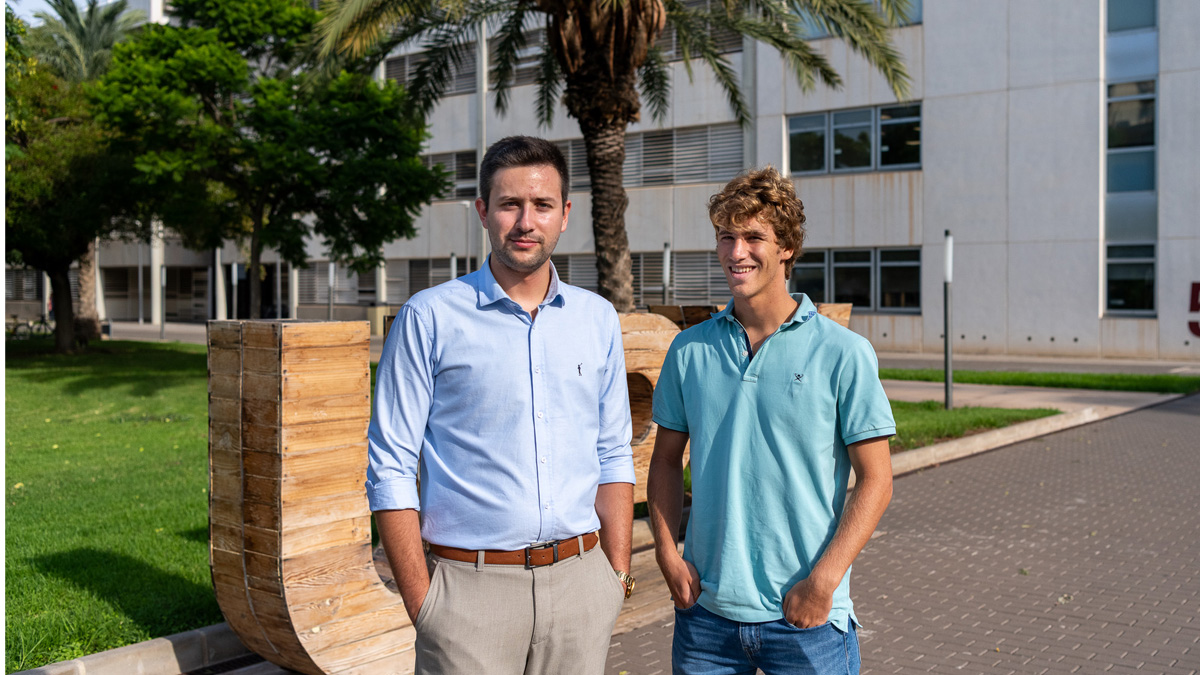
Joaquín Berenguer (Rocafort, aged 21) and Sergio Tordera (Picanya, aged 21), fourth-year students on the dual degree in Mathematics and Bachelor's Degree in Computer Engineering at the Universitat Politècnica de València (UPV), are the winners of the general category at the 2nd National Artificial Intelligence (AI) Awards, held as part of the Samsung Innovation Campus, with their project LiveR.
Developed in collaboration with the La Fe Health Research Institute for use at the Hospital Universitari i Politècnic La Fe, LiveR explores how AI can help identify better matches between donors and recipients for liver transplants.
Clinical decision-support tool
LiveR analyses several variables to identify potential matches and improve post-transplant outcomes, serving as a clinical decision-support tool that complements existing medical criteria without in any way replacing the judgment and decisions of healthcare professionals.
"LiveR applies various AI models to help doctors determine, when faced with a liver transplant, which match from the entire list of recipients offers the best prospects for organ survival," explains Sergio. "Subsequently, doctors take all this data, and it is they who ultimately make the decision. It is important to emphasise that this is a clinical decision-support tool; at no point are we making the final decision," stresses the UPV student.
"My grandfather pioneered the first liver transplant programme at La Fe"
In any case, the origins of LiveR lie far beyond the 'Programming and AI Course' run by the Samsung Innovation Campus through the Lifelong Learning Centre (CFP-UPV). It is the continuation of an extensive and prolific family legacy.
"I come from a family of doctors specialising in hepatology," explains Joaquín. "It was my grandfather who established the first liver transplant programme at La Fe, and my aunt is the head of the Hepatology and Liver Transplant Unit at La Fe and was president of the International Society for Hepatology. So, naturally, when it came to carrying out the final project for the Samsung course, I saw it as an opportunity to contribute to the family legacy, to use the IT skills I've learnt to help medicine in general and people in particular."
And that is exactly what he has done, alongside Sergio, who extends their joint thanks to everyone who made the project possible, from their academic staff at the UPV to the team of liver transplant surgeons, led by Dr Eva Montalvá and Dr Rafa López Andújar, as well as the Hepatology and Liver Transplant Unit, led by Dr Marina Berenguer and Dr Victoria Aguilera -both medical teams are part of the Biomedical Research Network Centre for Liver and Digestive Diseases (CIBER EHD)-, and, of course, to the jury of the Samsung Innovation Campus, which has awarded them the prize, along with the recognition, and a Samsung Galaxy Book6 Pro for each of them.
"A solid grounding in both mathematics and computer science, as well as courses such as the one offered by Samsung, is what has enabled us to carry out this project. Mathematics as the foundation, computer science about programming in AI – primarily Python – and, of course, all the knowledge the course academic staff have passed on to us about AI, machine learning (supervised and unsupervised), deep learning, neural networks…", explains Sergio.
Adapting the models to the current epidemiological situation: the next challenge
Now, Sergio and Joaquín's next step is to improve LiveR. "To ensure the AI is explainable, we determine what the models are based on most, to see if doctors agree," says Joaquín. "And after presenting the first version to the specialists at La Fe and discussing it with them, we realised that the initial dataset we used to train the models was based on data going back as far as 30 years, and that there has been an epidemiological shift in transplants since 2015."
"Specifically, between 1997 and 2014," he continues, "50 per cent of transplant recipients suffered from hepatitis C, a disease that is now mostly cured with a single tablet, so the percentage has fallen to 7 per cent. That is why, in our models, the most significant variables were associated with hepatitis C; and now, to address this, we are trying to use data augmentation techniques to generate more data on patients who do not have the virus, and thus create models that are not so heavily based on the epidemiology that existed previously, but rather on the current situation."
Fernández Angulo (Samsung Electronics Iberia): "The current challenge for AI is to turn its potential into useful solutions for people"
Elena Fernández Angulo, Director of Corporate Marketing and Communications at Samsung Electronics Iberia, noted that AI "is entering a stage where it is no longer enough simply to talk about everything it can do. The challenge is to turn that potential into useful solutions for people and to do so responsibly and reliably".
"At Samsung, we want to contribute to this transformation through technology, but also through training, talent and collaboration," said the head of a company which, in addition to "redefining the fields of televisions, digital signage, smartphones, wearable devices, tablets, household appliances and networking systems, as well as memory, LSI systems and semiconductor manufacturing, also boosts the development of medical imaging technologies, climate control solutions and robotics, whilst creating innovative automotive products and audio solutions through Harman."
Outstanding news
 Study a degree at the best technological university in Spain
The Universitat Politècnica de València is ranked number 1 among Spanish technology universities, according to the Shanghai ranking
 Highly Cited Researchers 2025
Avelí Corma, Juan Bisquert and Luis Guanter, the international scientific elite with a Universitat Politècnica de València hallmark
 Historic Milestone in Spanish Higher Education
The UPV inaugurates the Beihang Valencia Polytechnic Institute, the first Spanish university center in China
 Study in English
The UPV offers eight degrees, 16 master's and 650 courses in English for the 2025-26 academic year
 A Latin Grammy... with the UPV hallmark
'Music teaches us to listen and live together,' says Rafael Serrallet, Doctor of Music at the UPV, awarded in Las Vegas as the author of the Best Instrumental Album of 2025
 THE Impact Ranking
The UPV, the Spanish university with the greatest social and economic impact in the world