

Music can also be felt without needing to hear it.
VIBRA, the project born out of the personal experience of a deaf researcher, now brings together scientists, artists, healthcare professionals and organisations to make music more accessible
[ 25/09/2026 ]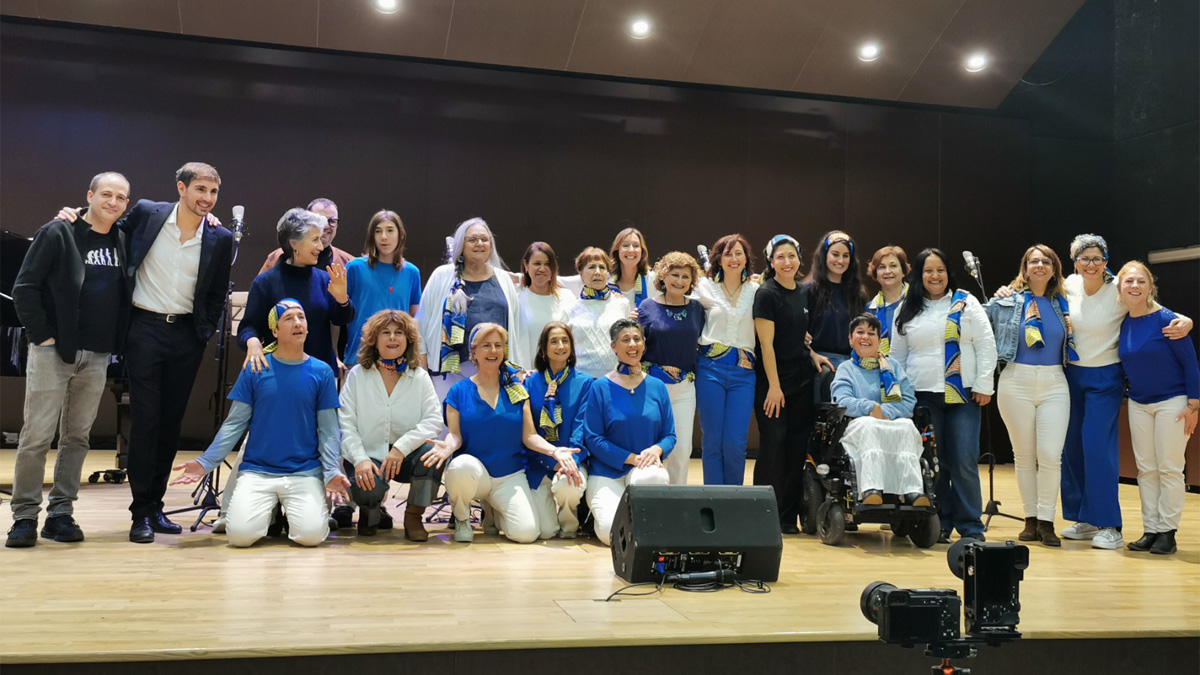
More than 430 million people worldwide live with some degree of hearing loss. However, most concerts and musical experiences continue to be designed primarily for those who can hear. In response to this reality, VIBRA emerged – a research project developed by Human Tech at the Universitat Politècnica de València (UPV) by postdoctoral researcher Claudia Elizabeth Goyes Yepez, whose research contract is funded by the Ramón Areces Foundation.
The initiative stems from a deeply personal motivation. Claudia Goyes has acquired hearing loss and uses cochlear implants. Her own experience facing barriers to accessing music and culture led her to wonder how deaf people can enjoy concerts and which factors can help create truly inclusive musical experiences.
From this concern, VIBRA was born – a project that seeks to assess how stimulating different senses and incorporating universal accessibility tools can influence the musical experience of people with hearing impairments. The study analyses resources such as subtitling, sign language interpretation, induction loops, and vibrating vests, as well as the interaction among the visual, auditory, tactile, olfactory, and gustatory senses during a musical experience.
To this end, VIBRA combines objective and subjective methodologies. On the one hand, it uses biosensors to record physiological responses associated with the participants' emotional experience. On the other hand, it employs questionnaires to assess multisensory perception, immersion in virtual reality, satisfaction and the audience experience during the concert.
"But VIBRA is much more than just scientific research. It is also an initiative built on the collaboration of numerous individuals and institutions who have decided to join forces for a common cause: making music more accessible to everyone," emphasises Claudia Goyes. Alongside her, Jaime Guxieres, Eleonora Minisini, Jesús Casal and José Carlos Soto from HumanTech UPV are also participating in the project.
A project with widespread support
The project's musical experience features Antonio Morant, a Valencian pianist, educator and professor, who performs the five pieces used in the experiment. His commitment to accessibility is closely linked to the story of his daughter Mara, who regained her ability to hear thanks to a double cochlear implant after suffering profound hearing loss during childhood. This experience made him a staunch advocate for a culture that is accessible to people with hearing impairments.
Also forming part of the project is the VozNColor Choir, directed by Leya Pourdevrai. This group promotes inclusion, diversity and social transformation through music. Their involvement in VIBRA was made possible thanks to Gema Mas, the Ombudsman for the Rights of People with Disabilities in the Valencian Community.
The tactile dimension of the experience has been made possible through the collaboration with the Music for All Foundation. This organisation promotes accessibility and inclusion in music for people with disabilities. The foundation loaned the vibrating vest used during the initial trials of the experiment, enabling music to be perceived through touch as well, via vibrations synchronised with the sound.
The project also receives support from the Federation of Deaf People of the Valencian Community (FESORD CV), which has provided a sign language interpreter. Furthermore, the Association of Cochlear Implants of the Valencian Community (AIC CV) has supported the incorporation of induction loop technology.
The participation of cochlear implant users has been made possible through the collaboration of Dr Carlos de Paula Vernetta, an ENT specialist who performed the surgical procedures on Claudia Goyes and is currently part of the project's support network. Together with professionals from La Fe University and Polytechnic Hospital and MED-EL Madrid, he has helped to identify and recruit participants for the trial screenings. The audiovisual production and subtitling of the VIBRA songs were made possible thanks to the altruistic collaboration of Enrique Quiles.
"What began as the personal experience of a researcher who lost her hearing has become a collective initiative that seeks to generate scientific evidence, promote cultural accessibility and demonstrate that music can be experienced in many different ways. Because inclusion is not just about removing barriers, but also about creating new opportunities so that everyone can be moved by, participate in and enjoy culture on an equal footing," concludes Claudia Goyes.
Outstanding news
 Study a degree at the best technological university in Spain
The Universitat Politècnica de València is ranked number 1 among Spanish technology universities, according to the Shanghai ranking
 Highly Cited Researchers 2025
Avelí Corma, Juan Bisquert and Luis Guanter, the international scientific elite with a Universitat Politècnica de València hallmark
 Historic Milestone in Spanish Higher Education
The UPV inaugurates the Beihang Valencia Polytechnic Institute, the first Spanish university center in China
 Study in English
The UPV offers eight degrees, 16 master's and 650 courses in English for the 2025-26 academic year
 A Latin Grammy... with the UPV hallmark
'Music teaches us to listen and live together,' says Rafael Serrallet, Doctor of Music at the UPV, awarded in Las Vegas as the author of the Best Instrumental Album of 2025
 THE Impact Ranking
The UPV, the Spanish university with the greatest social and economic impact in the world