

Close to 'outstanding'
Three buildings on the Vera campus have achieved the highest energy-efficiency rating following refurbishment
[ 02/09/2026 ]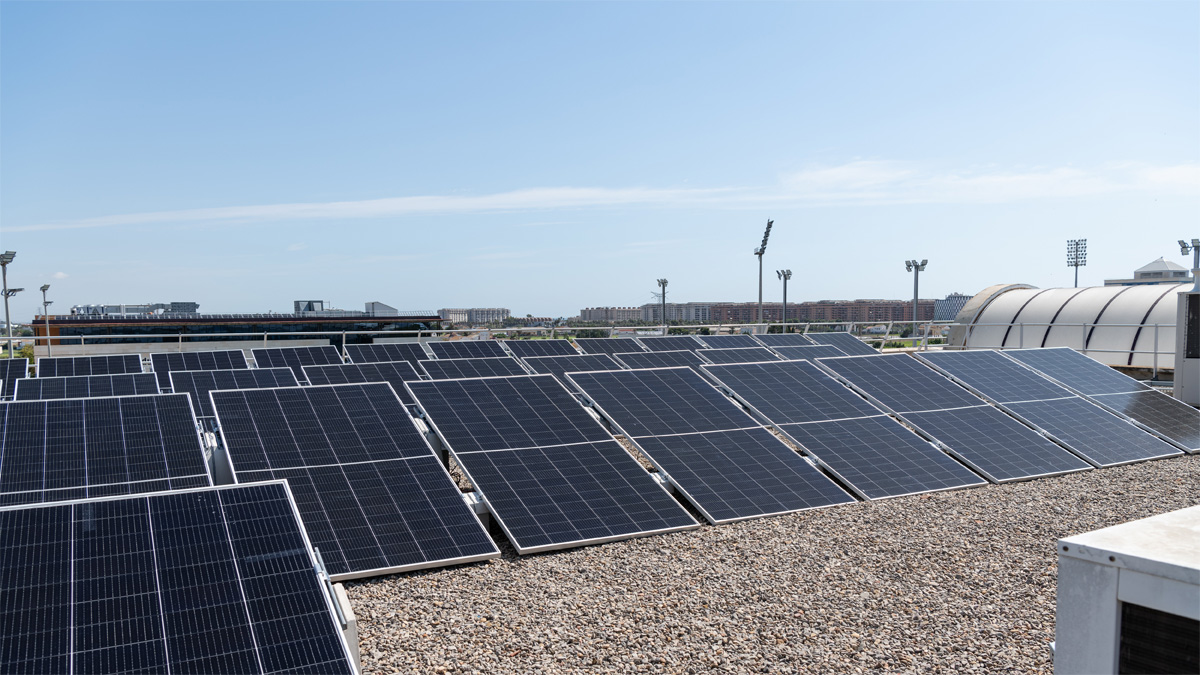
Building 5N at the School of Industrial Engineering (ETSII), Building 1E at the School of Informatics (ETSINF), and Buildings 2E and 3A of the Rectorate building have obtained an 'A' energy rating, the highest efficiency category awarded by IVACE.
The new certificates reflect a significant improvement over previous ratings. Both the ETSII and the Rectorate building have moved from a 'D' rating to an 'A', while the ETSINF has improved from 'C' to 'A'. A comparison of the consumption indicators set out in their previous and current energy certificates shows a difference equivalent to 2.9 GWh per year at the Rectorate building and 0.5 GWh per year at the ETSII. Furthermore, the difference between the emissions indicators in the two certificates equates to an estimated reduction of 474 tonnes of CO¿ per year at the Rectorate and 140 tonnes at the ETSII, according to an analysis provided by the Environment Department of the Universitat Politècnica de València (UPV).
These results are the outcome of measures implemented by the UPV in recent years to improve the energy efficiency of its infrastructure. Key interventions include the refurbishment of heating systems, improvements to the building envelopes, the replacement of lighting systems with LED technology, and the installation of photovoltaic systems for self-consumption.
Improved energy performance in five buildings
The five buildings on the Vera campus whose energy performance certificates have been renewed following the expiry of their ten-year validity period show improved energy performance.
The Student House (4K) has moved from a D rating to a B; the Faculty of Fine Arts (3M) from a C to a B; and the aforementioned ETSII building (5N) from a D to an A; the ETSINF building (1E) from a C to an A; and the 3A of the Rectorate buildings (2E-3A) from a D to an A.
Investment effectiveness
Débora Domingo Calabuig, Vice-Rector for Sustainable Development of Campus, states that "these results confirm the effectiveness of the investments made by the Universitat Politècnica de València in improving the energy efficiency of its infrastructure and contribute to reducing both the institution's energy consumption and its carbon footprint". The UPV's Infrastructures Services were responsible for carrying out this work, which was funded by the European NextGenerationEU programme. In the specific case of the Rectorate buildings, the works received grants from the Programme for the Promotion of the Refurbishment of Public Buildings (PIREP).
The new certificates highlight the scale of the improvements. The Student House has reduced its energy consumption by just over 50 per cent, from 269 kWh/m² to 77 kWh/m²; the ETSII has reduced its energy consumption from 70 kWh/m² to 40 kWh/m². The Rectorate buildings, with a new energy consumption figure of 19 kWh/m², have the lowest consumption among the buildings whose certificates have been renewed.
For the Rectorate, this achievement is particularly significant, as it is the oldest of the rated buildings. It was built in 1978, which demonstrates the potential of refurbishment to improve the energy performance and architectural quality of existing buildings.
The three buildings that have achieved an 'A' energy rating all have in common the installation of a photovoltaic system for self-consumption, amongst other improvements.
Transparency
To facilitate access to this information and improve transparency, the UPV has made a new interactive map available to the university community and the wider public, allowing users to view the updated energy ratings of the buildings on the Vera campus. In addition to displaying the energy rating of each building, the map highlights those that have improved their certification through recent refurbishment and energy-efficiency measures.
The gradual updating of energy performance certificates will continue over the coming months. This will enable assessment of the impact of the measures implemented and guide future investments aimed at moving towards an increasingly sustainable, efficient and decarbonised campus. The Universitat Politècnica de València has committed to becoming carbon neutral by 2030.
Outstanding news
 Study a degree at the best technological university in Spain
The Universitat Politècnica de València is ranked number 1 among Spanish technology universities, according to the Shanghai ranking
 Highly Cited Researchers 2025
Avelí Corma, Juan Bisquert and Luis Guanter, the international scientific elite with a Universitat Politècnica de València hallmark
 Historic Milestone in Spanish Higher Education
The UPV inaugurates the Beihang Valencia Polytechnic Institute, the first Spanish university center in China
 Study in English
The UPV offers eight degrees, 16 master's and 650 courses in English for the 2025-26 academic year
 A Latin Grammy... with the UPV hallmark
'Music teaches us to listen and live together,' says Rafael Serrallet, Doctor of Music at the UPV, awarded in Las Vegas as the author of the Best Instrumental Album of 2025
 THE Impact Ranking
The UPV, the Spanish university with the greatest social and economic impact in the world