

127 fin whales sighted off the coast of the Marina Alta
The data obtained by the ICTA-IGIC team from the UPV during this year's research campaign will help to improve our understanding of the fin whale population, its migratory patterns and behaviour
[ 13/07/2026 ]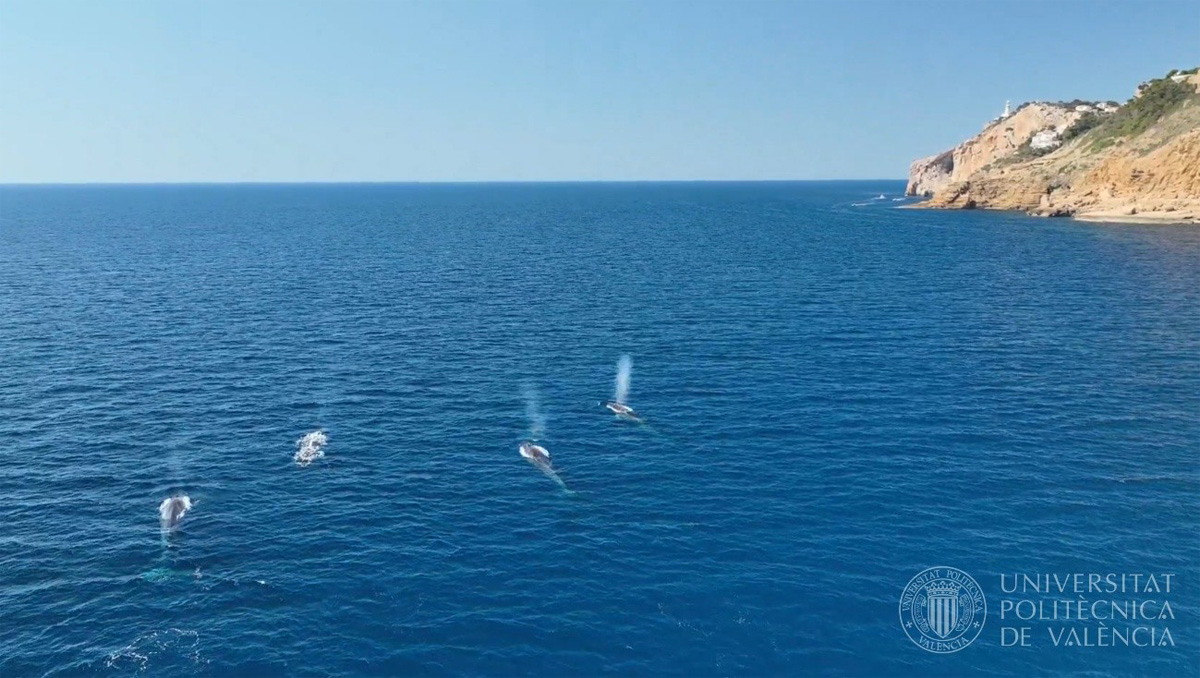
127 fin whales, the second-largest animal on the planet, have been sighted off the coast of the Marina Alta during the research campaign carried out by a team from the Universitat Politècnica de València (UPV) from 25 May to 6 July.
The UPV team has photo-identified more than 80 fin whales using a drone, adding further individuals to the species' catalogue. In addition, six blow samples were obtained using non-invasive techniques, with a drone equipped with a Petri dish onto which traces of the animal's blow were deposited after it exhaled. Thanks to these samples, it will be possible to determine the sex of the individuals and even ascertain their hormonal status. Furthermore, they have been able to detect (again, thanks to the drone) several females with calves actively migrating, which is an important piece of data for the species' recovery.
"Our work helps to understand better the presence, migratory movements and behaviour of this animal. This year's campaign has, without a doubt, been a resounding success: more fin whales than ever before, more photo-identifications than ever before, and more calves detected than in any other campaign," highlights Víctor Gallego, a researcher at the UPV's Institute of Animal Science and Technology.
250 hours at sea and a vital shore-based team from Cabo de San Antonio
As in previous campaigns, the UPV team has worked with two researchers at sea and two others on shore. The marine team included Eduardo Belda from the Research Institute for Integrated Management of Coastal Areas (IGIC) and Víctor Gallego from the ICTA. Between them, they have logged more than 30 days at sea this year in a small boat and 250 hours of sailing in the wake of the fin whales from late May to early July.
"The conservation of the fin whale in the Mediterranean goes beyond the protection of a threatened species, as it plays a key role in nutrient circulation and in mitigating climate change. The information we have obtained will enable us to understand the fin whale population better and contribute to its conservation," emphasises Eduardo Belda, a researcher at the IGIC.
Meanwhile, the land-based team consisted of Xavi Giménez and Maria Giovanna. Stationed at Cabo de San Antonio, their work has been essential for detecting the whales, as 90 per cent of sightings are produced from land; it is only then that the team at sea begins direct work with the animals (determining course and speed, counting the number of individuals, photo-identification and sample collection). Their work has been vital to the success of this year's campaign, and the hours spent waiting and observing at the Cape have paid off.
"Watching fin whales from land is an incredible experience. Spotting the blow from the cliffs is the first step in the research team's study of the animal. The Marina Alta is probably the best spot in Europe for whale watching from the coast, as with just a simple pair of binoculars you can enjoy a sighting that's unique on the planet," say Xavi and María.
Furthermore, the UPV team highlights the collaboration of several organisations in the sampling carried out throughout this campaign, "as without them it would not have been possible for us to monitor so many fin whales this season": Marina el Portet (Dénia), Martin Germann, Héctor Villar, the Ondara Red Cross, the Sub-Directorate-General for Terrestrial and Marine Biodiversity at MITECO, the GVA Marine Surveillance Service, and the GVA Wildlife and Natura 2000 Network, Wewhale "and all the spotters who have helped with whale detection efforts this season".
MYSTICMED Project
This year's campaign forms part of the MYSTICMED project, led by the UPV, which focuses its research on three strategic areas: the southern part of the Levantine-Balearic region, the Alboran Sea and the Strait of Gibraltar, and the Atlantic waters off Galicia. These zones represent areas of potential critical importance for the fin whale. In future campaigns, the UPV team will head to Galicia and the Strait to continue studying these ocean giants.
The project is supported by the Biodiversity Foundation of the Ministry for Ecological Transition and the Demographic Challenge (MITECO), through co-financing from the European Regional Development Fund (ERDF).
About the fin whale
The fin whale is the second-largest animal on the planet, second only to the blue whale. It is one of the most common mysticetes (whales) in the Mediterranean Sea, and every spring it is relatively common to spot individuals off the Spanish coast during their migration. It is classified as 'Endangered' by the International Union for Conservation of Nature (IUCN) in this region.
Outstanding news
 Study a degree at the best technological university in Spain
The Universitat Politècnica de València is ranked number 1 among Spanish technology universities, according to the Shanghai ranking
 Highly Cited Researchers 2025
Avelí Corma, Juan Bisquert and Luis Guanter, the international scientific elite with a Universitat Politècnica de València hallmark
 Historic Milestone in Spanish Higher Education
The UPV inaugurates the Beihang Valencia Polytechnic Institute, the first Spanish university center in China
 Study in English
The UPV offers eight degrees, 16 master's and 650 courses in English for the 2025-26 academic year
 A Latin Grammy... with the UPV hallmark
'Music teaches us to listen and live together,' says Rafael Serrallet, Doctor of Music at the UPV, awarded in Las Vegas as the author of the Best Instrumental Album of 2025
 THE Impact Ranking
The UPV, the Spanish university with the greatest social and economic impact in the world