
Planetary boundaries
The UPV is raising the alarm about the serious state of planetary health - with 7 out of 9 risk thresholds exceeded - through an exhibition at l'Espai n-1, which is free to visit until 24 July
[ 03/06/2026 ]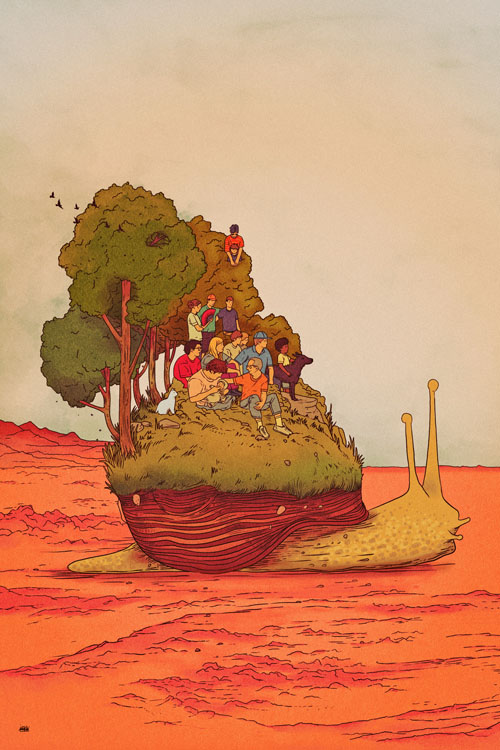
For more than 10,000 years, humanity thrived during a period of climatic stability in which, thanks in turn to a resilient Earth system, the conditions were right for the rise of agriculture, urbanisation and complex civilisations.
However, since the mid-20th century, with the onset of the Anthropocene – the current era in which human activity has become the dominant force – there has been a significant acceleration in socio-economic activity and its environmental impact, which have alarmingly weakened the planet's resilience, particularly its capacity for self-regulation and carbon absorption.
The risk of ecological collapse on the planet is real. The Universitat Politècnica de València (UPV) aims to raise awareness of this through "Planetary boundaries", an exhibition organised and curated by the Cor de Terra association, which will be hosted by l'Espai n-1 (UPV Library, ground floor) on the UPV Vera campus from 3 June to 24 July 2026.
Climate change, just one of the seven transgressed planetary boundaries
"Generally speaking," explains Carmen Pereira (Cor de Terra), "people talk about climate change as if it were the eco-social crisis affecting the entire planet, but that is not actually the case. Climate change is one of the nine existing boundaries—the thresholds of various terrestrial processes within which humanity can operate safely without causing significant disruption to the environment."
And the situation is critical. Not surprisingly, according to the latest Planetary Health Review Report produced by Planetary Boundaries Science (PBScience) – an international benchmark in the field – 7 of the 9 boundaries have not only been exceeded but are also showing trends of increasing pressure.
Probability of serious and potentially irreversible environmental impacts
In fact, only two of the indicators—the depletion of the stratospheric ozone layer and the increase in atmospheric aerosol load—are currently within the safe operating space.
By contrast, resulting in serious, potentially irreversible environmental impacts, four of them – ocean acidification, land-use change, changes in freshwater resources and climate change – have already been exceeded and are in the zone of increasing risk, with the latter two already very close to the high-risk zone where the remaining three boundaries are currently situated: altered biogeochemical flows, the introduction of new entities (chemicals, plastics, etc.) and changes to the integrity of the biosphere.
To clarify, the high-risk zone is defined as one in which conditions have deviated significantly from safe levels, resulting in serious, potentially irreversible environmental impacts.
30 illustrations, 9 texts, 9 videos and 5 lectures
The aim of the exhibition is clear: to raise awareness among as many people as possible of a reality that affects us all. "We need to know what is happening, with accurate information," emphasises Pereira. To this end, the exhibition features 30 illustrations, along with 9 texts accompanied by 9 testimonial videos—one for each limit—produced by professional environmental activist scientists.
The project also includes 5 lectures to be held at Espai n-1 itself at 5.30 pm, on 3 June ("Planetary boundaries"), 10 June ("Communicating the emergency from the air"), 12 June (“Caring for the planet from our cities”), 26 June ("The Earth is not a resource") and 29 June ("It's not normal"), all of which are free to attend, subject to capacity.
Fernando Valladares, Pablo Caracol, Núria Tamarit, Mijo Miquel, Olga Mayoral, Mar Palanca, Antonio Turiel, Juan Bordera, Irene Calvé, José Albelda, Maite Mompó and Nacho Lacomba amongst other prestigious figures in the field, make up the line-up of panellists for a series of talks that aim to raise awareness based on knowledge, encouraging everyone, to the best of their ability, to act in support of a vital need for humanity: caring for and improving the health of our planet.
Listen UPV Podcast - Pasearte 2.0: "Los límites del planeta"
Outstanding news
 Study a degree at the best technological university in Spain
The Universitat Politècnica de València is ranked number 1 among Spanish technology universities, according to the Shanghai ranking
 Highly Cited Researchers 2025
Avelí Corma, Juan Bisquert and Luis Guanter, the international scientific elite with a Universitat Politècnica de València hallmark
 Historic Milestone in Spanish Higher Education
The UPV inaugurates the Beihang Valencia Polytechnic Institute, the first Spanish university center in China
 Study in English
The UPV offers eight degrees, 16 master's and 650 courses in English for the 2025-26 academic year
 A Latin Grammy... with the UPV hallmark
'Music teaches us to listen and live together,' says Rafael Serrallet, Doctor of Music at the UPV, awarded in Las Vegas as the author of the Best Instrumental Album of 2025
 THE Impact Ranking
The UPV, the Spanish university with the greatest social and economic impact in the world