
UPV and AI: challenge accepted
The UPV is making AI a cross-cutting and strategic pillar of its educational model
[ 20/05/2026 ]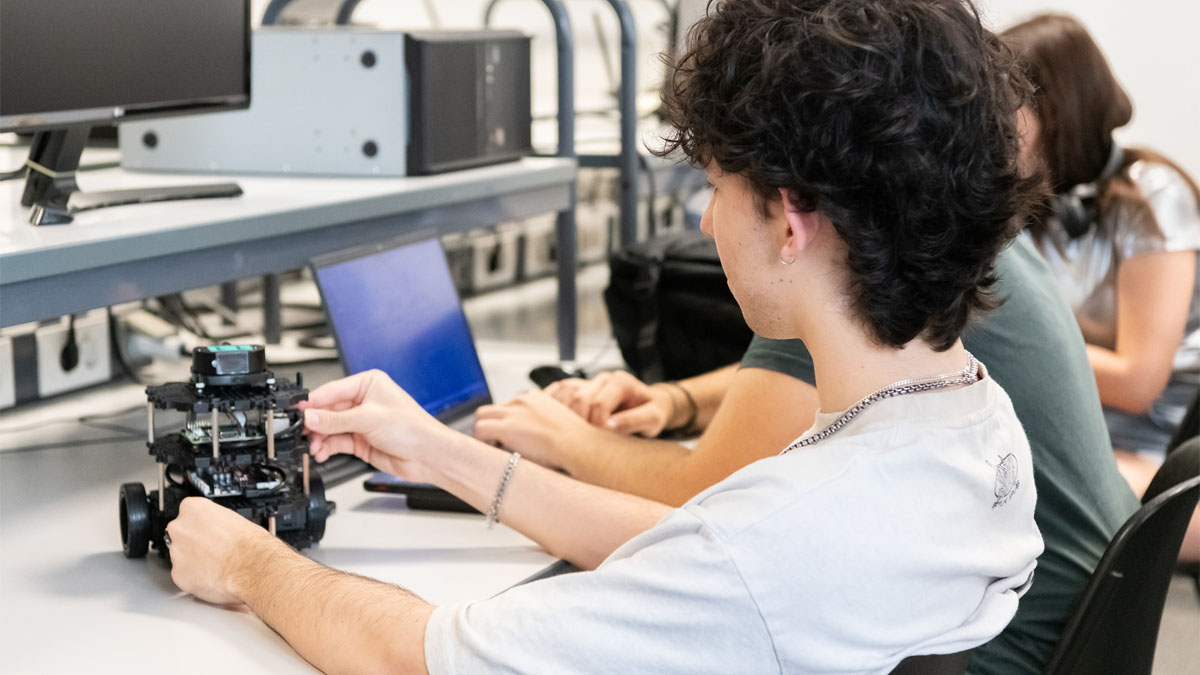
The Universitat Politècnica de València (UPV) is promoting the integration of Artificial Intelligence (AI) into both teaching processes and curricula in a cross-cutting, reflective and ethical manner. Staff training, which began in 2021, is a key pillar in this implementation process, evolving continuously alongside technological advances and labour market demands.
There are several examples of this, but we will focus on one in particular. The classroom feels more like a testing laboratory than a conventional one. Thirty final-year students on the Mobile and Wireless Communications course, part of the Bachelor's Degree in Telecommunication Technologies Engineering, are fine-tuning a 5G module that will enable two autonomous vehicles to communicate with one another to avoid collisions. Their final mark will depend on this test, alongside other assessments such as an oral defence of the project.
The group has spent months developing the system. It has also benefited from the support of Artificial Intelligence, which has helped them shorten timelines and increase their chances of success. Specifically, they have used AI for targeted programming tasks and for drafting technical reports—under the guidance, and even encouragement, of their lecturer.
This is just one example, among many, of how AI is becoming widely embedded across UPV degrees, gradually shaping lesson preparation, course content and teaching methodologies—not only in purely technological programmes.
Bachelor's Degree in Artificial Intelligence
Artificial Intelligence is now explicitly recognised not only in curricula and course outlines, but also within the official degree catalogue. The Bachelor's Degree in Artificial Intelligence, delivered at both the València and Alcoy campuses, began this academic year and is already training students to lead AI projects, with a strong emphasis on the ethical and social implications of this technology in strategic sectors such as finance, administration, logistics and healthcare.
At the same time, several UPV degrees now include at least one module focused exclusively on the use and application of AI, such as Physics Engineering and Marine Science and Technology, to name just two. However, transformation also occurs at a deeper level, as lecturers adapt their content and methodologies. When these developments go beyond existing regulatory frameworks, formal procedures to modify degree programmes are triggered. This is the process behind the substantial curriculum changes that several degrees will introduce from the 2026–2027 academic year onwards.
Open Innovation in AI
The institution was ahead of its time in launching IA²_UPV: Open Innovation in Artificial Intelligence at UPV. This line of work remains active and encompasses several fronts: fundamental research, applied research, tool development, the use of AI in teaching, research and administrative activities, and, finally, AI training. To support this, UPV invested 1 million euros in a high-performance server—the second-most-powerful of its kind in Spain.
Among other developments, the university has also launched an internal AI application (PoliGPT), designed to provide a secure chatbot service tailored to the university community.
However, it is in training where the institution has committed the greatest resources, particularly through the design and delivery of AI-based workshops for both online and face-to-face learning. Since October 2021, the Institute of Education Sciences has delivered 27 AI courses exclusively for teaching staff, amounting to 424 hours of training. Enrolment figures have now exceeded 2,500 participants.
A Strategy Focused on Teaching Staff
For UPV, it is "strategic" that academic staff receive advanced training in the use and understanding of AI, according to José Pedro García Sabater, Vice-Rector for Planning, Studies, Quality and Accreditation. He adds that the "Achilles' heel of the process lies in the potential combination of AI and the law of least effort".
"Both lecturers and families need to understand how students do their work. Otherwise, assignments may appear excellent without realising that the learning process has been entirely outsourced to AI," he explains.
Héctor Esteban, Director of the School of Telecommunication Engineering, also stresses that universities must promote the use of AI from a critical and ethical perspective: "We must teach students to think, to tackle challenges and to develop independent thought; otherwise, they risk becoming overly dependent on technology." He concludes: "If a machine can do what you do, why would a company pay you?"
The Universitat Politècnica de València (UPV) is ranked as Spain's top technological university according to the Shanghai Ranking (ARWU). This is reflected, among other factors, in the way it is embedding one of the most disruptive technologies of our time into its DNA—while remaining true to its core mission: to provide students with high-quality education tailored to the challenges of the future.
Outstanding news
 Study a degree at the best technological university in Spain
The Universitat Politècnica de València is ranked number 1 among Spanish technology universities, according to the Shanghai ranking
 Highly Cited Researchers 2025
Avelí Corma, Juan Bisquert and Luis Guanter, the international scientific elite with a Universitat Politècnica de València hallmark
 Historic Milestone in Spanish Higher Education
The UPV inaugurates the Beihang Valencia Polytechnic Institute, the first Spanish university center in China
 Study in English
The UPV offers eight degrees, 16 master's and 650 courses in English for the 2025-26 academic year
 A Latin Grammy... with the UPV hallmark
'Music teaches us to listen and live together,' says Rafael Serrallet, Doctor of Music at the UPV, awarded in Las Vegas as the author of the Best Instrumental Album of 2025
 THE Impact Ranking
The UPV, the Spanish university with the greatest social and economic impact in the world