
The cold drop intensified political polarisation among media outlets and readers.
According to a study by the PRHLT analysing over a thousand news articles and 10,000 comments published in the fortnight following the disaster in four online newspapers
[ 30/03/2026 ]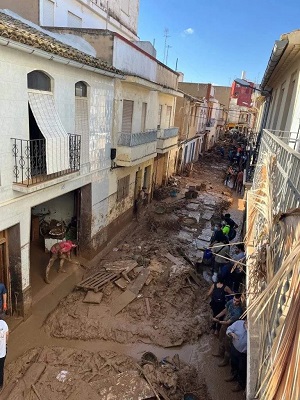
A team from the Universitat Politècnica de València has published a study on the media coverage of the cold drop that devastated the province of Valencia on 29 October 2024 and its impact on political polarisation. Among its main conclusions, it notes that whilst the published news articles maintained a relatively moderate tone, readers' comments were much harsher, more emotional, and clearly ideologically driven.
The research analyses over 1,000 news articles and 10,000 comments published during the fortnight following the disaster across four online newspapers with different ideological leanings: El País, elDiario.es, El Mundo, and El Confidencial. The study focuses particularly on two political figures who were very much at the centre of public debate following the tragedy: Carlos Mazón, then President of the Valencian Regional Government, and Teresa Ribera, then Third Vice-President of the Government and Minister for Ecological Transition.
The results show that, in the news articles, the differences between left-wing and right-wing newspapers were not so evident in terms of overall polarity. However, a deeper analysis of emotions did reveal significant nuances. In coverage of Carlos Mazón, left-wing media conveyed more anger and disgust, whilst right-wing media more frequently resorted to sadness and fear. In the case of Teresa Ribera, the difference was even clearer: the right-wing press displayed a more negative emotional tone, whilst the left-wing press more frequently introduced tones of support or relief.
Much stronger polarisation among readers
"Where the polarisation was most visible was in readers' comments. In our study, we found that the editorial filter had almost completely disappeared in these comments, with much more aggressive language. This is something seen in comments on countless news stories every day, but in this case, the level of polarisation and aggression was very high," notes Paolo Rosso, a researcher at the PRHLT centre at the UPV.
In the case of Carlos Mazón, the study reveals that the comments were overwhelmingly negative in both left-wing and right-wing media, although somewhat less harsh in the latter. Regarding Teresa Ribera, the difference was much more marked: in the right-wing media, almost total rejection prevailed, whilst in the left-wing media, more balanced positions emerged, with even room for positive assessments.
Pioneering analysis using AI
The study also incorporates a pioneering image analysis, carried out using artificial intelligence tools. "The images used by the newspapers did not focus so much on the damage caused by the cold drop as on the faces, gestures, and body language of the politicians. In other words, the coverage prioritised the political conflict over the material dimension of the disaster," notes María Aloy, co-author of the study.
According to the analysis, this combination of headlines and images reinforced the emotional impact of the news and helped to construct differing narratives regarding political responsibility.
"Our study concludes that the DANA was not only a climatic and human tragedy, but also an episode of intense media and social confrontation. Furthermore, by combining linguistic, emotional, and visual analysis, it helps us understand how public perception of a crisis is constructed and how the media influence the debate on political responsibility," concludes Guillem Soler, also a co-author of this work.
Reference
Sanz, G.S., Mayo, M.A. & Rosso, P. Computational Multimodal Analysis of Polarised Political Discourse After the DANA in Valencia. Corpus Pragmatics 10, 12 (2026). https://doi.org/10.1007/s41701-025-00213-5
Outstanding news
 Study a degree at the best technological university in Spain
The Universitat Politècnica de València is ranked number 1 among Spanish technology universities, according to the Shanghai ranking
 Highly Cited Researchers 2025
Avelí Corma, Juan Bisquert and Luis Guanter, the international scientific elite with a Universitat Politècnica de València hallmark
 Historic Milestone in Spanish Higher Education
The UPV inaugurates the Beihang Valencia Polytechnic Institute, the first Spanish university center in China
 Study in English
The UPV offers eight degrees, 16 master's and 650 courses in English for the 2025-26 academic year
 A Latin Grammy... with the UPV hallmark
'Music teaches us to listen and live together,' says Rafael Serrallet, Doctor of Music at the UPV, awarded in Las Vegas as the author of the Best Instrumental Album of 2025
 THE Impact Ranking
The UPV, the Spanish university with the greatest social and economic impact in the world