
'Scientific Artefacts. Women, Identity, Science and Objects'
The exhibition combines art, history and imagination to highlight the role of women in science. It can be visited until 27 February at the UPV Central Library.
[ 30/01/2026 ]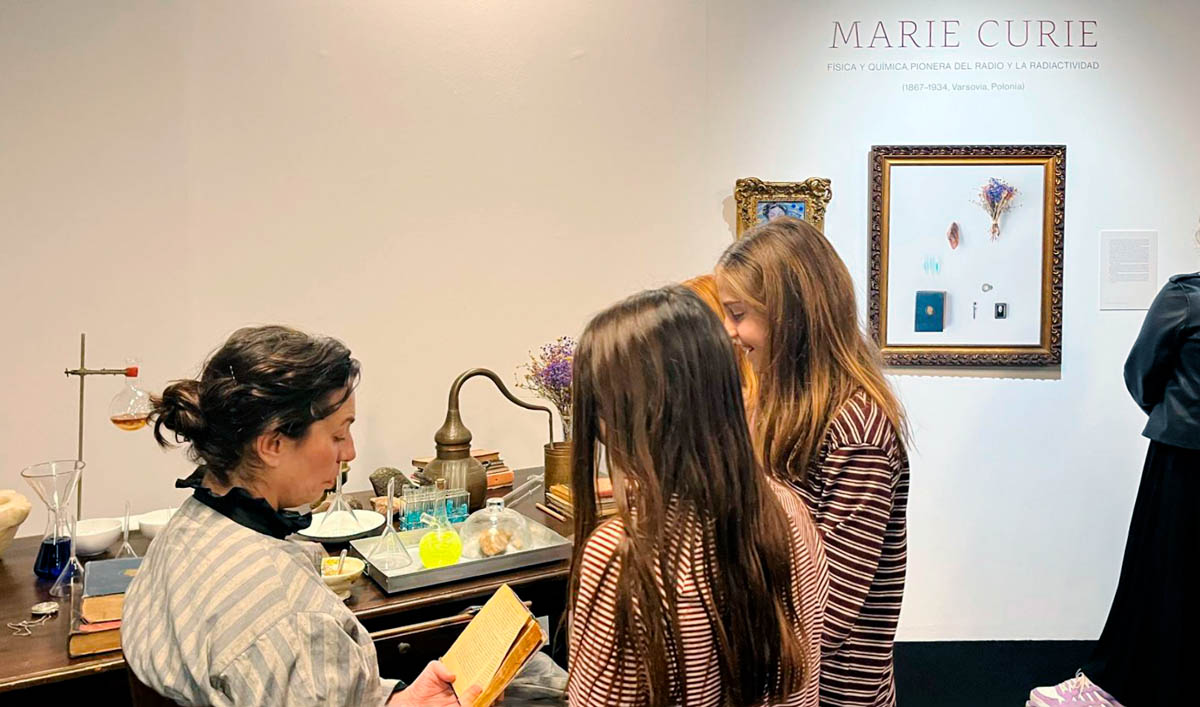
The Universitat Politècnica de València is hosting the exhibition Scientific Artefacts: Women, Identity, Science and Objects until 27 February. The exhibition takes visitors on an artistic and symbolic journey through the personal and professional lives of eleven women scientists by means of compositions created from significant objects, both personal and professional.
Inspired by the murals of the Dones de Ciència project and developed from the artistic and visual approach of the Artefacto Portraits project, the exhibition brings together art, history and imagination to highlight the role of women in science. Among its protagonists are UPV professor and restorer Pilar Roig; Sara García Alonso, molecular biologist and ESA reserve astronaut; and Anna Lluch, breast cancer researcher and professor of medicine.
The exhibition can be visited at Espai n-1 in the Central Library of the Universitat Politècnica de València, with free admission, Monday to Friday from 11 a.m. to 2 p.m. and from 4 p.m. to 7 p.m., and Saturdays from 11 a.m. to 2 p.m.
Original objects full of stories
The exhibition explores the universe of eleven women scientists through artistic compositions inspired by the portraits on the Dones de Ciència murals. The artefacts combine art, history and imagination to transform everyday objects into poetic narratives that celebrate their lives and achievements, inviting us to understand and imagine.
"We do not seek to represent history accurately, but to imagine it with rigour and care. We are interested in understanding and conveying the history, context, passions and legacy of each of the eleven women featured in this project," explain the curators and artists of the exhibition, Virginia Vinagre and Ella Ahonen.
To this end, they have conducted in-depth research into the life of each woman represented and, whenever possible, used objects personally provided by the protagonists or their families and friends. In other cases, the objects have been recreated or found in antique shops, flea markets and homes of family and friends.
The objects paint a portrait of the person and not just their scientific work. That is why the artistic perspective of the project is important, as it allows us to access the human dimension of the scientists, so closely linked to their scientific output, even when that connection is not so obvious when focusing solely on their scientific side. What is the relationship between a handkerchief, a fan, a pendant, a handbag or a pair of glasses and a scientific breakthrough? That is also a matter for exploration.
For example, Sara García Alonso has lent one of her official European Space Agency polo shirts, some guitar picks made for her wedding, a copy of her doctoral thesis, and a handbag she made herself from Lego bricks for the exhibition. Pilar Roig has loaned a restoration syringe, a box of her father's old weights, and a book of poems by Francisco Brines, signed by the author himself. Anna Lluch has donated a painting dedicated to her, the medal of the Royal National Academy of Medicine and the honorary doctorate ring awarded by the Universitat Jaume I in Castelló.
Pioneers and role models
In addition to Sara García Alonso, Anna Lluch and Pilar Roig, the exhibition also pays tribute to two other Spanish role models: Margarita Salas, biochemist and leading figure in Spanish molecular biology; and Concepción Aleixandre, doctor, gynaecologist and pioneering inventor in Spain.
And alongside them, Jane Goodall, primatologist, conservationist and explorer of animal behaviour; Ada Lovelace, mathematician and computing visionary; Katherine Johnson, mathematician and architect of space trajectories; Hypatia of Alexandria, astronomer, philosopher and teacher in Alexandria; Jane Jacobs, urban thinker and citizen activist; and Marie Curie, physicist and chemist, pioneer of radium and radioactivity.
Marie Curie is evoked through the tubes of radium salts she handled with fascination; Hypatia of Alexandria, through an abacus that refers to her astronomical and mathematical calculations; Jane Jacobs appears defending her city with banners, paint, and a megaphone; and Katherine Johnson performing complex orbital calculations with a Monroe calculator, surrounded by men at a NASA research centre.
On 27 February, a meeting with Sara García Alonso, Pilar Roig and Anna Lluch
To close the exhibition, the UPV has organised the 'Dones de Ciència' (Women of Science) meeting and discussion. It will be held on 27 February at 11 a.m. in the Auditorium of the Faculty of Fine Arts. It will be attended by Sara García Alonso, Pilar Roig and Anna Lluch.
The meeting will be open to the public, subject to prior registration and until capacity is reached (register at this link).
Both the meeting and the exhibition are organised by the Cultural Action Area and the Communication Area of the Universitat Politècnica de València. They are supported by the Spanish Foundation for Science and Technology (FECYT) of the Ministry of Science, Innovation and Universities.
Outstanding news
 Study a degree at the best technological university in Spain
The Universitat Politècnica de València is ranked number 1 among Spanish technology universities, according to the Shanghai ranking
 Highly Cited Researchers 2025
Avelí Corma, Juan Bisquert and Luis Guanter, the international scientific elite with a Universitat Politècnica de València hallmark
 Historic Milestone in Spanish Higher Education
The UPV inaugurates the Beihang Valencia Polytechnic Institute, the first Spanish university center in China
 Study in English
The UPV offers eight degrees, 16 master's and 650 courses in English for the 2025-26 academic year
 A Latin Grammy... with the UPV hallmark
'Music teaches us to listen and live together,' says Rafael Serrallet, Doctor of Music at the UPV, awarded in Las Vegas as the author of the Best Instrumental Album of 2025
 THE Impact Ranking
The UPV, the Spanish university with the greatest social and economic impact in the world