
25th Guidance Day
AI and neuroeducation take centre stage at the conference organised by the UPV and aimed at guidance counsellors in educational centres
[ 03/12/2025 ]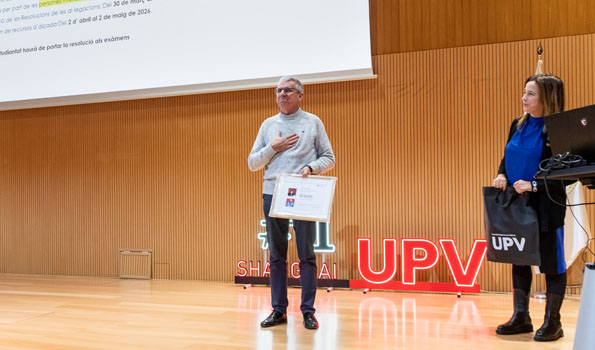
Neuroeducation, artificial intelligence and key skills for professional success were the focus of discussion at the UPV's 25th Guidance Day (JO), which brought together 600 people from educational centres in the Valencian Community. As is customary at this event, the latest developments for the upcoming University Entrance Exams (PAU) were also discussed.
This event serves to analyse a wide variety of educational aspects, from scholarship to knowledge. The various presentations address issues that already affect the lives of adolescents today, making them extremely useful for guidance counsellors at schools.
The event was attended by the regional secretary for Universities, Esther Gómez, who lamented that some bilingual autonomous communities, including Valencia, have once again ranked at the bottom of the list in terms of university entrance exam (PAU) scores this year. In this regard, she announced that her department is working on a joint proposal to be sent to the Ministry of Science, Innovation and Universities, which will advocate for a more equitable scenario for all autonomous communities.
How to look at our students
In a context of great uncertainty and rapid change, such as the current one, David Bueno's presentation (‘Learning from uncertainty: what neuroeducation can teach us’) generated maximum excitement.
The founder of the Chair of Neuroeducation at the University of Barcelona delved into the most human aspect of education, ‘where AI cannot reach’. He did so by presenting and arguing some key points for significantly increasing efficiency in the transmission of knowledge.
He advocated, above all, reducing stress in different ways. Among these, he suggested that teachers make eye contact with the whole class to ‘get in sync’. The expert recommended doing this at the beginning of each session: ‘for two or three minutes at the start, to make ourselves present as teachers, establish a bond and activate the neural networks of socialisation’.
In the short term, AI will create more jobs than it destroys
Two of the aspects that most influence educational planning in the short and long term are expectations regarding employability and the skills demanded by companies. Regarding the sectors with presumably better employability prospects, talent management expert Olga Barroso cited digital education and training, renewable energy and sustainability, health and care, cybersecurity, and logistics and supply chains, among others.
As for the skills most sought after by companies, Barroso stressed the importance of critical and creative thinking, knowing how to react to the unexpected, and the ability to motivate.
‘Chat GPT, from 4th year of secondary school’
Artificial Intelligence was very much present throughout the conference and even sparked a debate among those present: whether or not to introduce this technology into the classroom in a decisive manner.
In this regard, José Francisco Monserrat, Vice-Chancellor for Internationalisation and Communication, not only defended its suitability, but also established the most appropriate age and year to begin implementing the Chat GPT language model: ‘from the age of 15, that is, from the 4th year of secondary school’. He also encouraged guidance staff to try out various AI tools and to ‘do so with them (secondary school students)’.
Speaker María Alfonso, a researcher in Education Sciences, agreed with Monserrat's thesis and argued that students must learn to use this technology responsibly, ‘assimilating what can be useful and what can be harmful, with the help of teachers’.
No changes to the 2026 PAU
After substantial changes to the 2025 PAU (new weighting system, elimination of the maximum number of optional subjects and the incorporation of more skills-based exercises, among others), the 2026 PAU will be more stable after several years of changes, as commented by José Mas, the new general coordinator of University System Access, replacing Antoni Gil. Gil, for his part, took stock of this year's exams.
Antoni Gil received a standing ovation in the morning in recognition of his invaluable commitment and willingness to serve the educational community after 25 years as general coordinator of University System Access.
Outstanding news
 Study a degree at the best technological university in Spain
The Universitat Politècnica de València is ranked number 1 among Spanish technology universities, according to the Shanghai ranking
 Highly Cited Researchers 2025
Avelí Corma, Juan Bisquert and Luis Guanter, the international scientific elite with a Universitat Politècnica de València hallmark
 Historic Milestone in Spanish Higher Education
The UPV inaugurates the Beihang Valencia Polytechnic Institute, the first Spanish university center in China
 Study in English
The UPV offers eight degrees, 16 master's and 650 courses in English for the 2025-26 academic year
 A Latin Grammy... with the UPV hallmark
'Music teaches us to listen and live together,' says Rafael Serrallet, Doctor of Music at the UPV, awarded in Las Vegas as the author of the Best Instrumental Album of 2025
 THE Impact Ranking
The UPV, the Spanish university with the greatest social and economic impact in the world