
Nanomotors against cancer
Researchers at the UPV develop nanoparticles that transform glucose in tumours into energy to move and transport chemotherapy to the most inaccessible areas of the tumour.
[ 03/11/2025 ]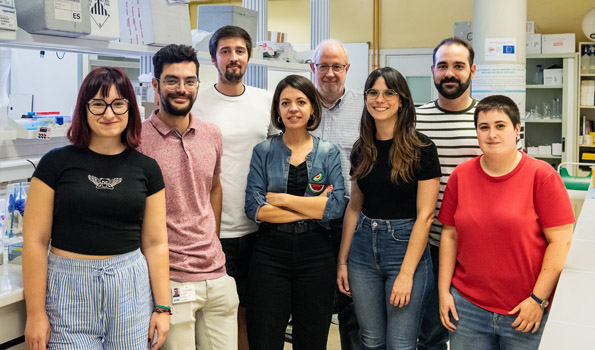
A team from the Universitat Politècnica de València (UPV), belonging to the Interuniversity Research Institute for Molecular Recognition and Technological Development (IDM), has led the development of nanoparticles that are able to self-propel (nanomotors) using glucose present in the tumour environment as fuel and releasing drugs inside tumours much more effectively. Validated in animal models and patient samples, their results have been published in the journal ACS Nano.
The study also involved La Fe Health Research Institute (IIS La Fe), the Bioengineering, Biomaterials and Nanomedicine CIBER (CIBER-BBN), the Cancer CIBER (CIBERONC) and the INCLIVA Health Research Institute, in collaboration with the Príncipe Felipe Research Centre (CIPF).
According to Ramón Martínez Máñez, director of the IDM Institute at UPV, in solid tumours, the drugs used in chemotherapy barely penetrate the inner layers, which reduces their effectiveness and allows some cancer cells to survive.
The nanomotors designed by the research team help to overcome this obstacle. The team has demonstrated their effectiveness in destroying tumour cells in cell cultures, spheroids, organoids derived from patients and in an animal model of mice. In the latter, the treatment significantly reduced the size of the tumours and increased the amount of drug reaching the centre of the tumour.
Paula Díez from IIS La Fe points out: ‘Nanomotors not only use glucose to increase movement, but by consuming it, they deprive tumour cells of energy. Besides, the nanomotors designed generate oxygen, which helps reduce hypoxia, a common problem that limits the effectiveness of many treatments, and produce reactive oxygen species, reinforcing the damage to malignant cells.’
‘The most innovative feature is the design of the nanomotor, which uses a double-sided nanoparticle (silica and platinum) and utilises the tumour's own glucose as fuel to activate movement. Not only do we manage to get the nanomotors much further into the tumour, but they also release the drug at the right time and place,’ adds Alba García-Fernández from CIBER-BBN.
‘The results obtained in breast cancer organoids derived from patients show that this technology has enormous potential for transfer to personalised therapies,’ add Iris Garrido and Juan Miguel Cejalvo from the INCLIVA Health Research Institute.
Outstanding news
 Study a degree at the best technological university in Spain
The Universitat Politècnica de València is ranked number 1 among Spanish technology universities, according to the Shanghai ranking
 Highly Cited Researchers 2025
Avelí Corma, Juan Bisquert and Luis Guanter, the international scientific elite with a Universitat Politècnica de València hallmark
 Historic Milestone in Spanish Higher Education
The UPV inaugurates the Beihang Valencia Polytechnic Institute, the first Spanish university center in China
 Study in English
The UPV offers eight degrees, 16 master's and 650 courses in English for the 2025-26 academic year
 A Latin Grammy... with the UPV hallmark
'Music teaches us to listen and live together,' says Rafael Serrallet, Doctor of Music at the UPV, awarded in Las Vegas as the author of the Best Instrumental Album of 2025
 THE Impact Ranking
The UPV, the Spanish university with the greatest social and economic impact in the world