
Groundwater reserves
Climate change threatens groundwater reserves on the Iberian Peninsula
[ 24/03/2025 ]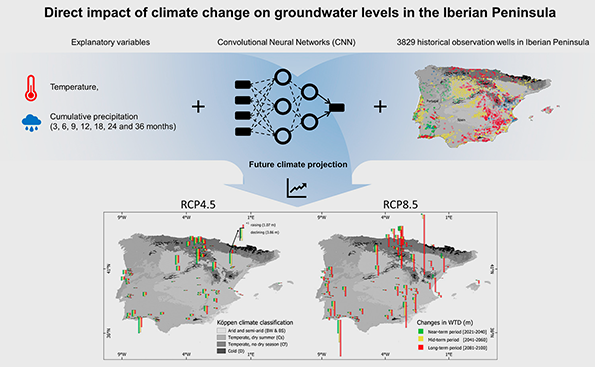
An international study involving Jaime Gómez-Hernández, researcher at the Research Institute of Water and Environmental Engineering of the Universitat Politècnica de València (UPV), highlights the direct impact of climate change on aquifers in the Iberian Peninsula. According to the study published in Science of The Total Environment, 40% of wells could see a drop in water levels of more than one meter by the end of the century. The research also concludes that temperature is the main determining factor in 72% of the wells, which means that evaporation significantly impacts groundwater levels more than rainfall reduction.
The study analysed data from over 3,800 wells across Spain and Portugal. Using an artificial intelligence model—specifically, convolutional neural networks (CNNs)—the research predicts how groundwater levels will evolve under different climate scenarios based on historical data and future projections.
Rising temperatures
The results show a clear downward trend, especially in shallower aquifers, where evaporation caused by rising temperatures plays an even more significant role than reduced precipitation.
In the most adverse scenario, climate models forecast an average temperature increase of 3.9?°C and a 20% decrease in annual rainfall. These conditions would cause a significant drop in groundwater levels in nearly half of the study sites, with extreme cases exceeding 18 meters.
“Groundwater is essential for human supply, agriculture, and ecosystems. And in regions like ours, facing increasing water scarcity, proper groundwater management is more urgent than ever,” stresses Jaime Gómez-Hernández.
“The results of this research are a wake-up call to implement measures that promote more sustainable groundwater management, support aquifer recharge, and improve water use efficiency. It is increasingly urgent to prepare water systems in the Mediterranean region for a drier future. Only then can we ensure the sustainability of our underground water resources in the face of an increasingly extreme climate,” concludes Gómez-Hernández.
The study is part of the European project OurMED, funded by the Horizon 2020 programme and led by the Helmholtz Centre for Environmental Research (UFZ) in Germany. Researchers from the University of Parma and the Polytechnic University of Turin (Italy), the University of Istanbul (Turkey), the University of Potsdam (Germany), and the Swiss Federal Institute of Technology Lausanne also participated.
Reference
Amir Rouhani, Nahed Ben-Salem, Marco D'Oria, Rafael Chávez García Silva, Alberto Viglione, Nadim K. Copty, Michael Rode, David Andrew Barry, J. Jaime Gómez-Hernández, Seifeddine Jomaa, Direct impact of climate change on groundwater levels in the Iberian Peninsula, Science of The Total Environment. Volume 970, 2025, 179009, ISSN 0048-9697, https://doi.org/10.1016/j.scitotenv.2025.179009
Outstanding news
 Study a degree at the best technological university in Spain
The Universitat Politècnica de València is ranked number 1 among Spanish technology universities, according to the Shanghai ranking
 Highly Cited Researchers 2025
Avelí Corma, Juan Bisquert and Luis Guanter, the international scientific elite with a Universitat Politècnica de València hallmark
 Historic Milestone in Spanish Higher Education
The UPV inaugurates the Beihang Valencia Polytechnic Institute, the first Spanish university center in China
 Study in English
The UPV offers eight degrees, 16 master's and 650 courses in English for the 2025-26 academic year
 A Latin Grammy... with the UPV hallmark
'Music teaches us to listen and live together,' says Rafael Serrallet, Doctor of Music at the UPV, awarded in Las Vegas as the author of the Best Instrumental Album of 2025
 THE Impact Ranking
The UPV, the Spanish university with the greatest social and economic impact in the world