
Cover in Nature
The UPV participates in the detection of the highest energy neutrino ever observed
[ 13/02/2025 ]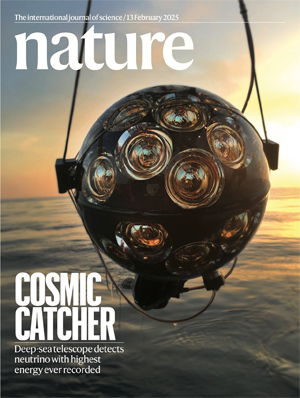
Today, Thursday, marks two years since the ARCA detector of the KM3NeT underwater neutrino telescope detected in the depths of the sea an extraordinary event associated with a neutrino with an estimated energy of around 220 PeV (220 x 1015 electronvolts or 220,000 trillion electronvolts).
This event, named KM3-230213A, is the most energetic neutrino ever observed and provides the first evidence that neutrinos of such high energies are produced in the Universe. After a long and meticulous process of analysing and interpreting the experimental data, the international scientific collaboration of KM3NeT - which includes a team of researchers from the IGIC Institute at the Gandia campus of the Universitat Politècnica de València and the IEO-UPV Joint Unit of the Spanish Institute of Oceanography of the CSIC and the UPV - has published the details of this amazing discovery in Nature.
The IGIG-UPV team, led by Miguel Ardid, has been involved in KM3NeT since its inception in 2006, when the design of the infrastructure began, and conducts R&D both in its technological aspects, mainly in the acoustic and positioning systems of the underwater detector, as well as in astroparticle physics analyses.
'We expected KM3NeT to make first-rate discoveries, but we didn't expect them to come so soon with a partial detector configuration. Moreover, it could be said that we have been lucky and doubly lucky at the UPV because the ultra-energetic neutrino was detected during the operational shift of the detector carried out by UPV,' explains Ardid.
Paschal Coyle, KM3NeT spokesperson at the time of the detection and Research at the IN2P3/CNRS Centre National de la Recherche Scientifique – Centre de Physique des Particules de Marseille (France), emphasises that KM3NeT has begun to explore a range of energy and sensitivity where the neutrinos detected can be produced in extreme astrophysical phenomena. 'This first detection of a neutrino of hundreds of PeV opens a new chapter in neutrino astronomy and a new window for observing the Universe,' he emphasises.
Black holes, supernovae and gamma-ray bursts
The high-energy Universe is the realm of colossal events such as the supermassive black holes at the centre of some galaxies, supernova explosions and gamma-ray bursts, phenomena that are not fully understood yet. These powerful cosmic accelerators generate streams of particles called cosmic rays. Some cosmic rays can interact with the surrounding matter or photons, producing neutrinos and photons. During the journey through the Universe, the most energetic cosmic rays may also interact with the photons of the microwave background radiation to produce extremely energetic neutrinos called 'cosmogenic'.
'The scale of KM3NeT, which will eventually cover a volume of approximately one cubic kilometre with a total of around 200,000 photomultipliers, along with its extreme location in the depths of the Mediterranean Sea, shows the extraordinary efforts needed to advance neutrino astronomy and particle physics. The detection of this event is the result of a tremendous collaborative effort among numerous international teams of engineers, technicians and scientists,' adds Miles Lindsey Clark, Technical Director of the KM3NeT project at the time of detection and Research Engineer at IN2P3/CNRS - Laboratory of Astroparticles and Cosmology, France.
The KM3NeT Collaboration brings together more than 360 scientists, engineers, technicians and students from 68 institutions in 22 countries worldwide. In Spain, in addition to the IGIC of the Universitat Politècnica de València, IFIC (Institute of Corpuscular Physics, a joint centre of the University of Valencia and the CSIC), the University of Granada, the IEO-UPV Joint Unit of the Spanish Institute of Oceanography of the CSIC and the UPV and the LAB of the Universitat Politècnica de Catalunya participate. Their work is funded by the Ministry of Science, Innovation and Universities and by European and regional programmes (Generalitat Valenciana and Junta de Andalucía).
'The field of neutrino astronomy is booming. We are confident that with the full installation of the two KM3NeT detectors, ARCA and ORCA, new light can be shed on the mystery of the origin of cosmic neutrinos,' concludes the group of Spanish researchers participating in KM3NeT.
Reference
The KM3NeT Collaboration. Observation of an ultra-high-energy cosmic neutrino with KM3NeT. Nature, 2025. DOI: 10.1038/s41586-024-08543-1
Outstanding news
 Study a degree at the best technological university in Spain
The Universitat Politècnica de València is ranked number 1 among Spanish technology universities, according to the Shanghai ranking
 Highly Cited Researchers 2025
Avelí Corma, Juan Bisquert and Luis Guanter, the international scientific elite with a Universitat Politècnica de València hallmark
 Historic Milestone in Spanish Higher Education
The UPV inaugurates the Beihang Valencia Polytechnic Institute, the first Spanish university center in China
 Study in English
The UPV offers eight degrees, 16 master's and 650 courses in English for the 2025-26 academic year
 A Latin Grammy... with the UPV hallmark
'Music teaches us to listen and live together,' says Rafael Serrallet, Doctor of Music at the UPV, awarded in Las Vegas as the author of the Best Instrumental Album of 2025
 THE Impact Ranking
The UPV, the Spanish university with the greatest social and economic impact in the world