
A life dedicated to chemistry
The European Inventor Award for Lifetime Achievement goes to Spanish scientist Avelino Corma
[ 20/06/2023 ]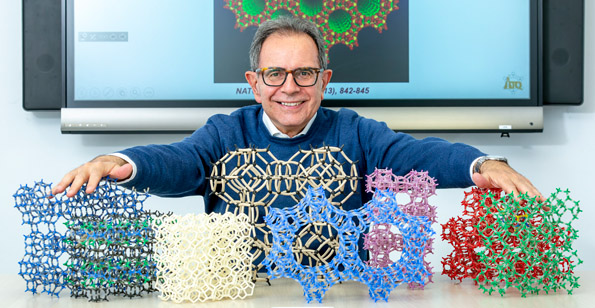
Chemistry is all around us and not just in medicine and cleaning products. Everything you hear, see, smell, taste and touch involves chemistry. The processes by which our bodies can transform food and water into energy are spurred on by catalysts. Spanish scientist Avelino Corma (Moncofa, Castellón, Spain 1951), co-founder of the Institute of Chemical Technology, a joint centre from the Universitat Politècnica de València and the Consejo Superior de Investigaciones Científicas (CSIC), has dedicated his life to developing more sustainable chemical processes and catalysts.
For his remarkable career spanning over three decades, the European Patent Office (EPO) announced today that Corma is the Lifetime Achievement laureate in the 2023 European Inventor Award. The EPO will pay tribute to his work during the ceremony live-streamed from Valencia on 4 July at 12:00.
Optimising chemical reactions
Catalysts are used in chemical processes for a number of purposes, including improving the efficiency and environmental cleanliness of chemical reactions in all industries. Most of Corma’s achievements have been obtained thanks, in part, to the development of synthesised zeolites. Zeolites are crystalline materials made up of silicon, aluminium and oxygen. They act as a sponge with very small holes, which trap small molecules so a specific chemical reaction can then take place. Although some zeolites occur naturally, “shape-selective catalysts” can be created to target molecules of a particular size.
While millions of synthesised zeolite structures are theoretically possible, only about 300 have been developed to date. Approximately one-fifth of these have been developed by Corma and his colleagues at ITQ (UPV-CSIC), firmly positioning this research group, based in Valencia, as an authority.
Corma’s first synthetic zeolite was developed in 1989. It produced fuel with better mileage, lower carbon emissions in warmer weather and a better capacity to withstand compression in an engine. Since then, his synthetic catalysts have benefited industry and society immeasurably, with his work being used in biomass energy generation or removing NOx to tackle air pollution, for instance, and have had a positive impact on a wide range of industries, including refining and petrochemistry, pharmaceuticals and cosmetics. To date, Corma has nearly 200 European patent applications and more than 50 of his patents have been licensed by international companies.
A greener chemical legacy
Having grown up in Moncofa, a small agricultural town in Castellón, Spain, Corma’s talent was clear early on and he left this rural life behind to enrol at the University of Valencia. He began his studies in chemistry in 1967 and continued for over a decade, including a postdoc at Queen’s University in Canada. In 1979, he started working as a researcher at the Consejo Superior de Investigaciones Científicas (Spanish National Research Council), becoming a professor in 1987.
Corma has since led research into heterogeneous catalysis in academia and the private sector in collaboration with several companies. He worked on fundamental aspects of acid-base and redox catalysis to understand the nature of the active sites and reaction mechanisms. Based on these aspects, he developed catalysts used commercially in several industrial processes today, such as the reduction of polluting emissions from vehicles and factories, the improvement of food, water purification, oil refining processes, the production of medicines and, in general, the development of a greener chemical industry. Corma’s first zeolite was brought to market by the Spanish petrol company CEPSA (Compañía Española de Petróleos, S.A.U.) and German chemical firm Süd-Chemie AG (now Clariant) under the brand name HYSOPAR. It has since been adopted at more than 20 refineries worldwide to improve efficiency.
Among his most important milestones, Corma co-founded the Institute of Chemical Technology (ITQ, UPV-CSIC) in Valencia, Spain, in 1990 to further studies in scientific chemical research, focusing its research on four main areas: energy, sustainability, health and water. ITQ has since become an international reference centre in the areas of catalysis, new materials and photochemistry. Corma sees his work there as a legacy that he can leave behind for generations and underlined the importance of being willing to follow your instincts to make pioneering discoveries: “In this field, since it was not based on a theory that could predict what you are going to obtain, a key point was to have a good imagination, good and original ideas”.
Corma is the author of several books, including ‘Catalytic Cracking’ and ‘Introduction to Zeolite Molecular Sieves’, as well as more than 1 200 publications.
About the European Inventor Award
The European Inventor Award is one of Europe's most prestigious innovation prizes. Launched by the EPO in 2006, the award honours individuals and teams who have come up with solutions to some of the biggest challenges of our time. The finalists and winners are selected by an independent jury comprising former Award finalists. Together, they examine the proposals for their contribution towards technical progress, social and sustainable development, and economic prosperity. Read more about the different categories including the Lifetime Achievement Award and the Popular Prize as well as the selection criteria and the hybrid Award ceremony on 4 July 2023.
About the EPO
With 6 300 staff members, the European Patent Office (EPO) is one of the largest public service institutions in Europe. Headquartered in Munich with offices in Berlin, Brussels, The Hague and Vienna, the EPO was founded with the aim of strengthening co-operation on patents in Europe. Through the EPO's centralised patent granting procedure, inventors are able to obtain high-quality patent protection in up to 44 countries, covering a market of some 700 million people. The EPO is also the world's leading authority in patent information and patent searching.
Outstanding news
 Study a degree at the best technological university in Spain
The Universitat Politècnica de València is ranked number 1 among Spanish technology universities, according to the Shanghai ranking
 Highly Cited Researchers 2025
Avelí Corma, Juan Bisquert and Luis Guanter, the international scientific elite with a Universitat Politècnica de València hallmark
 Historic Milestone in Spanish Higher Education
The UPV inaugurates the Beihang Valencia Polytechnic Institute, the first Spanish university center in China
 Study in English
The UPV offers eight degrees, 16 master's and 650 courses in English for the 2025-26 academic year
 A Latin Grammy... with the UPV hallmark
'Music teaches us to listen and live together,' says Rafael Serrallet, Doctor of Music at the UPV, awarded in Las Vegas as the author of the Best Instrumental Album of 2025
 THE Impact Ranking
The UPV, the Spanish university with the greatest social and economic impact in the world