
The Church of Los Santos Juanes in Valencia regains its splendour after restoration
The church has undergone work on two levels: pictorial, led by Pilar Roig, professor at the Universitat Politècnica de València (UPV); and architectural, directed by architect Carlos Campos.
[ 05/12/2025 ]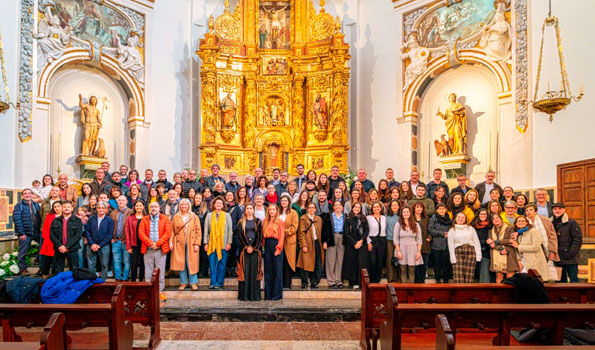
The restoration and refurbishment work on the Church of Los Santos Juanes, declared a National Historic-Artistic Monument in 1947, has been completed, and the church is once again in all its splendour after five years of work.
The project has addressed three main areas of intervention: the architectural restoration of the façades and structures, the pictorial and sculptural restoration of the interior and, as a culmination, the creation of an immersive audiovisual projection that invites visitors to experience the church in a completely new way, complementing the planned projections in the apse.
The architectural restoration work, directed by architect Carlos Campos and carried out by the company Estudio Métodos de Restauración (EMR), has enabled the repair of structural deficiencies and the restoration of the building to its original character, as well as the renovation of the lighting.
At the same time, led by Professor Pilar Roig, from the Conservation and Restoration of Cultural Heritage Department at the UPV and researcher at the Institute for the Heritage Restoration, the interior of the temple has recovered the frescoes on the vault, the work of the painter Antonio Palomino, in addition to the renovation of the interior cladding.
Thanks to the support of the Hortensia Herrero Foundation, the building has regained its splendour after decades of deterioration. The project, involving an investment of around ten million euros, has returned to the city a historic, artistic and spiritual space of the highest order, which once again shines as an essential part of Valencia's heritage.
Pictorial and ornamental restoration: 350 m2, 85 panels, 8 lunettes and video mapping
The pictorial and ornamental restoration, carried out by the Institute for Heritage Restoration at the Universitat Politècnica de València, is the result of over 30 years of research. Following an initial phase between 2004 and 2009 on a third of the vault, this new intervention has completed almost all of the ornamental areas of the central nave, including the pictorial decoration of 10 of the 12 side chapels.
The main objective of the intervention was to restore the "image of Antonio Palomino's paintings, destroyed by fire during the Civil War. The idea was based on achieving the coexistence of historical photographic material, as the most faithful approximation to reality, and the preserved original fragments, thus allowing the aesthetic and documentary values of the ensemble without neglecting the practical and symbolic values that a space of this nature requires," explains Pilar Roig.
The completed project has addressed the effective intervention of the entire Palomino mural. This second phase of intervention covers an area of 350 m², distributed over 85 panels, together with 8 lunettes. It involves recreating the paintings that disappeared from the presbytery dome through video mapping.
"The physical intervention received by the fragments of torn-off paint consisted of reversing and improving the work carried out on the paintings by the Gudiol brothers' team in the mid-20th century. In this way, each fragment has undergone a series of cleaning and consolidation procedures on its front side, has been separated from the plywood board and, after various reinforcement works on the back, has been attached to a new support specially designed to reintegrate it into its original architectural structure," says Pilar Roig.
Stucco
The fire and repairs carried out in the 20th century also caused severe damage to the stucco. The IRP-UPV's intervention in this case focused on reversing unsuitable treatments, restoring original volumes, removing repainting, re-establishing the cohesion of the mortars and restoring the finishing layers. ‘The recovery of the gilded surfaces and the textures typical of the “stucco” technique is one of the main achievements of this project,’ says Pilar Roig.
Carbon fibre and aluminium, bio-cleaning with bacteria...
The most noteworthy technical achievements have been reflected in the processes of replacing inadequate wooden supports with carbon fibre and aluminium structures, as well as cleaning and pictorial reconstruction. According to Pilar Roig, ‘the cleaning process has combined innovative and respectful alternatives, such as gelled emulsions without surfactants, lasers and bio-cleaning with bacteria, which have provided technical efficiency with a sustainable and non-invasive approach, in line with the principles of contemporary conservation.’
The pictorial reintegration has combined traditional retouching with the reconstruction of major losses through the transfer of printed virtual images, obtained from the rectification and digital colouring of J. Alcón's photograph before the 1936 fire, enabling the aesthetics and legibility of the whole to be faithfully restored.
Architectural intervention
Meanwhile, the architectural restoration project has involved a comprehensive intervention of great heritage value. The exterior restoration included work on all façades, as well as the Communion chapel and bell tower.
"The intervention on the façades of the Church of Santos Juanes has aimed to restore the image of the building, a compendium of history and art, in a particularly significant urban space. Significant work was carried out to consolidate its walls and decorative and stonework elements, bearing in mind that half of its façades, those on the north and west sides, had not been restored for a long time. The other two, south (Central Market) and east (Lonja), were partially restored in the late 1990s," explains Carlos Campos.
The intervention has unified the level of treatment within the diversity of the building's construction types. The north façade was significant, considering that it is the part of the building that retains its original Gothic structure, which can be seen from the Plaza del Tossal. "The restoration of the large ogival windows, which were blocked during the Baroque transformation, and the functionality of the original gargoyles are particularly important aspects in revealing the long history and vicissitudes of this temple, since its interior retains the style introduced in the 17th century. The last stage of the project was the restoration of the façade on Plaza del Mercat, which features sculptural and popular elements of great interest, concluding this phase of the intervention with the greatest urban impact,‘ concludes the architect in charge, Carlos Campos.
’Barroc Immersive': art and technology at the service of heritage
To mark the completion of the restoration, the Hortensia Herrero Foundation has presented an immersive projection project, ‘Barroc Immersive’, which transforms the church into a space of light, sound and audiovisual narrative. It is an audiovisual journey that uses the most advanced technology to immerse us in the history of the Church of Los Santos Juanes from a symbolic perspective.
Outstanding news
 Study a degree at the best technological university in Spain
The Universitat Politècnica de València is ranked number 1 among Spanish technology universities, according to the Shanghai ranking
 Highly Cited Researchers 2025
Avelí Corma, Juan Bisquert and Luis Guanter, the international scientific elite with a Universitat Politècnica de València hallmark
 Historic Milestone in Spanish Higher Education
The UPV inaugurates the Beihang Valencia Polytechnic Institute, the first Spanish university center in China
 Study in English
The UPV offers eight degrees, 16 master's and 650 courses in English for the 2025-26 academic year
 A Latin Grammy... with the UPV hallmark
'Music teaches us to listen and live together,' says Rafael Serrallet, Doctor of Music at the UPV, awarded in Las Vegas as the author of the Best Instrumental Album of 2025
 THE Impact Ranking
The UPV, the Spanish university with the greatest social and economic impact in the world