

Inside Maya Life
A joint study by UPV and Tulane University reveals vaulted Maya buildings beneath the jungle and offers new hypotheses on the organization of this ancient civilization
[ 04/09/2025 ]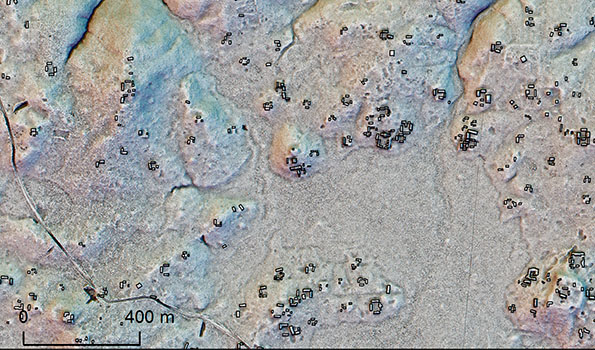
Laura Gilabert, a researcher at the Universitat Politècnica de València (UPV), has developed an innovative method to identify vaulted Maya buildings using Lidar maps. This technology makes it possible to “see” beneath the vegetation.
One of the most significant findings is that Maya elites tended to be dispersed among the general population, both in urban and rural areas, to oversee the use and exchange of resources.
A study by Laura Gilabert, architect and researcher at the PEGASO Research Centre of the Universitat Politècnica de València (UPV), has led to the development of an innovative method to detect vaulted Maya buildings using Lidar maps. This technology enables researchers to “see” through the forest canopy.
Funded by the Valencian Regional Government and carried out in collaboration with Tulane University (USA) and the international consortium Pacunam Lidar Initiative, the project analyses over 2,600 km² of jungle in the Maya Lowlands between Guatemala and Mexico. Over 100,000 ancient structures have been identified, around 30% of which have been classified as vaulted.
The project has shown how Lidar technology can trace wealth and social status patterns in ancient Maya society by detecting vaulted structures and analysing their spatial distribution across urban and rural settings. To this end, the research team developed a predictive model—validated with 93% accuracy—that classifies ancient buildings based on their construction system, identifying those built with stone walls and vaulted roofs, a feature linked to greater wealth and social prestige.
New hypotheses on the social and economic organization of the Maya
The ability to distinguish vaulted buildings from simpler constructions enables researchers to put forward new hypotheses about the social and economic organization of the ancient Maya civilization. The study thus sheds new light on the daily lives of thousands of people who inhabited Maya cities during the Classic period (250–900 AD).
One of the most significant findings is that Maya elites tended to be dispersed among the general population, both in urban and rural areas, to oversee the use and exchange of resources.
“So far, it has been difficult to define Maya neighbourhoods,” explains Francisco Estrada-Belli, lead author of the study, archaeologist, and researcher at Tulane University. “Seeing the distribution of elite and non-elite residences on a large scale is key to understanding Maya urbanism.”
“In this article, we show how the combination of archaeological excavation, architectural analysis, and Lidar data can offer new insights into the organization of ancient Maya society,” adds Marcello A. Canuto, Director of the Middle American Research Institute at Tulane University.
In addition to buildings, Lidar technology has made it possible to detect agricultural and water management infrastructure, such as terraces, canals, and reservoirs. These findings support the idea of a high degree of territorial planning and complex political organization.
“Lidar-based remote sensing allows for a more efficient use of economic and human resources in archaeological research, as excavations can be planned with great precision. Lidar opens up new horizons for conserving and managing archaeological heritage, especially when it lies beneath protected natural areas,” concludes Laura Gilabert.
References:
Gilabert Sansalvador, Laura (2025). La investigación del patrimonio arquitectónico maya a través de Lidar. III Jornada de Presentación de Resultados de Proyectos I+D+i del Centro de Investigación PEGASO-UPV. ETSIE-UPV, June 2025.
Estrada-Belli, F., Gilabert-Sansalvador, L., Canuto, M. A., ?prajc, I., & Fernandez-Diaz, J. C. (2023). Airborne lidar mapping revealed architecture, wealth, and status in Classic Maya urbanism. Journal of Archaeological Science, 157, 105835. https://doi.org/10.1016/j.jas.2023.105835
Outstanding news
 Study a degree at the best technological university in Spain
The Universitat Politècnica de València is ranked number 1 among Spanish technology universities, according to the Shanghai ranking
 Highly Cited Researchers 2025
Avelí Corma, Juan Bisquert and Luis Guanter, the international scientific elite with a Universitat Politècnica de València hallmark
 Historic Milestone in Spanish Higher Education
The UPV inaugurates the Beihang Valencia Polytechnic Institute, the first Spanish university center in China
 Study in English
The UPV offers eight degrees, 16 master's and 650 courses in English for the 2025-26 academic year
 A Latin Grammy... with the UPV hallmark
'Music teaches us to listen and live together,' says Rafael Serrallet, Doctor of Music at the UPV, awarded in Las Vegas as the author of the Best Instrumental Album of 2025
 THE Impact Ranking
The UPV, the Spanish university with the greatest social and economic impact in the world