

Castellón, Alicante and Valencia, among the most benefited
The confinement and the reduction of the economic activity to fight against the COVID-19 have reduced 64% of average the contamination of the air in Spain
[ 24/03/2020 ]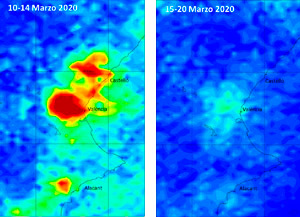
The concentration levels of nitrogen dioxide—one of the main elements responsible for air contamination— have declined 64% in the main Spanish cities after the implementation of the measures decreed to fight against COVID-19. They have fallen most in Barcelona, with an 83% decline. In Madrid, levels have dropped 73% and 64% in València.
These are some of the results of a study carried out by researchers from the Universitat Politècnica de València (UPV), belonging to the Centro de Tecnologías Físicas (Physical Technology Center). To carry out this study, the UPV team has analyzed satellite images of the Sentinel-5P mission of the Copernicus program of the European Space Agency (ESA), comparing data from March 10-14 against data from March 15-20. Based on this data, they have generated a series of maps that show the concentrations of nitrogen dioxide in some of the main Spanish cities.
According to Elena Sánchez-García, researcher at the Land and Atmosphere Remote Sensing (LARS-UPV) group of the UPV’s Centro de Tecnologías Físicas, nitrogen dioxide is an important indicator of air quality. “High concentrations of this gas can affect the respiratory system and aggravate certain medical conditions. In addition, this gas is related to the formation of acid rain,” she added.
Nitrogen oxides, like NO2, in the urban air originate from combustion reactions at high temperatures that are mainly produced from motorized vehicles. Oxygen and nitrogen are combined to make nitric oxide (NO), which later is partially oxidized, creating nitrogen dioxide.
“As has been verified in the case of Wuhan (China), and northern Italy, our study shows how the confinement measures and reduction of economic activity have translated into a clear decrease in air pollution throughout the country,” added Elena Sánchez-García.
Additional Data
In addition to València, Madrid and Barcelona, the study also took data from seven other cities. In the Autonomous Community of Valencia, nitrogen dioxide levels have dropped most in Castellón, with a 76% decline. Of the cities analyzed, it had the second largest reduction, only behind Barcelona. In Alicante, the decline was 68%. Though atmospheric variability (winds and precipitation) can affect the numbers calculated for each city, the effect of the current situation of confinement is predominant.
Outstanding news
 Study a degree at the best technological university in Spain
The Universitat Politècnica de València is ranked number 1 among Spanish technology universities, according to the Shanghai ranking
 Highly Cited Researchers 2025
Avelí Corma, Juan Bisquert and Luis Guanter, the international scientific elite with a Universitat Politècnica de València hallmark
 Historic Milestone in Spanish Higher Education
The UPV inaugurates the Beihang Valencia Polytechnic Institute, the first Spanish university center in China
 Study in English
The UPV offers eight degrees, 16 master's and 650 courses in English for the 2025-26 academic year
 A Latin Grammy... with the UPV hallmark
'Music teaches us to listen and live together,' says Rafael Serrallet, Doctor of Music at the UPV, awarded in Las Vegas as the author of the Best Instrumental Album of 2025
 THE Impact Ranking
The UPV, the Spanish university with the greatest social and economic impact in the world